

In this changing world parents and teachers look forward to implementing effective educational approaches which improve students’ learning outcomes.
However, the development is not only limited to academic growth but also promotes emotional intelligence , independence, and lifelong learning curiosity.
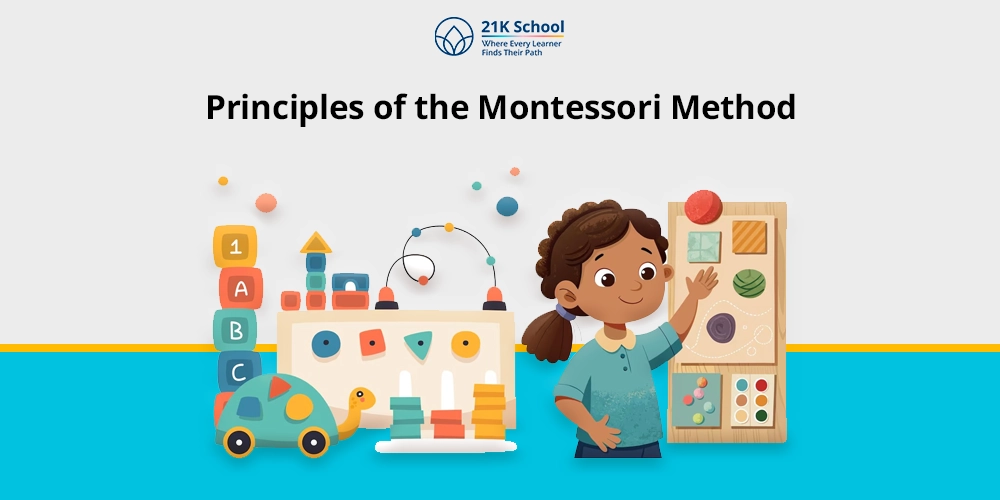
The Montessori method is one of the popular children-centric educational approaches which helps students to explore, understand and grow with modern education.
The article takes you on the journey of principles of the Montessori method in detail. Let’s begin with a simple meaning.
What is the Montessori Method?
The Montessori method of education was proposed by an Italian physician and educator named Dr. Maria Montessori. She was one of the first female physicians in Italy specifically trained in psychiatry and pediatrics.
Montessori method is an educational technique based on:
- Self-directed activity
- Hands-on learning
- Collaborative play
The main objective of the Montessori method of education is to provide independence, freedom within limits, and respect for a child’s natural psychological, physical, and social development.
11 Key Principles of the Montessori Method
The Montessori method is designed for children to foster cognitive, physical, social, and emotional development. To understand in-depth check out the 11 key principles of the Montessori method:
1. Respect for the Child
Montessori education is built on meaningful interaction with children. It is a principle of the Montessori method known as “respect for the child”.
The principle is important because it helps in:
- Respecting children’s decisions
- identifying their learning needs
- Providing freedom to select right
2. Absorbent Mind
The Montessori method proposed by Dr. Maria Montessori believes that the initial six years of a child’s life are crucial for their development.
The principle of this Montessori method is known as the “absorbent mind”. It showcases that children from 0 to 6 years naturally gain the information from their environment.
In this period, they are like sponges that quickly absorb information in different domains.
For example, from learning languages at home through parents’ conversation to cultural norms, movement, and social behaviors by peers and teachers.
3. Sensitive Periods
Sensitive periods are the third popular principle of the Montessori method because it opens an opportunity for learning specific skills or knowledge in a particular period.
In simple words children develop various knowledge and skills related to language, order, movement, or sensory refinement.
4. Educating the Whole Child
The next principle is known as educating the whole child.
This means the students overall growth including intellectual, physical, moral, emotional and social development is essential to achieve success.
Montessori methods encourage holistic development through various activities for example, real-world situations, collaborative practices, and self-care tasks. In this way, children learn both inside and outside the classroom.
5. Individualised Learning
Individualized learning is one of the most effective techniques of the modern education system. It is used by teachers in the classroom.
It is an important principle of the Montessori method in which children choose desired activities according to their interests and developmental stage. It allows them to grow at their own speed.
6. Freedom of Movement and Choice
Based on Dr. Montessori, kids learn effectively when they are free to move, choose, and follow their own passion.
When children are encouraged to study in their own way it promotes their decision-making skills, concentration, and self-regulation.
Teachers in the classroom create a positive learning environment to foster individual interest.
7. Prepared Environment
A well-prepared environment fosters students’ growth and development. The next principle is to create an environment which helps with meaningful learning.
In this environment students are free to follow their dreams, choose their tasks, and grow at their own speed.
8. Intrinsic Motivation
Intrinsic motivation is a process in which students instead of getting rewards or grades feel learning and task accomplishment as a reward.
The Montessori method nurtures lifelong learning that extends far beyond the classroom. In this way, students feel motivated to learn, play, and participate in different activities.
9. Independence
The next principle of the Montessori method is independence in learning. For example, choosing a favourite activity to solve complex maths problems students are independent to discover new things.
With time independence in learning leads to building confidence, resilience, and problem-solving abilities
10. Auto-Education
In auto-education, an effective principle of Montessori method refers to children becoming capable of and willing to teach themselves.
Here, kids understand best when they learn and solve independently. The objective of teachers in auto-education is to offer guidance, encouragement, and the proper environment.
11. Mixed-Age Classrooms
Montessori mixed-age classrooms are one of the principles of Montessori method which provide collaborative, familial community.
Here, children develop socially, emotionally, independent and confident.
Conclusion
The Montessori method is an effective style of teaching which offers growth and development. In this way, children can naturally develop various skills.
Make sure to use the principles of Montessori methods to foster long-term skills like critical thinking, problem-solving, and creativity.
Application of these principles at home or in the classroom is an excellent choice to nurture students’ potential.

You may also want to read