

What would it feel like to have all students with and without disabilities learn, contribute, and succeed?
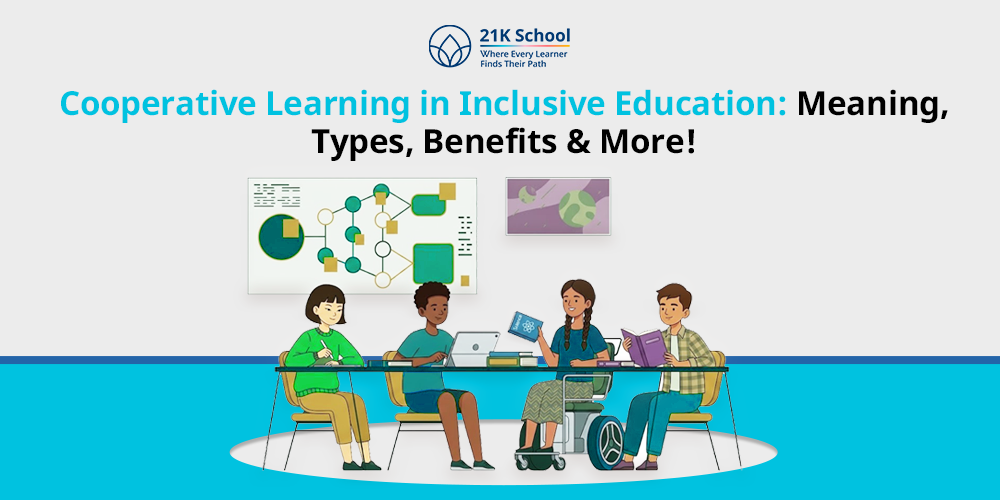
This may be through cooperative learning within inclusive education that involves grouping various learners into a team learning process, where the learning process is a team effort.
The students will not learn individually but will learn together, support each other, develop their strengths and become a team, rather than learning in isolation.
Not only will this strategy enhance educational successes, but will also make the learner more compassionate, self-assured, and communicative, creating a fully inclusive classroom where every learner feels appreciated and empowered.
Contents
- What is Cooperative Learning in Inclusive Education?
- Components of Cooperative Learning
- Principles of Cooperative Learning
- Why Cooperative Learning Matters in Inclusive Education?
- Types of Cooperative Learning Strategies for Inclusive Education
- Benefit of Cooperative Learning in Inclusive Education
- Challenges in Cooperative Learning in Inclusive Learning
- Role in Modern Inclusive Classrooms
- Concluding Thoughts
What is Cooperative Learning in Inclusive Education?
Cooperative learning in inclusive education is a mode of learning in which students with various abilities, backgrounds and learning requirements learn to work together in small groups to satisfy common learning objectives .
Through this, every student will get a chance to be part of an inclusive classroom , irrespective of their capabilities, and feel special. The instructors have an opportunity to play the role of facilitators since they mediate the communication between groups and balance groups.
It is the method that not only broadens the academic knowledge, but also builds social skills , empathy , communication and confidence and makes learning interesting, empowering and supportive to all students.
Components of Cooperative Learning
The dimensions of cooperative learning are individual responsibility, social skills, group processing, personal-to-personal interaction and positive interdependence, which enables successful group work.
1. Individual Accountability
Student responsibility to self sees to it that an individual student is responsible for his/her own learning and contribution as a group member. Members are involved and evaluated individually, with tasks being allocated to each member.
This will remove the reliance of anyone, generate equity and make all the students active, ready and willing to attain individual and group learning outcomes.
2. Interpersonal and Social Skills
In successful cooperation between students, interpersonal and social skills are significant. These are communication, active listening , leadership, conflict management and respect towards others.
All these competencies will assist in building a good rapport among the students and in forming relationships and working in groups. It also teaches them how to work out in real life as a team and also develops emotional intelligence in other learning areas.
3. Group Processing
Group processing is when the individual considers the performance of the group and how this can be improved. Students will narrate their experience of what was good, what the difficulties were, and how they would be able to improve teamwork in the tasks in future.
This introspection can strengthen teamwork, enhance efficiency and sustainable development of group processes, and therefore, cooperative learning will be more productive and transposable in the long run.
4. Face-to-Face Interaction
Face-to-face interaction gives an advantage to a student that he/she can communicate with other students directly in the form of discussions, explaining a given problem and providing a solution to it. It will facilitate further learning since students will present the concepts and discuss them in real time.
This dynamic learning enables trust, bonding and enhances communication competencies that create a more participatory, cooperative and enabling learning in a related classroom setting.
5. Positive Interdependence
Positive interdependence is the principle that group members rely on one another to achieve a shared goal. The effectiveness of the group is associated with the effectiveness of each of the students and promotes cooperation and support among students.
It creates the perception of cooperation, shared responsibility and inspiration that not only assures the students to work together in their efforts, but also recognises the contribution of everyone to learn.
Principles of Cooperative Learning
The concepts that are implemented in collaborative learning include positive interdependence, individual accountability, equal participation, social interaction and group reflection.
1. Positive Interdependence
Positive interdependence is student interdependence, and involves investing in one another towards the realisation of common objectives. The work of each member is linked with the overall work that provides teamwork and support.
It would be cooperative, and learners would share resources, roles and responsibilities equally. This value provides a sense of cohesion, responsibility and encouragement to the students that makes them realise that there is even more success when they work together.
2. Individual Accountability
Individual accountability ensures each student is responsible for their own learning. Every member does his/her job, takes part in discussions, and he/she is graded separately.
This annihilates non-similarity of effort and generates participation. It keeps the students on their feet, creates accountability, and group performance demonstrates the output and the learning of every member.
3. Equal Participation
This equal participation will make sure that all students can give their contribution to the group discussion . The teachers plan the activities in such a way that each member can have ideas, turn and keep in play.
This will help avoid the domination of the few students and will benefit the shy students. It possesses equity, inclusivity and confidence, with active participation and learning procedures in the group being equal and significant.
4. Social Interaction
The social interaction also means that students will be exposed to each other, share ideas and work in groups. It promotes learning as a result of discussion, questioning and clarifying.
The philosophy aids in the development of communication skills , empathy and team building skills. The interaction will be constructive to provide a learning experience in which the students will respect divergent views and establish good relations to pursue shared academic interests.
5. Group Reflection
The group reflection enables the students to assess their learning process and collaborations skills immediately upon the completion of their work. They talk about strong points, issues and what they can do to improve the activities in the next year.
This promotes critical thinking skills . The reflections strengthen teamwork, assist in resolving and transforming groups into more lively, coherent and productive groups in further learning work.
Why Cooperative Learning Matters in Inclusive Education?
Cooperative learning is a good aspect of inclusive learning as it helps in ensuring that learners of both ability learn in a responsible and interactive environment.
It promotes group work where students get the chance to be at their best, help others and can be part of a group. This is to alleviate the isolation of these students who have very diverse educational needs, which they otherwise would feel.
Collaboratively, students learn such social skills as working with a team, communication, and empathy. It may also be applied to close the learning gap since peers will be able to explain things in ways that are familiar to all, which will enhance greater understanding.
The collaborative learning encourages self-confidence and community and makes the classroom more accepting and respectful. It promotes the competitive nature of the centre to collaboration and helps the learners feel important, qualified and motivated to succeed in both academic and social life.
Types of Cooperative Learning Strategies for Inclusive Education
Some of the strategies of the theory of cooperative learning in inclusive education are: Think-Pair-Share, Jigsaw Method, Peer Tutoring, Group Investigation and team-based learning techniques.
The Think-Pair-Share strategy motivates students to be able to think individually, in pairs, and ultimately at the group level.
It encourages participation of all learners, such as the reluctant learners , enhances confidence, communication and understanding, and this is achieved by systemic participation of all learners in mixed classroom activities.
2. Jigsaw Method
In the Jigsaw Method, a student receives a portion of the subject, and after that, the student learns the subject and explains it to other students in a group. This fosters interdependence, responsibility and cooperation.
It makes sure that all students will make many contributions and be in a position to assist various learners in getting involved and learning through peer-teaching.
3. Group Investigation
Group Investigation is an engaging activity, which uses students in a group, where they work together to explore, investigate and report on a topic. It promotes group work, independent study, and critical thinking.
Learning is an interactive and inclusive process where there is role play, discussions and presentation of findings, and various styles and abilities are accommodated.
4. Peer Tutoring
Peer Tutoring refers to the process of pairing students so that some students can each help one another to learn by one student explaining something to the other student. It enhances awareness in all learners, fosters confidence and generates empathy.
It is a highly worthwhile approach to implement in inclusive classes because it could accommodate the learning needs of the various individuals by considering them one by one.
5. Team-based Learning
Team-based learning is a learning strategy employed in which students are engaged to form structured groups to address problems and assignments. It fosters responsibility, teamwork and participation.
The strategy promotes critical thinking, student engagement , and participation of every student; thus, it can be utilised in inclusion classes where we have diverse students.
Benefit of Cooperative Learning in Inclusive Education
Cooperative learning has improved academic achievement, communication, trust, collaboration and social-emotional development of diverse learners, which are the benefits of cooperative learning in an inclusive education system.
1. Improved Academic Performance
Cooperative learning enhances academic performance because students are given a chance to study as a team, through discussion, explaining and finding solutions to problems in a cooperative manner. The use of peer support is in elaborating things and cementing knowledge.
The numerous viewpoints are beneficial to different learners and hence, learning is simplified. This participatory strategy enhances knowledge retention , participation, and performance levels within various competency levels.
2. Better Communication Skills
Group work will also enable students to be effective communicators since they will be required to share their ideas, be great listeners and critical responders. They also get to know how to express their thoughts and how to respect different points of view.
The interactions enhance verbal and non-verbal communications, and the students become improved communicators in their academic life and in life.
3. Increased Confidence
Cooperative learning increases confidence, which provides all the students with an opportunity to participate and to perform. The fear of failure and participation is also less because group settings are conducive.
The students will also sense that they are valued and their ideas will be well received. This helps him feel good about himself, motivates learning and enables students to be more autonomous and active learners.
4. Social and Emotional Development
Teamwork, empathy and putting oneself in the other person’s point of view are the ways through which students learn to apply social and emotional learning skills. Cooperative learning enhances respect, patience, and emotional sensitivity.
It aids students in creating relationships and conflict management, as well as working with different groups. Such experiences contribute to the overall development of the individual, and it makes the learners ready to deal with the real world.
5. Collaboration Skills
Cooperative learning builds team learning skills as it trains students to work as a team. They are trained to divide roles, to work collaboratively and to be given equal objectives.
This implies group work, management and responsibility. These and other abilities are demanded in school life, work and even in group activities in future.
Challenges in Cooperative Learning in Inclusive Learning
The unequal participation, time management , group conflict and effective handling of the needs of different learners are some of the challenges of cooperative learning in the inclusive classrooms.
1. Unequal Participation
This inequality is experienced when a student takes part in group activities as compared to his or her counterparts. This could lead to disproportion, reduced contribution, and dependency on the active learners. It has an impact on learning outcomes and equity.
Clearly defined roles and responsibilities should also be given to the teachers to ensure that every student will be an equal member and will be actively interested in the work.
2. Classroom Management Issues
Interestingly, cooperative learning in the inclusive classroom might not be easy to control due to student capabilities and behaviours. The teachers are supposed to watch a lot of groups in a continuous sequence, maintain discipline and be attentive.
Without proper structure, the classrooms are either out of control or noisy. Planning, instructions and supervision are needed to experience good, positive learning environments .
3. Time Consumption
Cooperative learning may be more time-consuming compared to the traditional method of teaching . Group discussions, coordination and presentations can slow down lesson completion.
Teachers ought to be in a position to plan things that can be incorporated into the timetables. It is, however, time-consuming but enhances deeper learning, group work, and long-term learning of ideas among various learners.
4. Group Conflicts
Group conflicts arise when the students are not in agreement, dominate the discussion or do not work well as a group. These conflicts can disrupt learning and reduce the productivity of a group. Differences in opinion or in personalities may also cause tension.
In order to have an effective collaboration among groups, it is essential that teachers mediate conflict resolution and promote respect and positive communication.
5. Differences in Learning Pace
Students who are inclusive in a classroom might not be able to learn as fast as the rest of the class, and this could be a challenge in group work. The faster learners who will learn quickly will be held back, as the slower learners will not be able to keep up.
Educators must strike a balance between the tasks, as well as provide support in such a way that everyone is equally moving without considering the individuality of learning processes and skills.
Role in Modern Inclusive Classrooms
Role in the modern inclusive classroom emphasises the need for collaborative learning in fostering collaboration, accessibility and engagement, which ensures that all learners study effectively as a group.
1. Integration with Digital Learning
Cooperative learning is effective as a supplement to digital learning with the introduction of online applications, online courses and virtual groups. Students can learn to work together through shared documents, video conferencing and interactive activities.
This improves access, engagement and participation, which make learning more inclusive, flexible and responsive to different learners in the contemporary environment of modern technology-dominated learning.
2. Use in Online and Hybrid Classrooms
Cooperative learning can be used to make students collaborate in online and hybrid courses through breakout rooms, discussion boards, and digital projects in virtual classrooms . It also eases the communication even when there is physical distance.
This will hold them interested, create teamwork and ensure the participation of all, which makes remote and distance learning environments more participative, related and effective to all learners.
3. Support for Special Education Needs
Special education needs can be facilitated using cooperative learning in terms of peer assistance, role group and involvement. Students with diverse abilities are helped by their peers, which contributes to a better understanding and self-esteem.
Through this, teachers can be in a position to adapt tasks to the special needs, such that they can be accessible and even interesting, thereby providing equal learning opportunities and a classroom environment to all the learners.
4. Personalised Learning Enhancement
Cooperative learning enhances personalised learning , in which the student studies at his/her pace, and shares towards group goals. Teachers can be differentiated on the basis of abilities.
Association with peers will reinforce knowledge, and individual encouragement will guarantee progress. This equilibrium improves the success of learning and within the inclusive learning setting, different needs are met.
Concluding Thoughts
Cooperative learning is an effective theory in the area of inclusive learning, which enables cooperation, equality and active participation of learners with diverse abilities. It helps the learners not only to gain academic knowledge, but also life skills education such as communication, teamwork, empathy and problem-solving skills .
Team learning enables the students to support each other by sharing knowledge and confidence, learn together and improve their understanding.
Cooperative learning becomes the solution to inclusivity, engagement, and comprehensive development of learners in existing classrooms (online and real-life) and makes the process of learning more meaningful and student-centred.

You may also want to read