

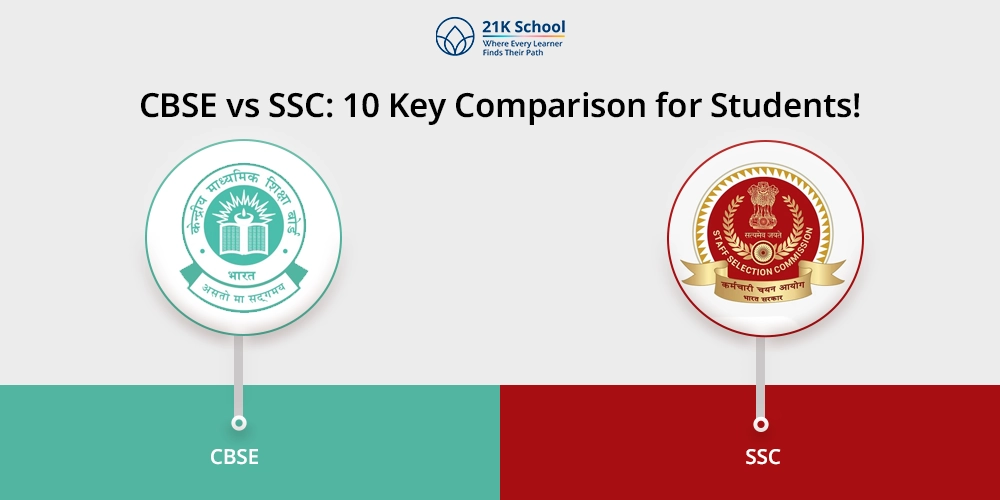
CBSE can be a decent option for those students who want a national-level board for their curriculum and evaluation methods.
While those who are confined to regional learning more, can select a state-level board like SSC.
Like others, if you are also finding it difficult to understand which would be the best for your kids, this article compares CBSE vs SSC.
What is CBSE?
CBSE is the educational board recognized and controlled directly by the central government of India.
All the syllabus , curriculum-planning, designing, teaching methods , and even evaluating criteria are set by the Indian Government.
The CBSE curriculum is based on the National Council of Educational Research and Training (NCERT) framework.
Every central-level competitive exam like JEE, NEET, UPSC, and others require advanced preparation from reading these NCERT books only.
CBSE has always been focused on delivering student-centred learning , thus building other skills like problem-solving and confidence.
CBSE has also introduced competency-based assessment.
It also encourages learners to participate actively in co-curricular activities that promote conceptual learning in them.
What is SSC?
The state-oriented boards are constituted under state legislation and regulated by respective state governments. They can be referred to as SSC.
Specifically, the Class 10 examination conducted by certain state boards is Secondary School Certificate (SSC).
Most Indian states have their own boards, conducting SSC exams.
This type of educational board in India is aimed at delivering regional-based content and curriculum to save diversity of the nation.
It tends to be much cheaper and apt for teaching children. SSC boards are also accepted internationally that provide learners with the freedom to go for higher education.
The SSC board is seen to encourage theoretical knowledge of learners, required especially in early-childhood education . Recently, state boards have undergone significant curriculum reforms (NEP 2020 alignment).
With this board, students appear for state-level competitions that can help them to qualify for government jobs.
CBSE vs SSC:10 Differences
CBSE and SSC have certain differences that are easy to spot and discuss.
Let’s see them with the help of a table first.
| Category | CBSE | SSC (State Board) |
| Curriculum Structure | Conceptual, NCERT-based | Varies by state, more theoretical/rote-based |
| Teaching Style | Application-oriented | Mostly, traditional and memory-based. Many state boards have reformed curricula with activity-based learning as well. |
| Exam Pattern | Objective + subjective, competency-based | Mostly subjective, theory-heavy |
| Scoring Pattern | Moderately high; conceptual accuracy required | Generally higher scores due to simpler difficulty. Though some state boards like Kerala, West Bengal, and Tamil Nadu have rigorous evaluation standards |
| Language Options | English/Hindi medium | Regional language options + English |
| Competitive Exam Readiness | Very strong (JEE, NEET, CUET) | Moderate; depends on state syllabus. Students score good in NEET or JEE by taking coaching. |
| Transferability | Highly transferable across India | Difficult when moving between states |
| Difficulty Level | Conceptual, moderate to high | Easier to moderate |
| Cost of Education | Moderate to high | Low to moderate |
| Impact on Higher Education | National-level advantage | Strong for state-level admissions |
1. Curriculum Structure
- CBSE: CBSE is a centralized curriculum, which is uniform to all the affiliated schools. NCERT has constructed it in order to facilitate conceptual clarity and national level relevance.
- SSC: It is more conventional in design and is inclined to deal with regional issues.
2. Teaching and Learning Style
- CBSE: CBSE schools tend to adopt the application-based learning style. This focuses on the concepts, acquisition of analytical skills , and the interrelationship between topics in subjects.
- SSC: The SSC classrooms tend to follow the textbook type of teaching approach. More often, rote learning is promoted, and the approach to teaching is usually aimed at ensuring the students do well in state-level exams.
3. Exam Pattern and Evaluation
- CBSE: CBSE exams focus on objectives along with skill-based questions. The process of evaluation is more organized.
- SSC: The SSC exams are however diverse in the states. They are usually based on lengthy answers. Assessment can be a bit less fair because subjective interpretation and marking schemes across states may vary.
4. Scoring Pattern
- CBSE: CBSE students have an advantage in scoring since CBSE has a standardized format of examination, moderate level of difficulty, and is objective in nature.
- SSC: SSC scoring has been said to be more difficult because in some states there is strict evaluation. As different states have different marking schemes in SSC boards, there is no uniformity in the consistency of scoring.
5. Language Options
- CBSE: CBSE schools majorly teach two standard languages, English and Hindi in India. Also a second language can be chosen depending on schools and other choices.
- SSC: SSC boards offer core subjects in regional languages, with English frequently being taught as a secondary language. Many parents prefer SSC so that their children remain in touch with their mother tongue and local culture.
6. Competitive Exam Readiness
- CBSE: CBSE also has a definite upper hand to students who are willing to take competitive exams on a national level. The syllabus is aligned with the necessity of exams such as JEE, NEET, NDA, and UPSC.
- SSC: Competitive exams might require more coaching by SSC students. Since the curriculum does not match the competitive exam pattern.
7. Transferability and Recognition
- CBSE: It is possible that CBSE is well-known in all the states of India and also on the international level.
- SSC: The SSC recognition is largely regional. Students who are relocating one state to another can also have difficulties adapting to the new SSC curriculum or syllabus.
8. Difficulty Level
- CBSE: CBSE is said to be moderately difficult because it aims at understanding, which is harder than memorizing.
- SSC: The level of SSC difficulty is greatly state specific. There are some state boards that are relatively easier, and others which have strict standards of evaluation making them difficult to clear.
9. Cost of Education
- CBSE: Private schools in the CBSE syllabus have higher fees as they generally have modern facilities and co-curricular activities .
- SSC: SSC schools are much cheaper, especially those which are government-subsidized. This renders a good option to families who require an affordable education without any compromise in the quality of the basic academic-level.
Note: Many private schools offer state board curriculum at similar costs to CBSE schools.
10. Impact on Higher Education
- CBSE: CBSE students tend to do well in entrance examinations due to the exposure to objective and analysis-based learning. They find it easier to transfer to tertiary education.
- SSC: Students of the SSC might find it tough to adjust to high-end competitions right at the beginning of their higher education . They can be equally good performers in the long run with additional efforts and training.
Conclude It All
CBSE and SSC are two educational boards of India who have different audiences to serve and unique properties.
CBSE is the most famous one and is applied in thousands of schools in India due to its alignment with higher learning and conceptual understanding.
On the other hand, SSC is suitable for those who want cheaper and adequate education aimed at providing competency for appearing in government jobs in India.
To your surprise, both boards are equally valid for higher education admissions as state board students are also seen doing well in various fields.
Whatever you choose is your responsibility to continue with while also sharpening your skills with time.

You may also want to read