

Affiliation No: IA702, 94883
Admissions open for Academic Year 2026-2027
Call us at: +919663213636

"Express through literary Storytelling - LIT Fest"

Enquire Now Download Prospectus
  • Home
  • International Benchmark Test

International Benchmark Test

The International Benchmark Tests (IBT) are an internationally administered assessment programme designed to compare learner performance globally, across grades, and over time.

At 21K School, IBT is offered to learners from Grades 3 to 8 and covers:

Why did we choose IBT assessment over any other assessment?

  • English
  • Mathematics
  • Science
  • Reasoning

The assessment provides reliable insights into how learners are progressing in comparison with global benchmarks, while focusing strongly on skills, reasoning, and application rather than rote learning.

The 21K Assessment Journey

1. Diagnostic Assessment (June–July)

The academic year begins with a Diagnostic Assessment, conducted in June–July, to identify each learner’s current proficiency across key competencies such as:

  • Reasoning and critical thinking
  • Problem-solving
  • Data interpretation
  • Conceptual understanding

These results are analysed carefully, enabling facilitators to plan targeted instruction and support.

2. Skill Building Through the Year

Based on diagnostic insights, facilitators personalise learning pathways and strengthen required skills through:

  • Structured classroom interactions
  • Projects and real-world applications
  • Focused practice tasks emphasising reasoning and analysis

This ensures learning remains learner-centric and growth-oriented.

3. ACER IBT Assessment (January)

Learners then attempt the ACER International Benchmark Test in January, allowing them to apply the skills developed across the academic year.

The IBT is an online assessment, with each subject conducted for 60 minutes. The test is predominantly MCQ-based and designed to assess higher-order thinking skills.

What Does IBT Assess?

English

  • Locating and interpreting information
  • Inferring meaning and predicting outcomes
  • Drawing conclusions and reasoning

Mathematics

  • Interpreting data
  • Applying concepts to real-life situations
  • Problem-solving and logical reasoning

Science

  • Observing and interpreting data
  • Applying scientific principles
  • Inquiry-based reasoning and problem-solving

Reasoning

Reasoning is assessed as a separate subject, focusing on:

  • Logical and analytical thinking
  • Pattern recognition
  • Decision-making and problem-solving skills

Reporting and Feedback

ACER provides comprehensive individual learner reports, offering insights into performance across strands and skill areas. These reports support facilitators in refining instruction and tracking learner progress over time.

Why ACER IBT at 21K School?

  • Internationally benchmarked assessment
  • Strong focus on Reasoning and higher-order thinking
  • Personalised learning driven by diagnostic insights
  • Aligned with holistic, skill-based education
  • No additional cost to learners

Why IBT and Not Olympiads?

The IBT experience goes beyond traditional Olympiad exams. While Olympiads are often curriculum-bound and limited to the Indian context, IBT is globally benchmarked and skill-focused. It enables meaningful comparison with international learners and supports deep skill development rather than exam-oriented preparation.

Strong Performance of 21K Learners

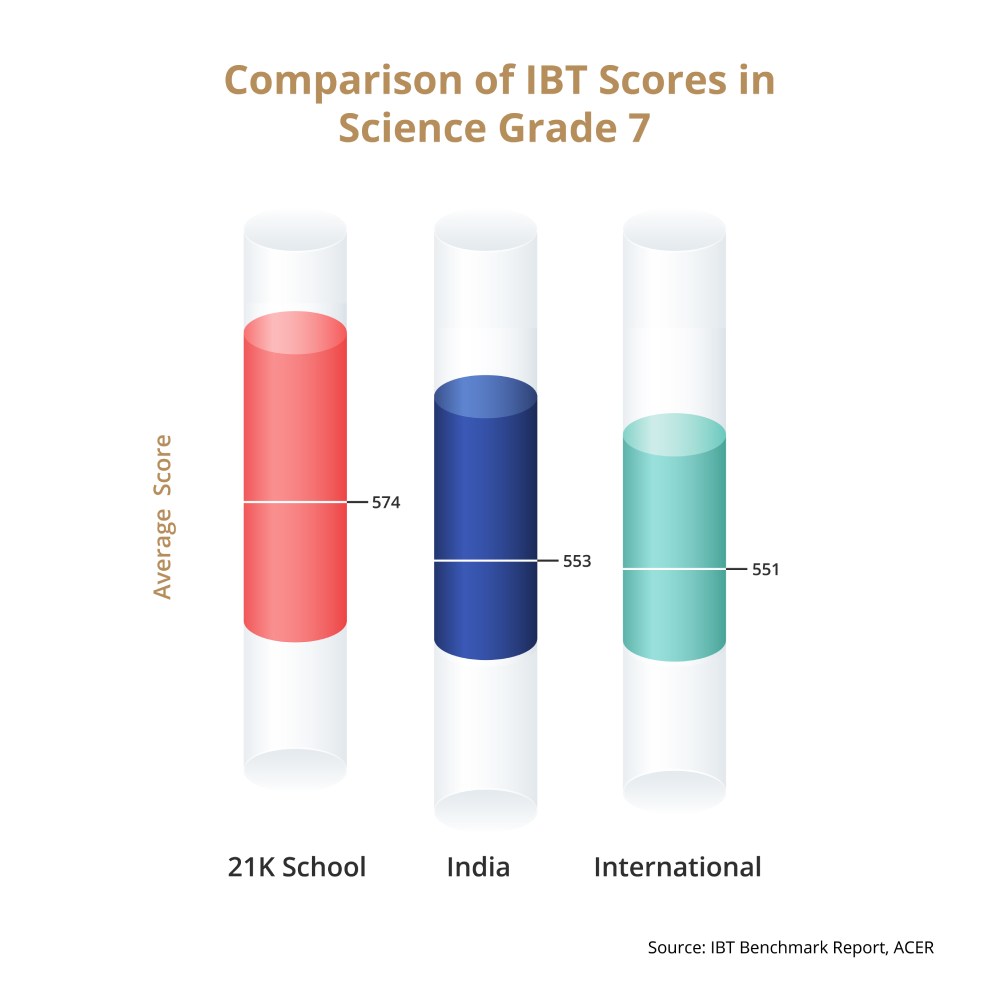
21K School learners continue to demonstrate strong performance across English, Mathematics, Science, and Reasoning, reflecting consistent growth in critical thinking and application skills. Their outcomes position 21K School strongly at both national and international levels, reinforcing our commitment to future-ready learning.
In English the skills assessed are locating information, inferring, predicting, drawing conclusions and reasoning. Learners are not asked merely to retrieve information from a passage; they are asked to make inferences, form judgements, and reflect on the texts. Questions addressing higher-order thinking skills are used to ascertain whether a learner can 'read between the lines' and understand subtlety and nuance in the English language.

In Mathematics the skills assessed include interpreting data, inferring, predicting, drawing conclusions, reasoning and problem solving. For Mathematics questions, learners are asked to make sense of mathematical concepts in everyday situations. IBT Mathematics is not about simply remembering rules and procedures; it requires learners to use higher-order thinking skills to apply their mathematical skills to solve problems.

In Science the skills assessed include observing and measuring, interpreting data, inferring, predicting, drawing conclusions, reasoning and problem solving. Learners are asked to apply scientific principles to specific problems. IBT Science not only assesses learners' knowledge of science, it assesses whether learners are capable of applying this knowledge to given contexts. Many of the questions are based on scientific enquiry.

How does ACER report results?

The IBT provides many different reports on learner performance to help facilitators and schools better understand where their learners are positioned on the learning continuum. The Individual learner report provides comprehensive details of the learners’ performance across strands.

This experience of IBT is better than any Olympiad exam, as the curriculum of Olympiads is limited in the Indian context only and does not necessarily evaluate skills. IBT on the other hand is of an international standard and helps you compare the abilities of your child to global standards and work on them.

There is no additional cost for attempting the IBT assessment. We encourage every learner to mandatorily attempt the IBT and benefit from the outcome.