


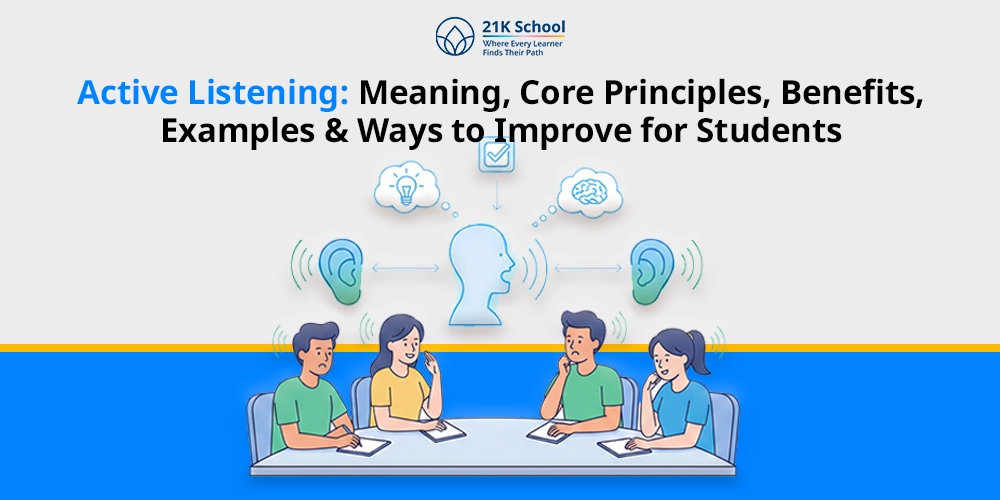
Do you know communication plays an important role in education ? One of the key parts of communication is active listening.
It is a technique through which individuals focus on the speaker to gain knowledge or information to retain, summarise, clear doubts etc.
Implementing active listening in life helps in both personal and professional development. So, in this guide let us take you to the journey of active listening in detail.
Contents
- What is Active Listening?
- Importance of Active Listening for Students
- 6 Core Principles of Active Listening
- 6 Easy Ways to Improve Your Active Listening Skills
- Difference Between Active Listening vs Passive Listening
- Top 5 Active Listening Examples for Students
- 5 Popular Active Listening Activities for Students
- 5 Key Benefits of Active Listening
- 5 Common Mistakes to Avoid While Practicing Active Listening
- Conclusion
What is Active Listening?
Active listening means paying full attention to a speaker, understanding the information or message, replying with the correct answer, and retaining the data of what is being said.
Active listening is different from passive listening because it requires intention and awareness.
While in passive listening individuals can be distracted or only partially engaged in the communication process.
Importance of Active Listening for Students
In daily life, active listening is important both personally and professionally. It reduces misunderstandings, enhances problem-solving and many more. Some key points to consider are:
1. Personal growth
Active listening directly promotes self-awareness and personal growth through which students gain new information, ideas, viewpoints, and experiences.
This helps in increasing thinking skills, finding effective solutions, and improving self-reflection.
2. Emotional intelligence
Active listening is ideal for students to improve their emotional intelligence through which they can recognise, understand, and manage various emotions.
It works as a foundation which helps in understanding others’ feelings, empathy , and compassion. It is also ideal to reduce emotional misunderstandings.
3. Decision-making
One of the importance of active listening is it ensures students can gather complete and correct information, understand viewpoints, and avoid misunderstandings.
This helps in decision-making through right information.
6 Core Principles of Active Listening
For effective understanding and practice, go through 6 core principles of active listening in detail:
1. Paying Full Attention
Learners should start with paying full attention to the speaker by eye contact, avoiding multitasking, and focusing through mental and physical presence.
This helps listeners in better concept understanding and improve knowledge retention.
2. Show That You’re Listening
Listeners should show that they are listening through appropriate expressions like nodding, eye contact, smiling etc.
One can also participate in the conversation if required by adding a few words like “yes right” or “oh i see”.
3. Provide Feedback
Active listening involves reflecting on what the speaker has said. Listeners can ask questions, repeat the sentence, summarise etc.
Providing feedback makes sure listeners are actively listening. It also avoids misunderstanding, especially in particular concepts or chapters.
4. Defer Judgment
One of the core principles of active listening is suspending judgment in which listeners should remain neutral and non-judgmental to make the environment comfortable.
In this way, the conversation proceeds and ends smoothly.
5. Respond Appropriately
By giving thoughtful and positive responses, one can promote active listening. To do so start by responding:
- Honestly and relevant
- Show empathy and understanding
- Truly connect throughout the conversation
- Match the tone and context of the conversation
6. Be Patient and Avoid Distractions
In active listening, being patient is a key to focus and understanding. One must avoid distractions while studying like phone, noise etc.
Concentrate from the beginning for clarity.
6 Easy Ways to Improve Your Active Listening Skills
Parents and teachers often think about how to develop listening skills . To consistent practice of active listening, one must follow 6 easy ways to improve your active listening skills:
1. Encourage Students’ Own Curiosity
For better student engagement curiosity is a key. Choosing interesting topics or concepts helps to increase curiosity.
This ultimately leads to active listening where students want to learn instead of passively listening.
2. Listen Without Interrupting
To improve active listening skills in students, one must listen without interrupting.
Making advance conclusions or interruptions can negatively affect everyone in the room.
3. Ask Thoughtful Questions
By asking thoughtful questions ensures that listeners are listening actively which improves their knowledge and critical thinking.
Participation by asking related questions builds positive connections between speaker and listeners.
4. Control Emotional Reactions
Emotional control while active listening is important to focus on understanding instead of reacting and distraction.
This showcases respect towards both speaker and other listeners.
5. Practice Mindfulness
By practicing mindfulness activities like deep breathing, focus on one thing at a time, mental clarity through meditation before the session etc, enhance concentration.
Mindful learning also helps students to become attentive towards the speaker.
6. Seek Feedback
Through feedback students can identify and improve their knowledge. It supports continuous improvement in students’ listening skills.
Difference Between Active Listening vs Passive Listening
Understand the 5 key difference between active listening vs passive listening through table:
| S No. | Particular | Active Listening | Passive Listening |
| 1. | Level of Engagement | Listener is fully engaged and mentally present in the conversation | Listener hears the words but is not mentally involved |
| 2. | Response Style | Responds with questions, summaries, or feedback | Rarely responds or gives minimal reactions |
| 3. | Understanding | Understanding the message, emotions, and intent | Focuses only on hearing the words, often missing meaning |
| 4. | Body Language | Eye contact, nodding, and positive gestures | Shows little or no supportive body language |
| 5. | Retention of Information | High retention | Low retention |
Top 5 Active Listening Examples for Students
To know active listening in better way, here are the top 5 active listening examples for students:
1. During Classroom Lectures
Students actively listen during the history lecture to understand the scenario and remember important dates.
2. Speech Competition
Focus on different topics presented by the speaker on the stage during speech competition. For example, global warming, rain water harvesting etc.
3. Peer-to-Peer Conversations
Students listen to each other’s opinions to get a better solution to any challenge or conflict.
4. Taking Virtual Classes
Students actively listen in virtual classes to learn without distractions. This ensures effective learning in remote settings.
5. Group Discussions and Leadership
In group activities, listeners are actively involved to understand the strategy of the leader to execute effectively.
5 Popular Active Listening Activities for Students
For better understanding of active listening consider some of the popular activities for students:
1. Listening pairs exercise
In this active listening activity, two students participate where one speaks without interruption and the other listens carefully. In the end, the listener summarises the information.
This develops focus and attention in the listener.
2. Role-playing
Through role-playing a group of people represent a story in front of class or friends to encourage active listening.
In this way, listeners enhance communication skills in realistic contexts.
3. Reflection journals
Students often maintain journals which activate their mind to listen carefully and write down the important points to improve listening skills.
This encourages self-awareness and personal progress over time.
4. Mindful listening activity
Mindful listening activities are the best ways in which students concentrate on a particular sound, story, poem or short speech.
It is effective to calm down students’ minds.
5. Group discussion practices
In group discussion , students practice by listening and later retaining information. In this activity, teachers often assign roles like questioner or summariser for student engagement.
This promotes collaborative learning , critical and reflective thinking in students.
5 Key Benefits of Active Listening
Active listening on daily life offers a lot of benefits such as:
1. Builds Trust and Stronger Relationships
Active listening builds trust and stronger relationships. This is because speakers trust listeners that they are actively listening and listeners help to make the environment supportive.
This ensures long-term relationships and bonds.
2. Improves Problem-Solving
Active listening helps to understand the challenge or scenario to find the most effective solution by gathering all the information.
This boosts critical thinking and problem-solving skills in students.
3. Reduces Conflict
Conflicts mainly arise due to mislead or misunderstood. That’s why active listening plays a crucial role in which conflicts can be avoided or reduced.
4. Enhances Learning and Retention
Students participating in speech competition, group discussion or simply learning in the classroom, active listening focus on gaining knowledge and retaining for the long-term.
5. Increases Engagement
Active listening is one of the most beneficial ways to engage students’ minds for a longer term. They also show participation through expression, asking questions, and responding appropriately.
5 Common Mistakes to Avoid While Practicing Active Listening
Students often make mistakes while practicing active listening. Some common mistakes to avoid are:
1. Interrupting
Multiple interruptions not only impact on speaker continuity but also a distraction for other listeners. One needs to wait till the speaker finishes.
2. Jumping to conclusions
Listeners often jump to conclusions without actively listening to the complete information. This can lead to misunderstanding or mislead.
3. Offering unsolicited advice
Offering unsolicited advice can negatively impact the speaker and make the environment inappropriate. One must wait to ask questions or doubts.
4. Multitasking while listening
Active listeners must avoid multitasking because it can easily distract from the useful information.
5. Listen only to reply
Some listeners instead of understanding the concept focus on responding which can also impact active listening.
Conclusion
Communication is a basic requirement whether it is personal or professional life. Through active listening students can enhance their communication skills .
However, one must practice different ways to improve your active listening skills. To do so, learn different techniques, importance, benefits, and principles in detail.
Remember, through active listening students can stand out in their academic journey and beyond. Explore the importance of listening skills for students
.

You may also want to read