

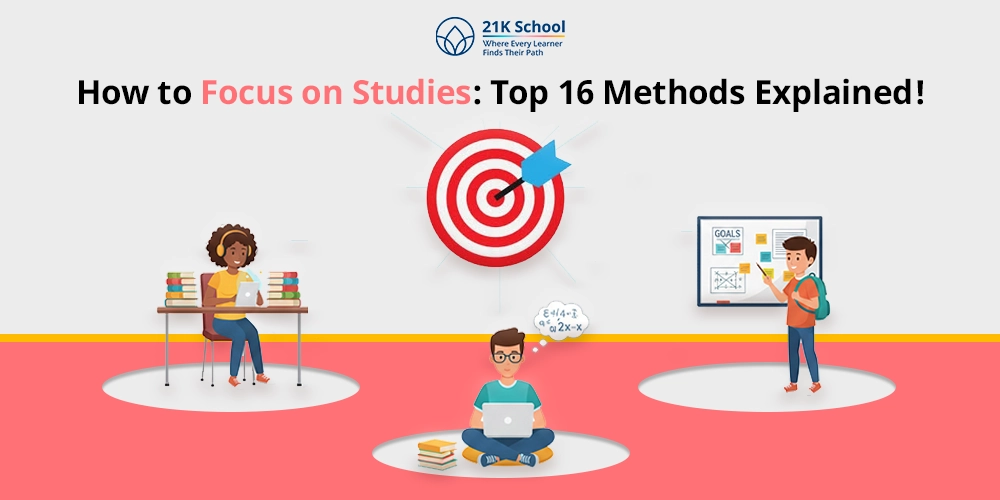
Difficult to concentrate and study, and confused about how you can concentrate despite the distraction that occurs whenever you study?
Focus on studies is an important aspect of an academic journey and the future achievement of a student. Today, most learners might find it difficult to stick to the track due to all the distractions that might take place.
Study habits, time management and a strict disciplined routine can assist students to be focused. With the right attitude and determination, students can manage to enhance their knowledge, learn to memorise information better, and get high marks.
Contents
- What Are the 16 Ways to Focus on Studies?
- 1. Make a Study Routine
- 2. Create an Effective Study Space
- 3. Avoid Overusage of Digital Devices
- 4. Set your Goals
- 5. Reduce Distractions
- 6. Listen to Calm Music
- 7. Avoid Multitasking
- 8. Proper Sleep
- 9. Take Frequent Rest
- 10. Daily Exercise
- 11. Study in Groups
- 12. Find the Best Study Method
- 13. Start Small
- 14. Take Help from Adults
- 15. Pomodoro Technique
- 16. Practice Mindfulness
- Ending Note
What Are the 16 Ways to Focus on Studies?
One might find it hard to remain focused on the studies despite the distractions and the academic pressure that one is going through. However, reflection on appropriate habits and plans may be quite beneficial to improve focus and learning capacity. These are the effective strategies for focusing on studies.
1. Make a Study Routine
It is good to have a habit of studying since your brain becomes accustomed to when it is time to focus. Going to classes as a habit inculcates discipline and reduces procrastination.
Study routine also helps you to keep time in a good manner to make sure that you balance between revising, breaking and rest and studies as well. By establishing a routine, students will find it easy to study without any struggle.
2. Create an Effective Study Space
An effective positive learning environment is helpful for concentration. The environment must be in a clean, quiet and well-arranged state to ensure that distractions are minimised.
Availability of books and stationery in one place helps students to get their needs in one place without moving. Makes the mind focused during the learning periods.
3. Avoid Overusage of Digital Devices
The smartphones or digital devices can easily divert attention through the use of notifications, social media and messages. You should also leave your phone aside when studying so that you can have more time to focus on your studies.
To reduce temptation, it is helpful to turn off the notifications or leave the phone in another room. Not using smartphones when studying improves productivity, and it will allow you to complete tasks in an effective and faster way.
4. Set your Goals
It helps you to have direction because you have your clear and attainable goals for the study. Instead of studying aimlessly, you will accomplish some goals, which will make you driven and concentrated.
Smaller goals are easier to achieve and reduce study stress . Reaching certain objectives will also result in confidence and create continuity that will eventually make studying more controlled and effective over time.
5. Reduce Distractions
Some of the distractions that interfere with concentration and reduce the quality of the studies are noise, television or chat. These distractions are supposed to be found and removed to increase the level of concentration.
Get your family members to know about your study timetable , and also choose a calm environment. When you clean your study area of things that you do not need, then you will be in a better position to focus on your education and spend your time more productively.
6. Listen to Calm Music
Some students are able to learn better when they listen to calming music or instrumental music. It helps to eliminate the background noise and turn a study into a quiet environment.
Lyricless music is better since words may lead to a person losing concentration. Soft music or nature music can be used to reduce the level of students stress , and one can study for longer hours without incurring any difficulty.
7. Avoid Multitasking
Multitasking divides focus and reduces the ability to learn effectively. Disorientation easily occurs when trying to learn using equipment or tampering with objects.
When one focuses on one thing, it improves learning and memory. It is more effective and time-consuming to do one subject and then the other because you end up learning more.
8. Proper Sleep
Concentration and memory are vital, and they are best achieved through proper sleep. The restful mind is alert and grasps concepts in a better manner.
Sleep deprivation results in fatigue, lack of concentration, and poor levels of performance. The students are expected to have a good bedtime routine and regular sleeping schedule so that they can be active and alert during the daytime, mainly during study sessions and exams.
9. Take Frequent Rest
Spending hours studying is a mental strain. Short breaks help to rejuvenate the body and enhance productivity.
The short breaks aid in the alleviation of stress and focus. The application of such techniques as studying for 25 minutes and having a short break can be used to avoid burnout and make learning enjoyable and effective.
10. Daily Exercise
Exercising helps students to get more concentrated, especially physical and mental wellness is boosted by exercise. Sporting activities promote the flow in the brain and release stress.
The body is revitalised by doing some basic activities like walking, stretching or even sporting. Exercising also boosts energy, improves mood and makes one concentrate when studying.
11. Study in Groups
Knowledge sharing can be an improvement in learning through communicating and sharing available ideas. Working in teams will help remove any form of doubts and will make the learning process more exciting.
However, the teams will be well-disciplined. Positively, group study can be employed to motivate, improve the communication skills and allow the students to learn concepts more effectively and confidently.
12. Find the Best Study Method
Every student has their own method of learning . Some learn by reading, others by writing, by watching and listening to videos or by listening.
To be more concentrated and understandable, it is preferable when it comes to finding a type of study that fits you. Efficient ways of learning make the learning process less annoying, fun and long-term.
13. Start Small
One should never overwork oneself, but start making a focus to build up step by step. Learning in brief sessions is easier than the long sessions.
The division of big issues into small ones will make learning easy. Completing small tasks builds confidence and encouragement that makes the students continue studying and invest more and more time in studying.
14. Take Help from Adults
Parental, teacher, or mentor help with academic challenges is also pertinent to seek. They can provide advice, motivation and the best modes of study. Adults help to clarify doubts and help with emotional intelligence .
Their experience and their encouragement make them easier to focus, confident, and consistent in academic learning.
15. Pomodoro Technique
The Pomodoro technique is a time management technique that also leads to an improvement in concentration and productivity. It is anchored on the 25-minute study of full concentration and the five-minute break.
The extended pause is made after four sessions. The approach prevents mental fatigue and improves attention span, as well as makes the learning process more structured and less intimidating.
16. Practice Mindfulness
Mindfulness will help the students to be mindful and reduce stress in the course of their studies. Even simple activities like taking a deep breath, short meditation or attention to the task to be done can calm down the mind and help to concentrate better.
The distraction and anxiety caused by mindfulness are also reduced to a minimum, allowing students to learn effectively, comprehend better and memorise better.
Ending Note
Focus on studies does not entail studying long hours, but studying smart and always.
Having the right habits of studying in order may make students avoid distractions, maintain good health and good working habits, which help them build their concentration and performance to a very high level.
All students are different, and it is worth experimenting with what works with them. Adult support will make it easy to stick to studies with time, as it will be fulfilling through patience and discipline.

You may also want to read