


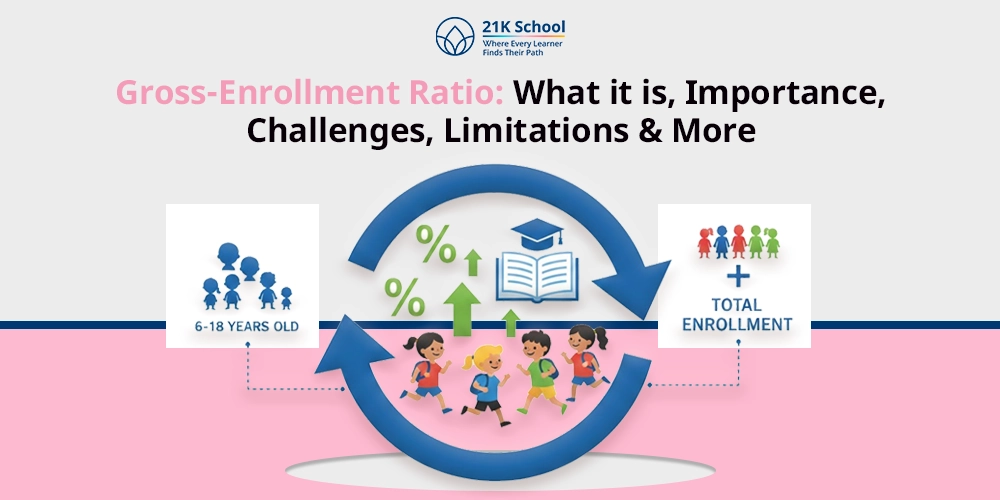
Educational systems and administrators want to refer to the number of individuals who are enrolled in schools and other institutes at a certain level of education .
They find this data by referring to the gross enrollment ratio.
It is to maintain an equitable access to education and other resources among the huge population of a nation.
It is also common to find a gross enrollment ratio to exceed 100%. If you are interested in knowing why so and all other details on gross enrollment ratio, you can read this article.
Contents
- What is Gross Enrollment Ratio?
- Importance of Gross Enrollment Ratio
- Gross Enrollment Ratio at Different Levels of Education
- Gross Enrollment Ratio: Global Perspective
- Gross Enrollment Ratio in India
- Challenges in India’s Gross Enrollment Ratio
- Limitations of Gross Enrollment Ratio
- Gross Enrollment Ratio (GER) vs Net Enrollment Ratio (NER)
- Factors Affecting Gross Enrollment Ratio
- Strategies to Improve Gross Enrollment Ratio
- Role of GER in Sustainable Development
- Conclusion
What is Gross Enrollment Ratio?
Gross Enrollment Ratio (GER) is a statistical index that states enrollment at a particular level of education regardless of age, as a percent of the population who fall within the specific age bracket.
Simply put, it compares the total number of students enrolled at a particular educational level with the total population of the age group that officially corresponds to that level.
The reason why GER is so popular among educational planners and international organizations is that it offers a detailed picture of the participation in education.
In contrast to some other indicators, GER incorporates over-aged and under-aged students, which reflects the actual level of enrollment into the system of education.
Formula for Gross Enrollment Ratio
The Gross Enrollment Ratio is calculated using the following formula:
Gross Enrollment Ratio (GER) = (Total enrollment at a given level of education, regardless of age/Population of the official age group for that level) × 100
This equation gives GER indicating total reach of the education system at that particular level together with repeaters, early entrants, and late entrants.
Why GER Can Exceed 100%
The peculiar feature of Gross Enrollment Ratio is that it may have a value over 100 percent.
This is because GER considers all students enrolled in a particular level of study, irrespective of their age.
GER more than 100 percent is due to the following reasons:
- Students who are over-aged or those who repeat the same grades.
- Students who are under-age and join school early.
- Education systems that permit re-entry or lifelong education.
A GER of above 100% is not a sign of inefficiency, rather a sign of access and inclusiveness in the education system.
Importance of Gross Enrollment Ratio
The significance of gross enrollment ratio include the following:
1. Measuring Access to Education
GER can be considered as a key measurement to access to education.
The larger the GER, the larger the percentage of the population attending school, implying an improvement in the accessibility and availability of schooling opportunities.
It aids the policymakers in determining if children and the youth are getting into the education system at different levels.
2. Assessing Inclusiveness
GER also points towards the inclusiveness of an education system by involving students of all ages.
It is a measure of the flexibility of the system in terms of other learners including late entrants, working students, and students who need to resume studies after a break.
This is particularly crucial in developing nations whose education channels are mostly non-linear.
3. Policy Planning and Evaluation
Governments use GER information to design learning infrastructures, to allocate funds, as well as to develop specific interventions.
When the GER is low, it can be an indication that more money needs to be allocated to schools for scholarships and recruiting of teachers.
GER being tracked over time may also assist in measuring the success of the policies and reforms in the field of education.
4. Tracking National and International Goals
Gross Enrollment Ratio is directly related to the domestic education goals and international commitments like universal education and lifelong learning .
It can be used as a reference to evaluate the progress towards larger development goals and changes in education.
5. Comparing Educational Progress
GER enables the comparison of education participation across countries and time periods.
Although comparisons should be done with caution, GER still proves to be an effective instrument when it comes to analyse comparative progress and find loopholes in the development of education.
Gross Enrollment Ratio at Different Levels of Education
As we know that gross enrollment ratio is evaluated at different levels of education, here are the three of them:
1. GER in Primary Education
Calculations of GER in primary education are commonly used to assess the reach of basic education .
In many countries, the primary GER is quite high as a result of enactment of compulsory school, free education, and government-sponsored programs.
High primary GER indicates high enrollment to elementary education.
A GER over 100 by far can also signal grade repetition or late entry, because of which quality or efficiency can be pointed out.
Achieving a balance between large enrollment and smooth grade succession is one of the major issues at this level.
2. GER in Secondary Education
GER in secondary education is often lower when compared to elementary education. This is because the rate of dropouts is often high after completion of elementary school.
Economic constraints, early employment, social norms, and absence of secondary schools in the rural set-up are some of the factors that influence enrollment in this stage.
It is critical to enhance GER at secondary-level education as this level of education results in development of skills , employability, and social mobility.
Scholarships, school transport policies, and vocational education pathways are common policies applied to enhance participation in this level.
3. GER in Higher Education
Participation in colleges, universities and other tertiary institutions are a measure of GER in higher education .
It is regarded as a great marker of how a particular country is advancing towards a knowledge-based economy.
The GER in higher education is generally far lower than the primary and secondary GER, particularly in developing states.
Larger universities provide the facilities of online learning with flexible education models, leading to slow increments in higher education GER on a global scale.
Gross Enrollment Ratio: Global Perspective
Gross enrollment ratio varies in different countries because of the variations in population structure and education policies.
1. GER in Developed Countries
Developed countries commonly demonstrate high GER at all levels of education, especially at secondary and higher education.
Good government education systems, existing institutions, and funding systems all help in increasing the rate of enrollment.
In most developed countries, high education GER is an expression of the extensive opportunity to higher education institutions, including universities, college, and lifelong learning programs.
These nations pay attention to quality assurance and effective advancement using the levels of education too.
2. GER in Developing Countries
In developing countries the level of GER drops often after primary school.
The enrollments are influenced by economic constraints, inadequacy of infrastructure, supply of teachers, and other social issues which include child labour and early marriages.
Though, with the policy reforms, foreign assistance, and local efforts, a lot of developing nations have gone a long way.
Improvements in these regions can ensure greater access, but inequalities still might exist.
3. Gender and GER
Gender inequality has been one of the global concerns in the case of GER.
In past times, girls were less enrolled in most areas, especially for secondary and tertiary education.
Still, gender gaps have been minimized through specific policies like the girl-only scholarships, creation of awareness, as well as legal restructuring.
In certain nations today, female GER is equal or even greater than male GER, particularly at higher education levels.
Gender-based GER data is still needed to enhance educational equity and inclusivity in education .
Gross Enrollment Ratio in India
India is a multinational country with a huge population, and depicts a complicated and dynamic image of gross enrollment ratio across various levels of education.
GER Trends in India
India has shown improvement in GER for primary level of education.
The enrollment in elementary education reflects the success of government interventions and mandatory education policies.
At secondary level, GER has been on a steady improvement though there are still challenges like dropout rates and disparity in the regions.
Indian higher education GER, too, has grown steadily over the past decades showing an increase from 23.7% (2014-15) to 28.4% (2021-22).
This development took place due to the growth of universities, colleges, and other professional institutions under NEP 2020.
To our surprise, girls GER has surpassed that of boys in recent years, showing gender inclusion and equity.
Despite this progress, there are still disparities between the states, rural and urban locations, and various socio-economic classes.
Reconciling these disparities is one of the major concerns of educational planning in India.
Government Initiatives to Improve GER
The Indian government has undertaken various programs to increase Gross Enrollment Ratio across education levels. These include:
Universal elementary school policies.
- Programs of scholarship and bonuses to underprivileged groups.
- Increase in high schools and universities.
- Marketing of online and open learning systems .
- Skill development and vocational education courses.
These initiatives are meant to promote enrollment, retention, equity, and quality education .
Enhancement of GER is also interconnected with national agendas of expanding economic, social, and human capital.
Challenges in India’s Gross Enrollment Ratio
India’s gross enrollment ratio still faces barriers to increase:
1. Regional disparities between urban and rural areas
The high level of inequality between urban and rural areas is one of the key problems that influence the GER of India.
Urban areas have easier access to schools, colleges, qualified teachers, and digital learning centers.
On the contrary, most rural and remote locations lack proper infrastructure, longer commutes to schools, and a few educational institutions, mostly at secondary and higher education levels.
Such loopholes result in reduced enrollment data and retention in rural areas.
2. Gender gaps in certain regions
Even though India is now achieving success in reducing gender differences in education, there are still some regions where gender differences occur.
Social issues like early marriages, household chores, and lack of security are barriers to girls’ education. Other reasons include cultural preference for boys’ education.
This has adverse effects on the entry of females in school, especially in the secondary and higher education, hence influencing GER.
3. Socio-economic barriers
Poverty, unemployment, and other financial problems are socio-economic challenges that have a great impact on enrollment rates.
Indirect costs of education including uniforms, transportation, books, and digital devices cannot be afforded by many families.
Children belonging to poorer economic backgrounds might be forced into labor to support their family incomes, which causes them to not enroll or leave school earlier.
4. Quality of education concerns
Admission alone cannot assure you effective learning .
The poor quality of education, outdated curriculum , inappropriate teaching methods , and the inadequacy of learning materials make students discontinue their learning in certain areas.
Perceived low value of education is a major cause of dropouts, which influences GER and general educational results.
Limitations of Gross Enrollment Ratio
Although Gross Enrollment Ratio is a very popular indicator, it still has some limitations that have to be taken into consideration when examining data.
1. Does Not Measure Age-Appropriate Enrollment
GER involves all enrolled students irrespective of age.
This translates that it does not specify whether children are attending appropriate levels of education at a given age.
Subsequently, these issues like late entry or grade repetition could be disguised by the high GER values.
2. Does Not Reflect Quality of Education
GER exclusively talks about the number of enrolled people and never talks about the quality of education, learning outcomes , and improvement of skills.
High enrollment could be accompanied by low education standards which denotes GER as a partial indicator of education achievement.
3. Can Be Misleading
Since GER can be higher than 100 percent, it can create the illusion of effective and universal education systems.
High GER scores can be due to students of older ages and high instances of repetition of students, and not efficient attendance of education levels.
4. Does Not Capture Dropout Rates
The drop-out or retention rates are not directly considered by GER.
A country can have high GER but still witness high student dropouts, particularly at the transition level between the primary, secondary, and higher education.
Gross Enrollment Ratio (GER) vs Net Enrollment Ratio (NER)
Gross Enrollment Ratio (GER) and Net Enrollment Ratio (NER) are significant measures of educational participation although they are referring to different things.
Gross Enrollment Ratio depicts total enrollment at a particular level of education at any age. But, NER only includes students who are within the official age range of a given level of education.
NER can give a better understanding of age-related involvement and evaluate the enrollment of children pertinently.
NER can, however, underestimate all access to education by omitting over-aged and under-aged students.
GER, in its turn, brings out the total ability and inclusivity of the education system.
Therefore, GER and NER provide complementary information which should be applied together in 2-dimensional analysis of education and policy development.
Factors Affecting Gross Enrollment Ratio
The gross enrollment ratio is affected by the following factors:
1. Economic conditions
The general economic status of a country impacts the total amount of money people spend in education.
This includes funds for employment opportunities, and household income, which further determines the rates of enrollment.
2. Poverty and income inequality
Low education standards and poverty deprive many groups from access to education, especially for the marginalized ones.
Early dropout or delayed enrollment is usually a result of a lack of financial support .
3. Gender norms and cultural beliefs
Attitudes of cultures towards education (often with regard to girls) may have a very strong influence on enrollment.
The existing gender norms and societal demands might hold back further education.
4. Availability of schools and colleges
The availability of local schools, colleges, and universities has a great influence on enrollment.
Areas with few educational centers tend to have low GER.
5. Government policies
Most educational policies emphasize mandatory schooling, free education, scholarship, and reservations. These are important in enhancing GER.
6. Teacher availability and quality
The required amount of trained and motivated teachers is the key to attraction and retention of students.
The lack of teachers and incompetence results in inefficient education systems.
7. Scholarships and financial aid
Financial support initiatives assist in reduction of economic barriers and promotion of admission, for students belonging from a poor background or to a minor group.
8. Awareness and parental education
The awareness among parents about the value of education is very important in the enrollment process.
Parents who are educated would emphasize on the schooling of their children.
Strategies to Improve Gross Enrollment Ratio
GER can be increased if the government and general public focuses on the following areas:
1. Expanding Educational Infrastructure
Establishment of more schools, colleges, and universities, particularly in rural and disadvantaged communities, enhances people’s access and minimizes regional inequalities.
Online learning centres should also be incorporated in infrastructure development.
2. Financial Support for Students
The digital access programs, scholarships, fee waivers, free textbooks, and transportation support, etc. can aid in reducing financial burdens and encourage more enrollments.
3. Reducing Dropouts
Specific solutions that can allow retaining the students and lowering the level of dropouts, are remedial education, counseling, mid-day meal programs, and flexible learning .
4. Promoting Gender Equality
Providing incentives to girls’ education, creating safe learning environments, along with challenging social barriers are vital to filling gaps in gender education.
5. Improving Quality of Education
The overall education quality can be improved through enhancing teacher training, curricula renewal, incorporation of technology, as well as through an emphasis on the learning outcomes.
Better quality of education leads to engagement, retention, and long-term participation in students.
Role of GER in Sustainable Development
Gross Enrollment Ratio (GER) is very important to the realization of sustainable development, especially, when it comes to the Sustainable Development Goal 4 (SDG 4).
It intends to attain inclusive and equitable quality education, and lifelong learning opportunities to all people.
GER enables the policymakers and stakeholders to monitor the advancement in educational access and participation that is very vital to the general socioeconomic development.
GER is a key variable which can be used to measure the extent to which education opportunities are being availed at various education levels.
Greater GER values indicate increased inclusiveness and robust development of universal education, which is one of the priorities of SDGs.
The increased GER also drives productivity and overall economic growth. Hence, reducing poverty and ensuring a better standard of life.
It is also crucial to minimize gender and social disparities in GER to empower women and poor societies.
The GER data guides the national and international policies on education by alerting the policies on areas that need investments or other changes.
Follow-up is a sure way of being accountable in meeting SDG-4 targets and development goals at large.
Conclusion
Gross Enrollment Ratio is the measure of all students getting a certain level of education.
It is important that the GER of a nation is high, but it cannot denote how many students are repeating the class or dropping out.
The number of enrollments have increased in India as well, due to educational policies, scholarships, awareness, and gender equality.
Still, there is much space for India to improve and support sustainable education
for all.
This can bring a better picture of education in front of us, that would include more capable professionals in future.

You may also want to read

CBSE Passing Marks Out of 100: Theory, Practicals & Grading

- Last updated on: 13 Mar, 2026
- 7 min read