

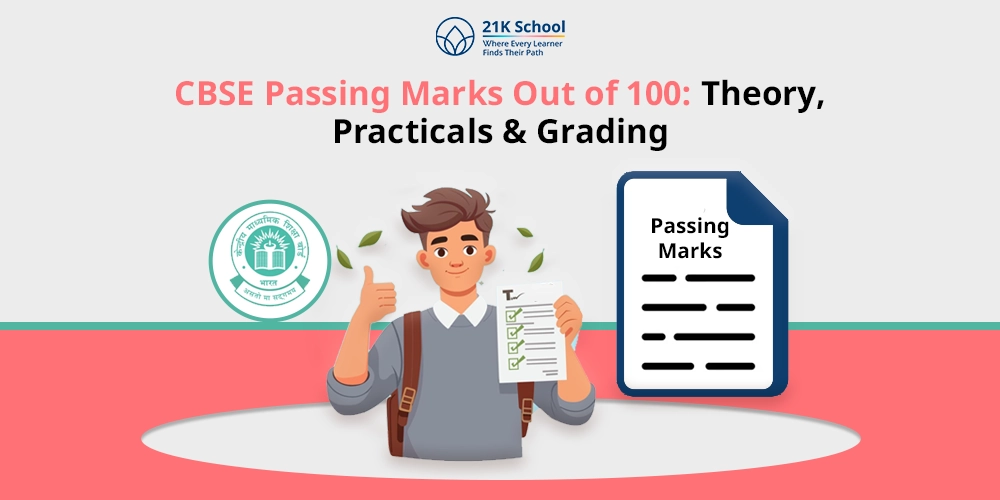
CBSE has been conducting exams for school kids for years. It has designed an exam pattern, syllabus, curriculum, and passing marks out of 100.
Students, parents, and teachers need to know these passing marks before taking board exams.
The reason behind this is that they can prepare themselves before facing any academic challenges during the term of their studies.
In this article, we have stated the CBSE passing marks out of 100 separately in theory and internal assessment, and the grading system followed.
You will also come across the situations that might occur if you fail exams and tips to stay put.
Contents
What Are the CBSE Passing Marks Out of 100?
Passing marks in the examinations of CBSE board are 33 percent of total marks. This applies both to Class 10 and Class 12 students.
In cases where the aggregate marks of a subject are 100, a student has to score a minimum of 33 marks to pass the subject.
These marks, however, could be calculated based on several factors which can include theory tests, internal assessments, and practicals.
To illustrate, suppose that the marks granted to a subject are 80 for theory and 20 for internal assessment, the student would have to get the minimum number of marks required by the CBSE on the different parts.
In simple words, a total of 100 marks makes passing marks 33.
If a student scores less than 33% in aggregate, they shall be considered a fail in that subject.
CBSE Passing Marks in Theory and Internal Assessment
In most subjects of the CBSE, examinations are separated with marks allocated to theory, and internal tests and/or practical examinations.
These components have a minimum requirement which the students must meet.
The theory examination typically has 70 or 80 marks based on the subject. The students need to achieve at least 33 percent of the theory marks in order to pass the exam.
For instance, when the theory paper carries 80 marks, the passing marks out of 80 is 27 (i.e., 33% of 80).
Internal tests are made up of projects, assignments, regular tests, and at times, practical work. Such tests typically have 20 or 30 marks.
The students should obtain a score of at least 33 percent in the internal assessment as well.
As an example, when the internal assessment is 20 marks then each student should get a minimum of 7 marks to pass.
Since they are part of the final outcome, internal assessments should not be overlooked by the students.
A good performance in these parts can assist in getting more marks and pass the subject more easily.
CBSE Passing Marks Out of 100
CBSE has almost the same passing criteria for different classes like 10th and 12th, however their practical assessments criteria differ sometimes. Let’s have a closer look at it.
1. CBSE Passing Marks for Class 10
Most subjects in CBSE Class 10 board exams take a similar format with the theory exam having 80 marks and the internal assessment having 20 marks. These are totalled to 100 marks.
A student needs to achieve a minimum score of 27 marks in the theory exam and no less than 7 marks in the internal assessment in order to pass the subject. The combined total must be at least 33 marks out of 100.
Subjects like Mathematics, Science, Social Science, and languages tend to follow this trend.
There is a possibility that students are forced to face a compartment examination in case they do not attain the minimum requirement in any given subject.
2. CBSE Passing Marks for Class 12
In class 12 board examinations, depending on the subject, the marks distribution might vary.
In science courses like Physics, Chemistry, and Biology, the marks are normally separated into 70 marks of theory and 30 marks of CBSE practical exams.
In this instance students need to get around 23 or 24 marks in theory and 10 marks in practicals to reach the criteria of passing.
Most papers in commerce and humanities have the pattern, which is 80 marks on theory and 20 marks internal assessment.
In this case, students should have 27 marks in theory and 7 marks in internal assessment.
Even though the marks are allocated in different ways, the general passing regulation of 33 percent is similar in all subjects.
3. CBSE Grading System
The CBSE grading system has been slightly revised from the previous ones to focus more on reducing academic pressure and boosting student performance. The table shows the classification of relative grading.
| CBSE Grades | Categorization |
| A-1 | Top 1/8th of the passed candidates |
| A-2 | Next 1/8th of the passed candidates |
| B-1 | Next 1/8th of the passed candidates |
| B-2 | Next 1/8th of the passed candidates |
| C-1 | Next 1/8th of the passed candidates |
| C-2 | Next 1/8th of the passed candidates |
| D-1 | Next 1/8th of the passed candidates |
| D-2 | Next 1/8th of the passed candidates |
| E | Essential Repeat |
What Happens If a Student Scores Below Passing Marks?
When a student gets Grade E, they are considered to have failed in that subject, which can lead to three significant pathways for passing in exams.
1. Compartment Examination
Failed students can take compartment exams that are administered by CBSE. These tests are conducted immediately after the board examination results have been announced.
By passing the compartment exam, the students will be able to proceed without repeating the whole academic year.
2. Re-evaluation or Verification
A student who feels their answer sheets were not marked appropriately can request for verification, previous photocopy, or re-evaluation.
In the process of re-evaluation, the examiners go through the answers one more time to determine that they made no mistakes in marking.
The marks might increase or decrease as a result, therefore students should be confident in their answers if applying for verification or re-evaluation.
3. Reappearing in the Next Board Exam
In case a student fails in various subjects or does not qualify the compartment exam, they would have to repeat in the next cycle of the board examination.
This implies students should be ready to rewrite the subjects and take the exam in the next year.
Grace Marks in CBSE
CBSE can also offer grace marks in some cases to enable the students to pass an exam.
Grace marks in CBSE are commonly awarded to ensure that a student who is a few marks below the passing marks can pass the exams.
As an illustration, when a student gets 31 or 32 out of 100 marks, the board might consider granting the student a few grace marks to enable them to get the maximum passing mark of 33.
However, the board does not give grace marks as a favour, but only when the board sets a particularly tough question paper or when the question paper has some mistakes.
Tips for Students to Achieve Passing Marks
If you struggle and are fearful of exams that are around the corner, you can follow the below tips to score at least the passing marks:
1. Focus on Key Concepts
It is important to understand the fundamentals of each chapter.
The students do not have to memorize all information, but rather learn significant formulas, definitions, and basic concepts.
2. Practice Previous Year Question Papers
The benefits of solving the previous years question papers are that the students get to know the pattern of the examination and questions that are likely to be asked. It promotes speed and accuracy in the exam as well.
3. Manage Time Effectively
Time management is required to achieve good preparation so that you can be able to cover every subject.
Performance at exams could be enhanced by creating a study schedule and following it consistently.
This would reduce the sudden exam-stress that students face when exams are closer.
4. Perform Well in Internal Assessments
Internal evaluations such as projects, assignments, and regular tests are added to the final marks.
Consideration of these assessments would enable the students to score extra points and acquire a better score in final exams.
5. Seek Help When Needed
The students should seek clarification from teachers or classmates in case they encounter a doubt in any subject.
You can easily resolve the doubts before the exams without remaining confused during exams.
Concluding Comments
CBSE passing marks out of 100 is 33. It consists of internal tests like assignments, projects, presentations, and participation in co-curricular activities, and theory.
Students can pass the CBSE board exams if they pay attention to frequently tested concepts from previous years and solve them prior to final exams.
Though students feel stressed during exams, scoring passing marks isn’t that hard.
Even if you fail in a subject,
you can give compartment exams or send your paper for re-checking to ensure you pass the exam in the same academic year.

You may also want to read