

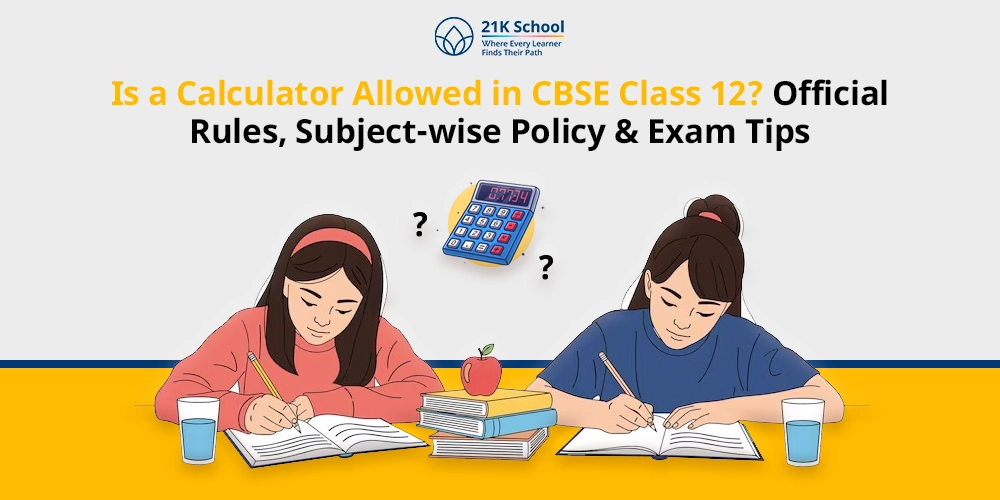
Are you wondering if a calculator is allowed in CBSE class 12 or not?
The use of calculators in Class 12 exams in CBSE is an issue that is widely raised among students. CBSE has certain instructions on the use of calculators, as to whether they should be used in the subject and the exam, and of what type. Understanding the CBSE marking scheme can further help students align their preparation.
The use of calculators in examinations is not allowed in CBSE primarily because it promotes mental expediency and problem-solving skills.
But in certain situations, the use of calculators can be given to students on special consideration. Knowing these rules will make students ready to pass the exams. Pairing this knowledge with effective strategies on how to prepare for board exams ensures students follow official instructions without making mistakes.
Contents
- Is a Calculator Allowed in CBSE Class 12?
- CBSE Class 12 Exam Calculator Policy
- Is a Calculator Allowed in Accountancy and Mathematics?
- Subjects in Which a Calculator is Not Allowed
- Why CBSE Doesn’t Allow a Calculator?
- How to Prepare without Using a Calculator?
- What if Any Student Brings a Calculator in Class 12 Exam?
- Conclusion
Is a Calculator Allowed in CBSE Class 12?
No, usage of calculators is not allowed in the CBSE class 12 board examinations. The allowances are not automatic, and the students are going to be required to do all the calculations manually during the exam.
However, it is not without exception that children with special needs (CWSN) may take a calculator, but under the conditions of the CBSE and with the previous permission of the board authorities.
CBSE Class 12 Exam Calculator Policy
The policy of the CBSE Class 12 exam calculator gives guidelines on the use of calculators in board examinations by students. The policy of the calculator can be checked below.
1. General Prohibition
Most subjects in the CBSE Class 12 examination do not allow the use of calculators. The students will be requested to perform the calculations using their mental arithmetic and rough work.
This provides fairness and challenges the conceptual knowledge and ability of the students in problem-solving. Calculators should not be used as unauthorised use of a calculator results in disqualification or penalty.
2. Specialised Intervention (Dyscalculia)
Students with the learning disability of dyscalculia can be given special treatment in terms of the use of calculators.
CBSE has made exceptions based on the medical recommendation, so that such students are not at a disadvantage when it comes to attempting calculations. This facility must be availed of by proper documentation and acceptance by the school authorities to be used during exams.
3. Children With Special Needs (CWSN)
In the year 2020, depending on their learning or physical disabilities, Children With Special Needs (CWSN) are allowed to use the calculators in case they need them. CBSE considerd this applications on an individual basis and maintains the accessibility and integrity of exams.
Such support allows fair treatment, which makes the students with disabilities show their level of knowledge without undue struggle because of the difficulties in calculations.
However, in 2025-26, no such provision was given to students.
Is a Calculator Allowed in Accountancy and Mathematics?
No, calculators are not allowed in the CBSE Accountancy and Mathematics exams and hence all calculations should be performed by students themselves.
Mathematics
CBSE Class 12 Mathematics also does not allow the use of calculators when taking exams.
This is not only just, but also it is conducive to and fine numerical proficiency is acquired. Any learner who is caught using a calculator is likely to be disqualified.
Accountancy
The use of calculators by the students is also not permitted in the CBSE Class 12 Accountancy tests. Students are expected to do arithmetic calculations, drawing up financial statements, ratios, balances and other accounting problems by themselves. Understanding which subjects are major and which are minor in cbse class 12th can help Commerce students plan better.
The allowance also allows the students to simplify difficult calculations and makes them accurate, thus eliminating errors and allows the students to focus on the accounting principle and accurate presentation of data.
However, CBSE is planning to allow the use of a simple calculator for basic arithmetic operations; no official statement has been given by CBSE. Students can also explore the CBSE improvement exam options if they feel not prepared well.
Subjects in Which a Calculator is Not Allowed
CBSE wants students to rely on conceptual knowledge, not to avoid it, and solve problem by their own.
The other subjects, such as Mathematics, are on the development of analytical skills and students are also tested to determine whether they have the ability to do their calculations without the use of external aid.
| Subject Name | Calculator Allowed |
| Mathematics | No |
| Accountancy | No |
| Physics | No |
| Chemistry | No |
| Economics | No |
| Business Studies | No |
Why CBSE Doesn’t Allow a Calculator?
CBSE does not permit the usage of the calculators to enhance conceptual clarity, mental computation, accuracy and sound evaluation of genuine learning amongst the students. This is the reason why using a calculator is prohibited.
1. Development of Numerical Ability and Accuracy
Calculations by hand are useful in learning mathematics, training faster mind speed in calculations, and thinking logically.
The approach would provide the students with the assurance of solving problems without using the devices and create a strong base in arithmetic and analysis skills that they would need later in their studies.
2. Evaluation of Step-wise Problem-Solving
Manual issue-solving will help the teacher assess all the actions of the work done by a student. CBSE is not a final solution but rather is founded on the learning process.
Teachers can challenge the logic, knowledge, reasoning, and problem solving tactics of students. It further helps in ensuring that the students have clear and organised thinking.
3. Uniform Assessment
These restrictions are similar for all students and ensure that no student enjoys the benefits of sophisticated tools. CBSE will offer uniformity to the assessment criteria, therefore making the manual calculation and rational aptitude of every student to be checked on equal terms.
This prevents evaluation differences, which come about due to the power of the calculators, and levels the playing field, presenting an accurate picture of the student’s knowledge of the student on the subject matter.
4. Prevention of Misuse
Calculator banning is one of the ways to minimise the chances of cheating or misusing the calculators during exams. Calculators with advanced capabilities are able to store programmable functions, text or formulas and could be compromised.
By not allowing it, CBSE reduces chances of unfair advantage, and makes examinations to be characterised by integrity and motivates students to use their knowledge, understanding and problem-solving techniques.
5. Skill Development
The manual calculations allow one to develop critical thinking skills, analytical abilities, and attention to detail. This CBSE restriction helps students to develop mental math and improve their concentration, and master the principles.
The skills can be applied in the real world outside exams and in academic development, solving daily problems, and any competitive tests where clarity in the concept and rapid thinking are superior to dependence on devices.
How to Prepare without Using a Calculator?
The students would be able to study and plan their examination, get regular practise, good fundamentals, math abilities and time management within the examination without using a calculator. These are the ways of making preparations without a calculator.
1. Practice Sums Daily
Solve numerical problems and practise on a daily basis to develop accuracy and confidence. Calculation should be practised on a regular basis to eliminate the use of electronic devices.
Concentrate on various levels of difficulty and time yourself in answering questions in order to become faster, more efficient, and generally exam-prepared.
2. Learn Short Calculation Tricks
Learn and use simple calculation shortcuts to multiply, divide, calculate percentages and squares. Knowing these tricks, alongside how to avoid silly mistakes in exams helps save time and become more accurate.
However, in order to be certain that you make no mistakes in solving complex numerical problems, you should attentively understand the reasoning behind each of the techniques.
3. Increase Multiplication and Division Speed
Learn at least 20 tables and learn how to do division rapidly. Faster problem-solving is based on strong multiplication and division.
Increasing speed in these fields will assist in the management of time, particularly in such subjects as Mathematics and Accountancy.
4. Do Rough Work Properly During Exams
Calculate on a rough column on a systematic and orderly basis when solving calculations. Write down each step in a clear manner, in order to avoid confusion.
It is also done through organised rough work, which recounts the answers in a hasty manner, as this is to give more precision and not to lose any marks needlessly.
5. Try to Do Mental Calculations as Much as Possible
Train to solve simple calculations in the head to work on numbers. Mental math will enhance students confidence, concentration and speed in exams. Begin with a few numbers and then increase the difficulty in a gradual way to improve accuracy and minimise the errors made when calculating under time pressure.
What if Any Student Brings a Calculator in Class 12 Exam?
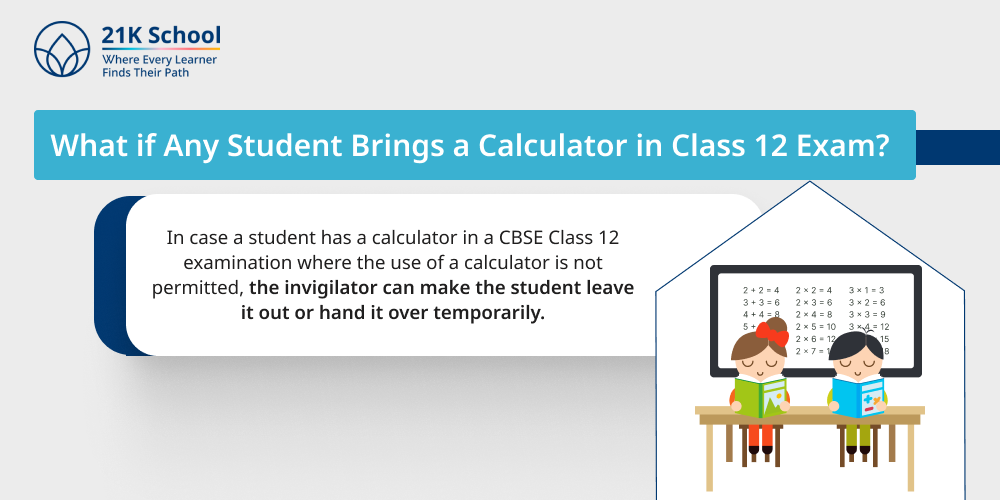
In case a student has a calculator in a CBSE Class 12 examination where the use of a calculator is not permitted, the invigilator can make the student leave it out or hand it over temporarily.
The use of calculators during the exam is said to be against the rules of CBSE and may result in cancellation of the exam, disciplinary measures, or lessening of marks. Learners have to abide by instructions.
Conclusion
The CBSE Class 12 exams mostly do not allow their use as a policy to encourage mental computation, conceptualisation, and solving problems. Although exceptions can be made in case of students with learning disabilities or special needs, the rest of the students have to do manual calculation.
These rules will not only lead to fairness in examinations and the integrity of exams, but also help students gain the critical thinking and analytical skills that they need to pass higher examinations and competitive examinations.

You may also want to read