

ICSE and ISC are different but confuse the first-time hearers including parents and children.
And if you are one of them, we understand your muddle.
ICSE is the board which provides education and takes examinations for the learners of class 10 with basic courses like maths, science, english, and social studies.
Conversely, ISC is the examination conducted for class 12 creating an additional advantage of knowledge among higher-education children who want to get college admissions.
You can also go through IB vs ICSE, for upgrading your knowledge.
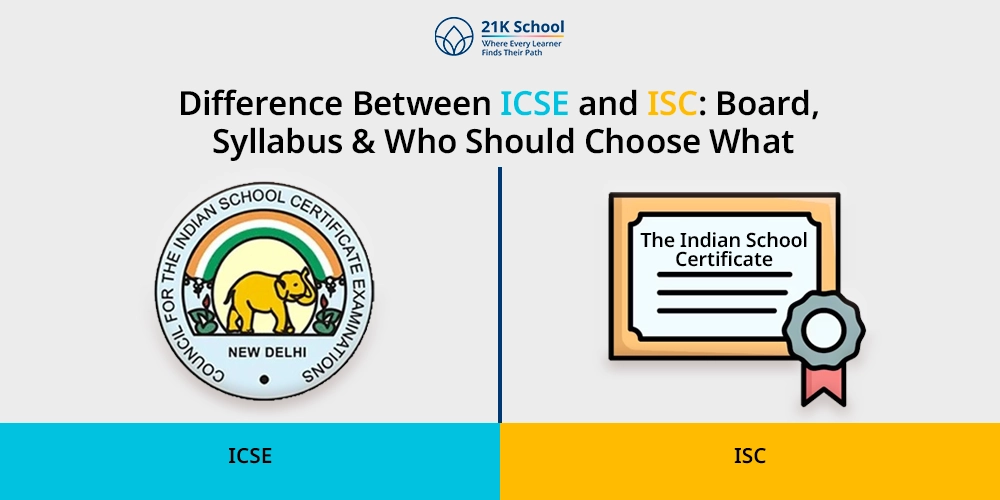
In this paper, both these boards are introduced and the differences between ICSE and ISC is discussed thoroughly.
Before moving further, it should also be mentioned that both the boards are components of CISCE i.e. Council for the Indian School Certificate Examinations.
Contents
Difference Between ICSE and ISC: Major Differences
Both the ICSE and ISC are very good examinations. They are administered by the Council for the Indian School Certificate Examinations (CISCE)which is a private and non-governmental education board in India, founded in 1958.
Although ICSE and ISC are put under the same board, their areas of focus, levels of education and goals dramatically vary.
Let’s understand with a table first.
| Aspect | ICSE | ISC |
| Level of Education | Secondary (Class 10) | Higher Secondary (Class 12) |
| Purpose | To evaluate both basic and general knowledge at school level. | To train students on higher education and professional courses. |
| Curriculum Focus | The equalization of languages, sciences, and humanities. | Extensive specialization in streams of choice (Science, Commerce, Arts). |
| Syllabus Depth | Deep, extensive, and concerned with conceptual analysis. | Gifted and talented, getting ready to college level. |
| Medium of Instruction | English | English |
| Evaluation Pattern | Theory + Internal assessment (project/ practical work) | Theory + Practice/Project (based on subjects) |
| Recognition | National and international | Well known domestically and all around the globe. |
| Student Age Group | Typically 15-16 years | Typically 17-18 years |
| Outcome | ICSE Certificate (Class 10) | ISC Certificate (Class 12) |
1. Level of Education
- ICSE: ICSE is the secondary level and general-based education (Class 10), which is a strong platform to further education.
- ISC: ISC is the short form of senior secondary level (Class 12). In this, students can choose their academic streams based on their career goals.
2. Purpose and Focus
- ICSE: The ICSE is created to find out the overall understanding of a learner and his/her ability to apply interdisciplinary learning.
- ISC: ISC test is career-oriented and it is designed to prepare university-level education among students.
3. Syllabus Depth and Breadth
- ICSE: ICSE identifies a general curriculum that has a teacher-oriented approach based on languages, science, mathematics, and humanities. It encourages critical thinking in addition to applied learning
- ISC: ISC is more specialized as students are able to gain proficiency in certain subjects, with good levels of English, and other electives.
4. Subject Options
- ICSE: English (compulsory), second language (Indian or foreign), social science, mathematics, science, and environmental education.
Read more on benefits of learning a second language in present times for learners.
- ISC: Under arts (History, Sociology, Psychology, Political Science, English, etc.), science (Biology/Computer Science, English, Mathematics, Physics, Chemistry), and commerce (Accounts, Business Studies, Economics, Mathematics, English).
5. Evaluation and Grading
- ICSE: There are external and internal assessments (project/practical work). Mark is awarded to each of the subjects for Groups I and II, in a proportion of 80:20.
- ISC: In this, Group III subjects have a 50:50 distribution, while Group I and Group II subjects follow the same 80:20 split between external and internal tests.
6. Medium of Instruction
- ICSE: English in ICSE as a medium of instruction, makes them fluent and competent in accordance with international standards of academic learning.
- ISC: The students of ISC have performed well in international education systems because the approach used is English-based.
7. Recognition and Global Acceptance
- ICSE: Certified by the Indian and foreign institutions, colleges, and exam boards.
You can refer to some of the international school boards in India that recognize ICSE.
- ISC: ISC candidates are accepted by a number of universities and even compared to the UK qualifications. Still, it would be better if students could clear standardized tests like SAT.
8. Higher Education Prospects
- ICSE: ICSE children have the option of senior secondary curriculum ISC, CBSE, IB, or state boards.
- ISC: The undergraduate programs in India and overseas are open to ISC graduates. ISC syllabus prepares the students for competitions such as JEE, NEET, CLAT, and SAT. It is therefore important to career goals
9. Pedagogical Approach
- ICSE: ICSE pedagogy aims at learning and studying concepts rather than memorizing.
- ISC: ISC pedagogy concentrates on single concept clarification, critical thinking skills, and mastery of the topics.
They both encourage project, in-house review, and interdisciplinary learning, therefore, helping the students to learn the most important 21st century skills.
What is ICSE?
The Indian Certificate of Secondary Education (ICSE) is an examination that is examined at the end of Class 10 and authorized by CISCE.
It replaced Cambridge School Certificate Examination and meet the education needs of the contemporary and diverse student population in India.
Objectives of ICSE
The overall objectives of ICSE for its learners and its institutions conclude as:
- To support practical and project-based learning.
- To evaluate the students by doing a continuous internal test and external test.
- To guide the students to higher learning under ISC or other higher secondary boards.
- To acquire problem-solving skills and cognitive abilities.
- To provide a holistic education, setting a balance between languages, science, and humanities.
Structure and Curriculum
The basic areas of study include:
- Basic subjects: English, second language, history, civics, geography, science, and mathematics.
- Electives: Economics, environmental science, computer applications, commercial studies, etc.
- Assessment: It will involve a mixture of written tests and internal examinations, which will make sure that there is a comprehensive growth.
The strength of the ICSE curriculum is that it is conceptually rich and analytical in the way it focuses on learning. Thus it is highly regarded by the teachers and universities.
What is ISC?
At the end of the 12th class, a test is held, called the Indian School Certificate (ISC).
It determines the knowledge and preparation of higher education among the students in different streams.
Objectives of ISC
ISC has certain objectives that differ slightly from those of icse. These are as:
- To improve analytical abilities and communication with the help of the English language and interdisciplinary topics.
- To encourage subject specialisation.
- To equip the students with university-level studies.
- To mould the theoretical and practical advancements hand in hand.
- To come up with balanced, globally competitive human beings.
Structure and Curriculum
The subject distribution in ISC looks like the following:
- Streams: Science, commerce, and arts/humanities.
- Subjects: The students will choose English (mandatory) and three to five elective subjects.
- Evaluation: Theory, internal evaluation and practicals (where applicable).
ISC curriculum is a well-recognized curriculum characterized by academic rigor, richness of content, and emphasis on research and presentation skills.
Concluding Points
ICSE and ISC are crucial in the formation of academic experiences of the students under the CISCE board.
ICSE is prepared with the groundwork of conceptual focus and an outlook of balance in the disciplines.
ISC is also based on the same, but it also provides specialization and readiness to higher education and career directions.
Altogether, ICSE is broad and ISC is where specialisation begins.
Together, both of them can be considered the philosophy of the CISCE that implies providing balanced, and internationally-recognized education.

You may also want to read