

We all know about various popular boards in India including the Central Board of Secondary Education that offers standardized exams to build the careers of students.
One of the key types of assessment known as CBSE open book exam is getting popularity due to its unique open book feature.
According to the latest CBSE board guideline, an open book exam for Class 9 is announced in the 2026-27 academic year.
This blog is all about addressing every detail of the CBSE open book exam. Let’s begin!
Contents
- What is CBSE Open Book Exam?
- Objective to Introducing CBSE Open Book Exam
- Types of CBSE Open Book Examination
- How Students Should Prepare for CBSE Open Book Exams?
- CBSE Open-Book Exam Circular
- Benefits of CBSE Open-Book Exam
- Preparing for CBSE Open-Book Exams: Best Strategies
- CBSE Open-Book Exam vs CBSE Closed-Book Exam: Key Difference
- Common Myths About CBSE Open Book Exam
- Challenges and Concerns of CBSE Open Book Exams
- Conclusion
What is CBSE Open Book Exam?
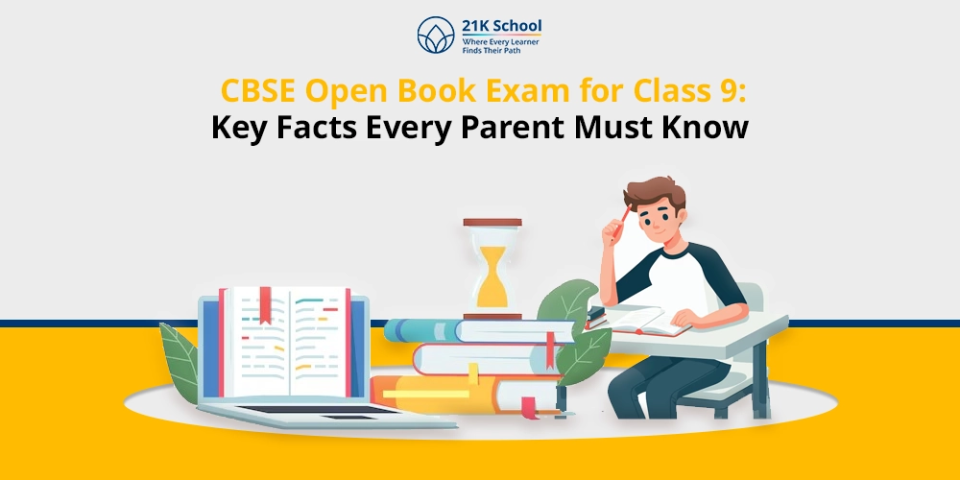
The CBSE open-book exam is an assessment announced by the Central Board of Secondary Education in which students can use any reference book, class notes or textbook during the examination.
The open book exam is different from traditional exams in which students can write answers by remembering everything from memory. The board aims to improve problem-solving ability and knowledge of students.
In traditional examinations students used a rote learning approach while in open-book exams students get the opportunity to write by searching answers in the books.
Objective to Introducing CBSE Open Book Exam
The open book exam by CBSE is a transformative step towards the education system in India. The key objective is to promote students’ analytical abilities and practical application of knowledge.
Go through some key points to understand the objectives in-depth:
1. Move Away from Rote Learning
The CBSE open book examination is an ideal opportunity to move away from traditional rote learning. Instead students are able to understand how to learn through analytical approach and application-based education.
It promotes a deep learning and better understanding of concepts.
2. Encourage Critical Thinking
Open book examinations encourage students to enhance their critical thinking skills by providing the environment to research and write answers.
Teachers in open book examination set the question paper based on:
- case studies
- scenario-based questions
- problem-solving tasks
This helps them to think critically to understand the questions and write customised answers instead of copy pasting from books.
3. Align with NEP 2020
NEP 2020 promotes open book exams because it recommends competency-based education instead of rote memorisation.
Open book assessments are perfectly aligning with NEP 2020 to improve modern education in India.
4. Reduce Exam Anxiety
CBSE open book exams for Class 9 are a great approach for students who are afraid of examinations due to various factors like getting difficulties to retain information.
However, it’s important for students to understand the relevant way to prepare for examinations to get good marks.
5. Application-Oriented Education
Open book examinations offer application-oriented education which means students understand information, analyse data to resolve problems.
In the CBSE open book exam students use reference materials to apply information in the right manner. In this way students are prepared to deal with real life challenges.
Types of CBSE Open Book Examination
There are two main types of CBSE open book examination
1. Restricted Open Book Assessment
In restricted open book assessment, students are allowed to use only the study material approved by the exam-conducting authority.
The objective of this type is to maintain fairness in the examination without lacking the quality. The material mainly includes prescribed textbooks, class notes, or printed reference sheets.
2. Free Type Open Book Assessment
In free type open book assessment, students are flexible to choose any material as per their need. For example, any textbooks, notebooks, reference guides, or other relevant resources.
The format promotes students to gather information from multiple sources to enhance research-based learning.
How Students Should Prepare for CBSE Open Book Exams?
Open book exam is a new format for students of Class 9 which offers an opportunity to study with modern approaches. Students often get confused about how to prepare for the CBSE open book exam.
1. Shift from Memorisation to Understanding
By shifting from memorisation technique to deep understanding approach students are able to align with open book assessment.
Instead of remembering definitions, formulas, and long answers, individuals can analyse, understand, and apply concepts.
In this way, one can quickly identify from which page the information is taken.
2. Organise Study Materials Effectively
One of the crucial parts of the open book exam is organising study materials effectively. Arranging everything from textbooks, class notes to reference materials for examination.
A well-organised study material helps in finding answers effectively without wasting time. Understand the key concept and create a summary of concepts to retain information.
3. Develop Efficient Time Management
Time management skill in CBSE open book exam is crucial for any student which requires regular practice.
Develop time management skills to avoid rush or stressful situations in the examination. This can be done by prioritising time management strategies during practice sessions.
4. Exam Day Strategy
On exam day students must be confident and focus on concept understanding instead of taking pressure of knowledge retention.
Through conceptual learning students can perform better during the exam.
CBSE Open-Book Exam Circular
CBSE is introducing open-book assessments (OBAs) for Class 9 students. Some of the key considerations are:
- Implementation Year: Starting from the 2026-27 academic session.
- Target Grade: For Class 9.
- Subjects Covered: Languages, Mathematics, Science, and Social Science.
- Format used: The assessments will be integrated into the three existing pen-and-paper tests.
- Resources Allowed: Textbooks, class notes, and approved materials in the examination hall.
- Guidance: New format question paper designed by teachers.
Benefits of CBSE Open-Book Exam
CBSE introduced an open book exam for class 9 to improve the quality of modern education in India. This transformative step helps students in various ways.
Key benefits of CBSE open book exam are:
1. Encourages Higher-Order Thinking
The open book exam by CBSE encourages students to develop high-order thinking skills such as analysis, evaluation, and problem-solving.
It promotes the idea of interpretation and implementing ideal solutions instead of writing direct answers in open book exams.
Teachers can promote higher-order thinking in the classrooms to make students ready for open book exams. They can ask open-ended questions, incorporate real-world problems, and provide feedback.
2. Reduces Exam Anxiety
Students often feel exam anxiety in traditional assessment due to various reasons such as failure of fear, low self-esteem to remember information etc.
Open book exams follow a unique format in which students can appear in the exam with study material. It helps in increasing confidence and reducing exam stress.
3. Simulates Real-World Conditions
Open book examination is beneficial for simulating real-world conditions by allowing students to use materials.
In this way, students are able to develop practical problem-solving skills and prepare them for future academic and professional challenges.
4. Promotes Better Retention
Students who prepare for open book exams often repeatedly analyse information in books and notes which directly help them to remember.
It is an ideal mechanism where students don’t try to retain information. Instead they analyse, which results in high retention.
5. Enhances Study Skills
Open book assessment enhances the study skills of students by giving them opportunity to understand chapters, concepts, making notes, and reference books.
It is an ideal way of motivating students for lifelong learning.
Preparing for CBSE Open-Book Exams: Best Strategies
To prepare for CBSE open-book exams students require effective strategies which help them to get good marks. Given below are some key points one must consider:
1. Practice Application-Based Questions
Practicing application-based questions by solving sample papers, case-study questions etc. It helps in improving their ability to apply theoretical knowledge to real-life situations.
Remember to write in your own words instead of copy pasting from material.
2. Time Management
One of the key strategies of the open book exam is time management. Searching for information in material can take a lot of time in the exam.
Practice at home to improve the speed of searching and writing answers without hampering presentation.
3. Understand the Syllabus Thoroughly
Understanding the syllabus thoroughly can help students in identifying which topics are most important and how different concepts are connected.
Remember to go through each section to make sure the question is from which part of the syllabus.
CBSE Open-Book Exam vs CBSE Closed-Book Exam: Key Difference
Let’s understand the specific differences between CBSE open-book exam vs CBSE closed-book exam with the help of a table and some bullet points:
| S.No. | Aspects | CBSE Open-Book Exam | CBSE Closed-Book Exam |
| 1. | Learning Style | Focuses on conceptual learning and understanding of topics. | Focuses mainly on memorisation and recalling information learned during study. |
| 2. | Study Method | Study by understanding concepts, organising notes, and practicing analytical questions. | Often rely on rote learning, memorising definitions, formulas, and answers. |
| 3. | Question Pattern | Application-based and case-study based. | Mostly direct, theoretical, and practical based. |
| 4. | Focus | Focus on: Problem-solvingReasoningInterpretationReal-life application of knowledge | Focus on: Memory recallWriting learned answersReproducing textbook content |
| 5. | Use of Books | Textbooks, notes, or reference materials. | Books, notes, and study materials. |
Common Myths About CBSE Open Book Exam
Parents and students often believe in various myths circulating about the CBSE open book exam. Let’s debunk some common myths:
1. Myth: Open Book Exams are Easy
People often believe that open book exams are easy. However, that’s not true. In reality, open book exams are difficult because they are designed to examine application, analysis, and higher-order thinking skills (HOTS) of students instead of memory.
2. Myth: I Don’t Need to Study or Prepare
Students often think of writing answers from the book without studying or preparation. But, it is not that simple.
Without in-depth concept understanding and speed research ability students lack to perform well in open book exams.
3. Myth: There is No Time Pressure
Students often misunderstood that they have no time pressure in open book exams. However, the reality is different.
Students who manage time in open book exams are able to achieve good marks. Remember that spending too much time in search for information can lead students to run out of time to write the answers.
4. Myth: It Will Replace All Traditional Exams Immediately
One of the myths is that open book exams will replace all traditional exams immediately.
However, in reality, the shift is gradual and will start with a pilot for Class 9 in 2026-27, focusing on core subjects including languages, mathematics, science, social sciences etc.
Challenges and Concerns of CBSE Open Book Exams
There are various challenges and concerns of CBSE open book exams which can impact the learning of students. Understand some common challenges to avoid:
1. Time Pressure
Time management plays a key role in open book examinations. Students often assume that writing from a book is easy, but it is not.
The question paper is designed according to analytical and application-based standards. It requires excessive research technique and speed.
2. Poor Preparation
Students due to research pressure avoid a good presentation while writing which can lead to low marks.
Copy pasting direct answers is not an ideal way of writing in an open book exam. Students who don’t prepare early often find difficulty understanding the question and answer in the wrong way.
3. Teacher Training Requirements
Introduction of open book exams in the school requires trained teachers who can handle the examination environment.
Lack of training can lead to difficulty in adapting the new format. To avoid this, the school can conduct seminars and training programs for teachers.
4. Question Design Difficulty
One of the challenges of open book exams is question design difficulty. It means if the questions are directly picked up from books they can undermine the fairness of the examination process.
While too complex questions lead to confusion and struggle to attempt.
5. Possibility of Misinterpretation
Open book examinations are different from traditional exams. Open book exams use descriptive and scenario-based question papers.
That’s why students often misinterpret questions and write incorrect answers which directly leads to low marks.
Conclusion
CBSE open book exam is an opportunity for students in class 9. However the new method often comes with some challenges like understanding the new format and practice accordingly.
The open book exams by CBSE provide a new way of evaluating students’ performance by providing analytical and application-based questions.
We hope this information helped you to understand about the CBSE open book exam and how it is different from traditional methods.

You may also want to read