

Intelligence and intellect are words that are common in practice. We switch between them everyday unaware of the fact that both are different.
Parents and educators who also do the same should read this article and find the difference between intelligence and intellect.
This way you could easily decide if your kid is born intelligent or intellectual, and which areas they need to still work on to boost their lifelong learning .
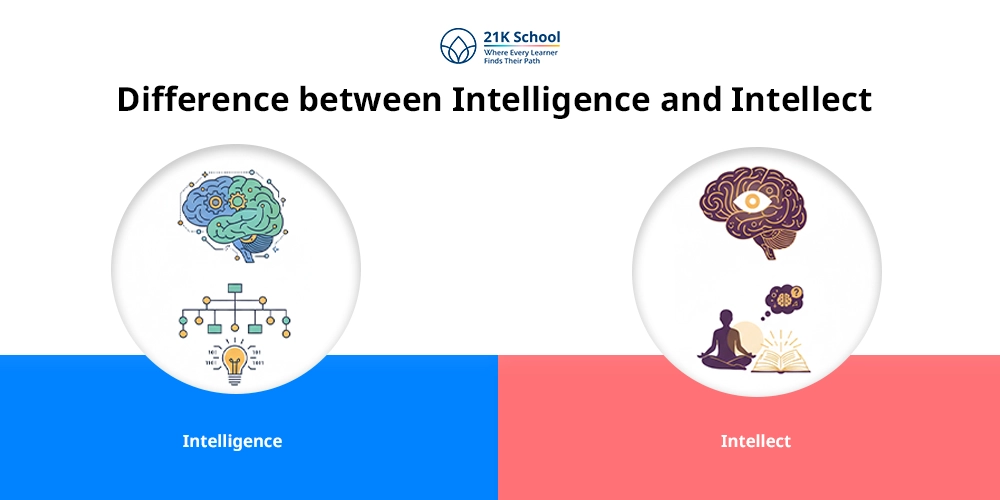
For a brief description, intellect is about deeply processing information based on one’s own reasoning and comprehension. While intelligence enables one to live their life and solve day-to-day issues effectively on their end.
Contents
Key Differences between Intelligence and Intellect
Some specific and obvious differences between intelligence and intellect would be mentioned in the table and then pointwise.
| Aspect | Intelligence | Intellect |
| Nature of Thought | Practical, adaptive, solution-oriented | Analytical, abstract, reflective |
| Application | Everyday life, quick decisions, social situations | Deep thinking, theories, interpreting complex ideas |
| Emotional & Social Aspect | Strongly connected to emotional and social intelligence | More detached from emotions; focuses on rationality |
| Scope | Broad. Includes creativity, emotions, logic, practical skills | Narrower-focused on reasoning and analysis |
| Innate vs Cultivated | Partly inborn but can be developed | Mostly inborn ability. |
| Example | Solving a real-life problem quickly | Writing a philosophical argument or analyzing a concept |
| Relationship | Helps in performing tasks effectively | Helps in understanding tasks deeply |
1. Nature of Thought
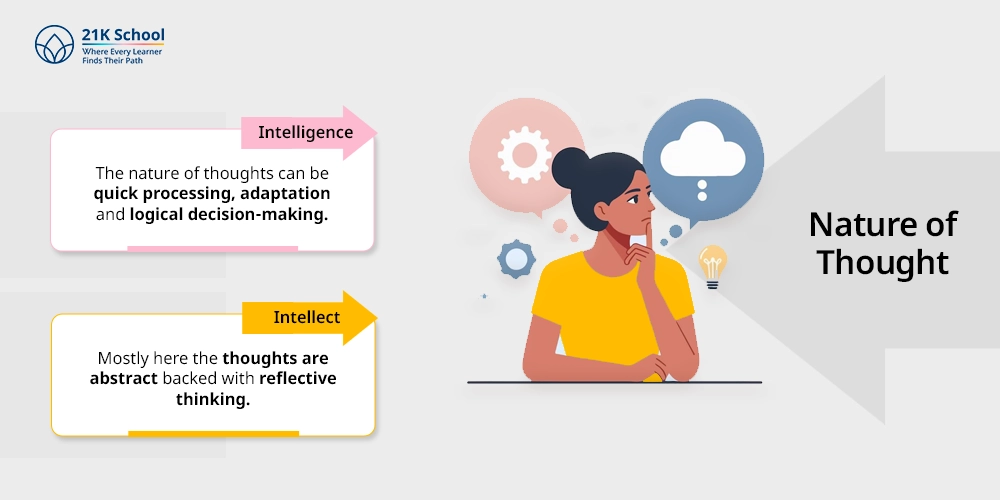
- Intelligence: The nature of thoughts can be quick processing, adaptation and logical decision-making .
- Intellect: Mostly here the thoughts are abstract backed with reflective thinking.
2. Application
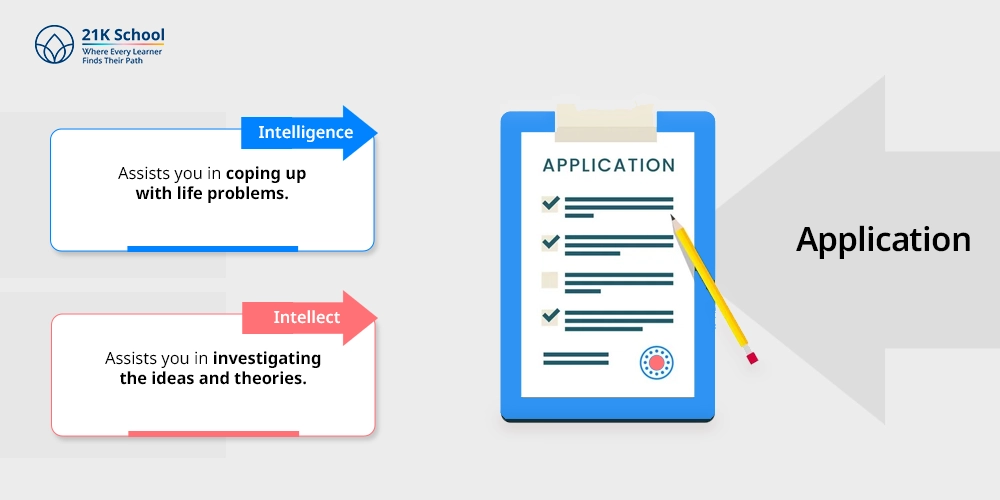
- Intelligence: Assists you in coping up with life problems.
- Intellect: Assists you in investigating the ideas and theories.
3. Emotional and Social Intelligence
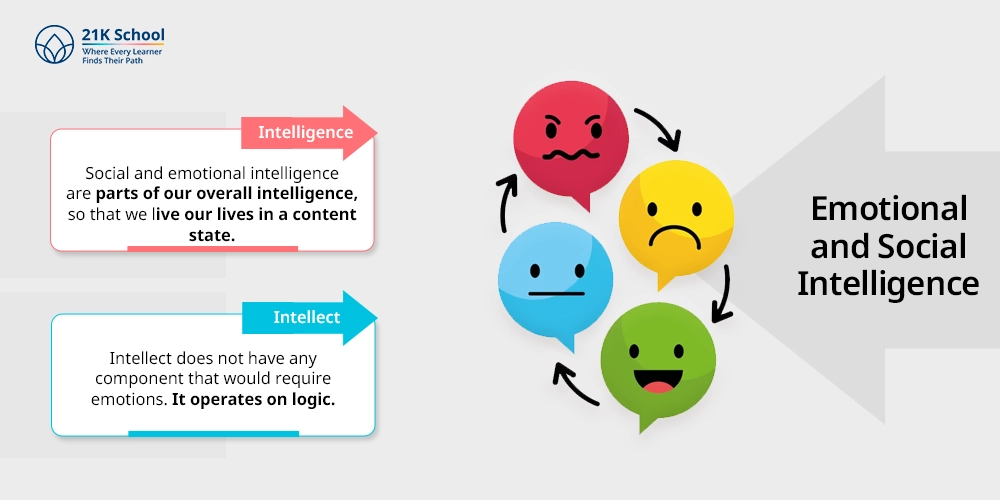
- Intelligence: Social and emotional intelligence are parts of our overall intelligence, so that we live our lives in a content state.
- Intellect: Intellect does not have any component that would require emotions. It operates on logic.
4. Scope
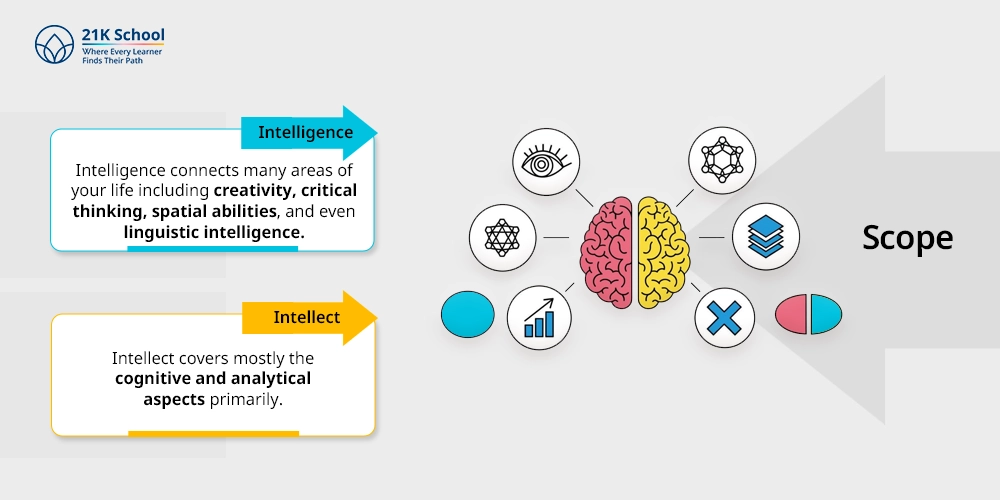
- Intelligence: Your intelligence connects many areas of your life including creativity, critical thinking , spatial abilities, and even linguistic intelligence. Thus it is multi-dimensional.
- Intellect: Intellect covers mostly the cognitive and analytical aspects primarily.
5. Innate vs. Cultivated
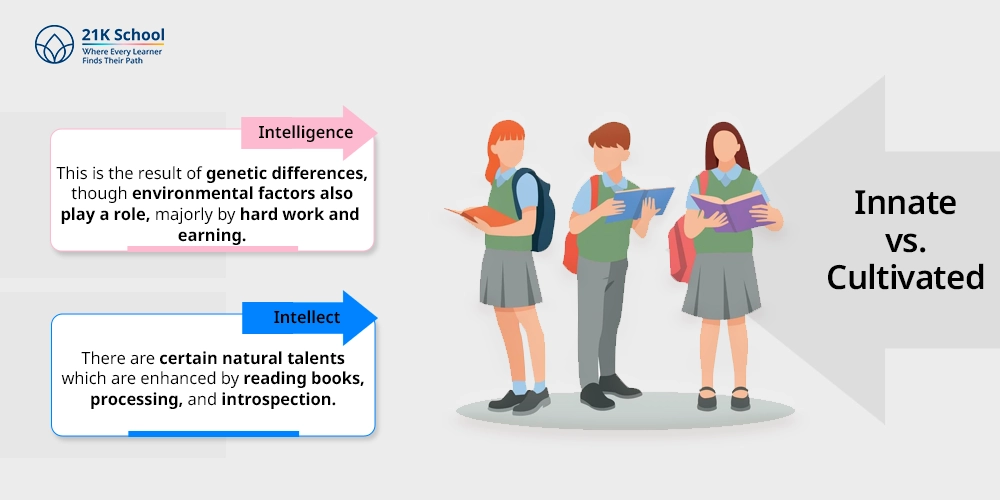
- Intelligence: This is the result of genetic differences, though environmental factors also play a role, majorly by hard work and learning .
- Intellect: There are certain natural talents which are enhanced by reading books, processing, and introspection.
Before moving ahead, explore some benefits of reading books .
6. Example
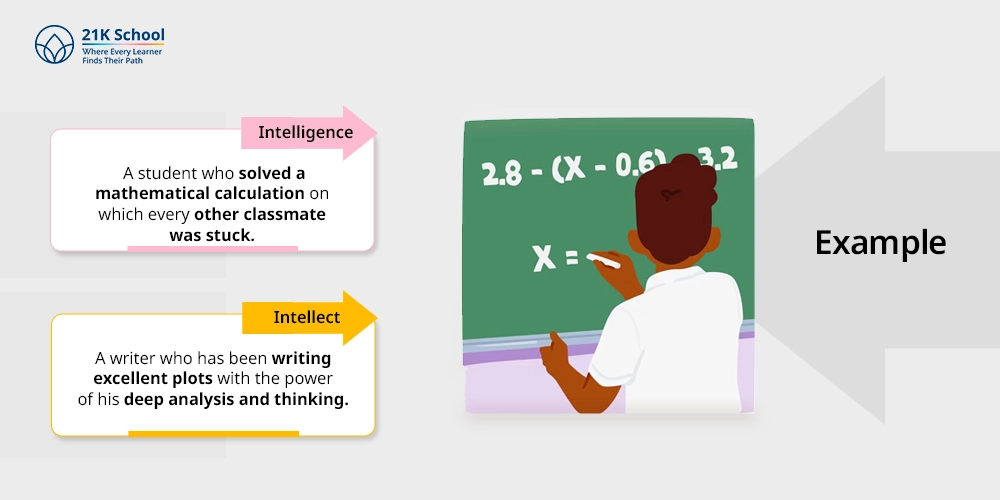
- Intelligence: A student who solved a mathematical calculation on which every other classmate was stuck at, he will be mathematically intelligent.
- Intellect: A writer who has been writing excellent plots with the power of his deep analysis and thinking.
7. Relationship
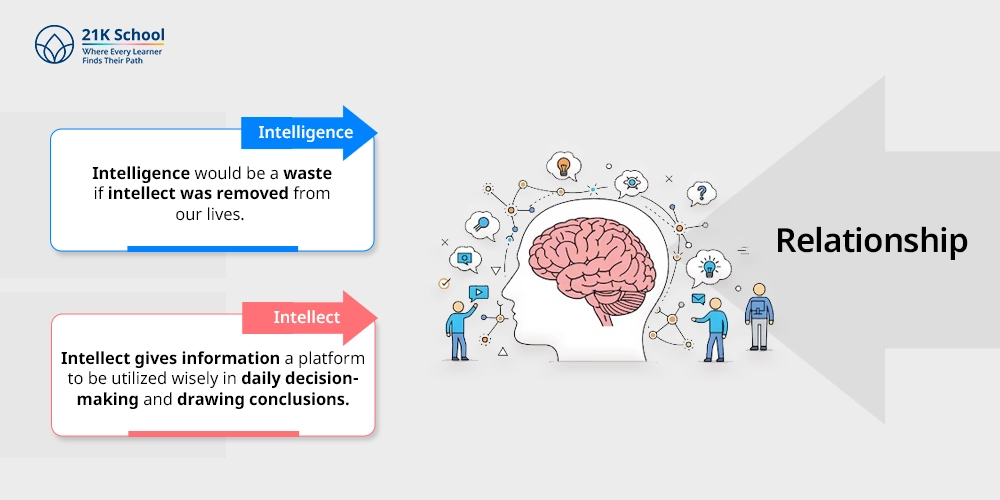
- Intelligence: Intelligence would be a waste if intellect was removed from our lives.
- Intellect: Intellect gives information a platform to be utilized wisely in daily decision-making and drawing conclusions.
What is Intelligence?
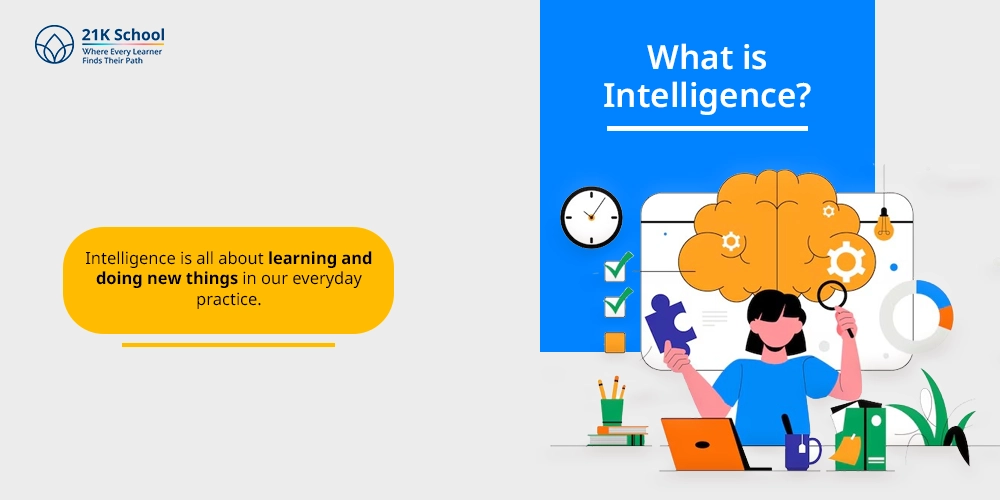
Intelligence is all about learning and doing new things in our everyday practice.
If you have acquired or are still acquiring knowledge and skills , your intelligence is functioning accurately.
In daily lives, intelligence might look like being good at either dancing, singing, maths problem-solving , nature-watching, drawing, or anything else.
Intelligence can be attained, increased, or decreased with time and efforts, and can be more or less depending on the person.
Types of Intelligence
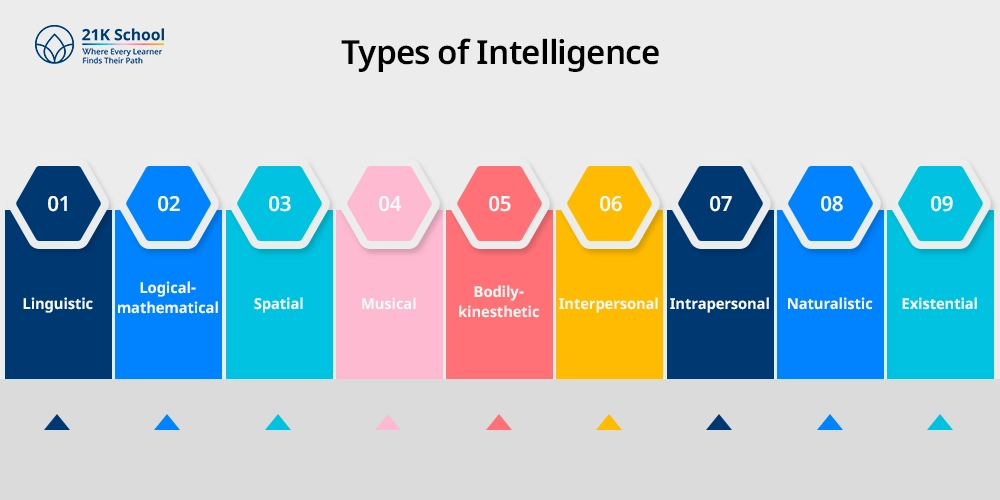
Though there are many intelligence theories based on which its classification has been done.
Here, we would be mentioning 9 types of intelligence stated by Howard Gardener:
- Linguistic: Being good with languages. It is the ability to use words in a conversation and written words.
- Logical-mathematical: It sums as the capacity for reasoning, number manipulation, solving maths problems, and logical associations.
- Spatial: Having skills to see things clearly and having an idea of spaces. Like it can be reading maps, or being good at remembering directions.
- Musical: Having ears for music that gives you the ability to differentiate scales, rhythm, and other aspects of music smartly.
- Bodily-kinesthetic: A type of intelligence to move your body parts and control it gracefully as you want.
- Interpersonal: The ability to communicate and understand other’s views.
- Intrapersonal: Having a positive relationship with ownself where you understand yourself and your strengths and weaknesses.
- Naturalistic: Skills to learn and notice differences in varied plants and animals.
- Existential: It deals with sensitivity and capacity to tackle deep questions about human existence.
What is Intellect?
Intellect is the capacity to reflect deeply and think abstractly while philosophising on ideas with both economical and theoretical reasons.
It is reflective instead of being reactive.
Those with high intellects might love reading, researching,discussing, speculating, or solving difficult puzzles which involve adequate analysis.
They have the capability to think better than others involving more intense learning and diving into the depths of concepts.
These individuals normally can be seen challenging old thinking and drawing their new conclusions based on relevant facts and concept mapping .
Characteristics of Intellect
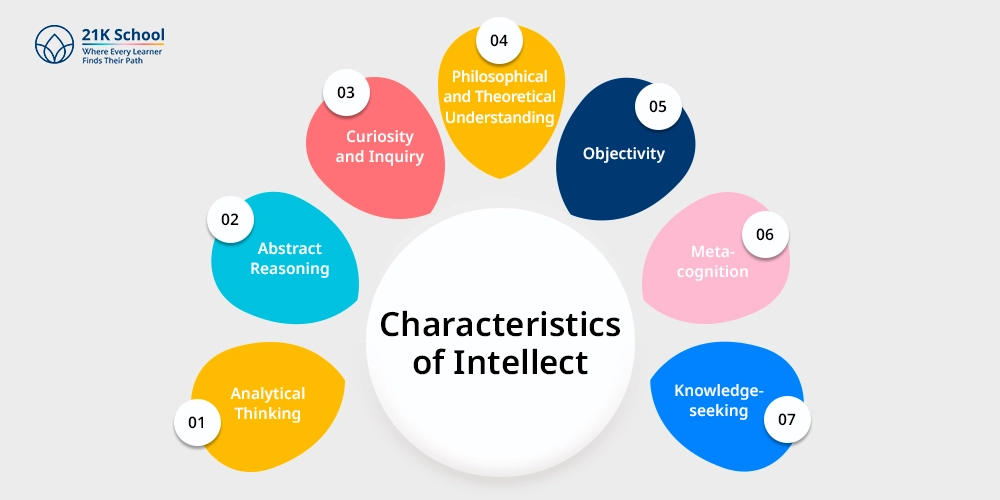
These features define how intellect can be differentiated from intelligence.
- Analytical Thinking: The capability to refer to proper resources and comprehend problems to lead to viable solutions.
- Abstract Reasoning: Imagining beyond normal thinking and finding conclusions that make sense.
- Curiosity and Inquiry: Intellect is also dependent on curiosity of individuals who never stop learning and remain inquisitive throughout life.
- Philosophical and Theoretical Understanding: Amalgamation of concepts like ethics, existence, values, and systems, leading to reasoning.
- Objectivity: Capacity to remove emotions and interpret things reasonably.
- Meta-cognition: Reflection which involves thinking about the thinking process. Thoughts about the nature, of the way you think, and why you arrive at a given judgement.
- Knowledge-seeking: Curiosity to learn (with the aim of knowing) and not merely because of its practical value.
Conclusion
Intelligence and intellect are related, but different at the same time.
Now, you might be clear that intellect has a deeper sense of knowledge acquisition leading practical reasoning during daily challenges.
Intelligence is normally a way to learn, know, acquire skills, and execute them as life goes on.
Someone can have intelligence, someone might have intellect, but both of these can be increased to a certain extent with consistent efforts and practice.
But what needs attention is, both these ideas should be present in a person for them to become real-life success stories in future.

You may also want to read