


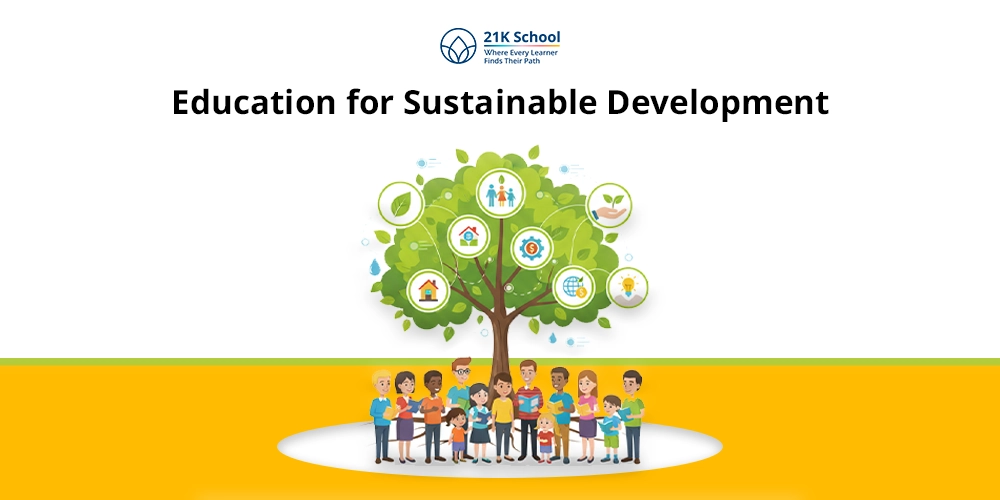
Sustainability is compulsory in present times for each and every student who is going to form the future world.
They should be taught how we need to change our daily practices from early childhood education to save it.
Keeping that in consideration, UNESCO has presented the idea of Education for Sustainable Development. It aligns confidently with the Sustainable Development Goals (SDGs), especially the SDG 4.7.
To bring educated changes in the human-approach towards nature and its blessings, ESD has to be implemented seriously all over the world.
The below article gives you the idea of Education for Sustainable Development, its significance, challenges and its future outlook.
Contents
- What is Education for Sustainable Development?
- Importance of Education for Sustainable Development
- Core Principles of Education for Sustainable Development
- Implementing Education for Sustainable Development in Schools and Universities
- Challenges in Implementing Education for Sustainable Development
- Future of Education for Sustainable Development
- Concluding Comments
What is Education for Sustainable Development?
Education for Sustainable Development enables us to tackle issues like poverty, climate change, and inequality with the help of required skills and attitudes.
With this, we can make informed decisions for economic stability, environmental concerns, and equality in general society.
We humans have been exploiting the natural resources for centuries of our existence without double-checking up on nature’s well-being.
We had forgotten that we are too a part of this nature and we cannot imagine living in the absence of nature.
ESD encompasses practices that can educate students on smartly utilising nature, so that this planet could be saved.
They are to include sustainability into the education of learners to create a nature-friendly future ahead.
Importance of Education for Sustainable Development
The main benefits of Education for Sustainable Development might include the following:
1. Building Environmental Awareness
Global issues such as global-warming, pollution, and deforestation need civilians who have knowledge about the environmental systems and the human-effects on them.
ESD develops environmental literacy so that the learners understand the complexity of the ecosystem and the need to conserve its resources.
It is upon this knowledge that people will be more inclined to embrace sustainable practices including waste reduction and energy conservation.
2. Promoting Social Responsibility and Equity
The concept of sustainability goes beyond the aspect of just conserving the environment.
It also encompasses the factors of social justice, equity, human rights, and cultural diversity.
ESD assists the learners in gaining knowledge about global inequalities to see how social-discrimination and poverty can be overcome.
With ESD, creating inclusive communities becomes easier where all people have equal access to succeed, thus reflecting empathy and social responsibility.
3. Encouraging Economic Literacy
The future needs a sustainable environment.
This would require a strong economic system that makes sure that our environment as well as the society are protected and evolving.
ESD promotes the knowledge of sustainable economic activities.
In this, the concepts of a circular economy, responsible consumption, and ethical trade to reconcile socio-economic and environmental welfare are common.
This prepares the learners to be agents of innovative solutions that enhance economic sustainability.
4. Fostering Sustainable Development
ESD encourages sustainable development in all major aspects of human evolution.
It is focused on emphasizing the rooting causes of natural depletion in the society and how it can be avoided in upcoming times.
Sustainability speaks about a balance between human consumption where all beings are treated equally to maintain the environmental stability.
This can only be possible when learners are aware enough to understand that there are enough resources for everyone on this planet if utilized wisely.
5. Supporting Critical and Creative Thinking
ESD is far beyond just remembering facts and figures, involved in rote learning .
It encourages the skill of critical thinking , the ability to examine complicated issues and come up with creative solutions.
These are the competencies that will help to deal with the uncertainties of the 21st century and make informed decisions that can help in sustainable development.
6. Empowering Active Citizenship
ESD is out to create active global citizens.
These are people who would contribute to the decision-making process of the community to master positive change, and participate in sustainable practices.
The skills are applied practically to enable learners to participate in societal-development through real-life problem-solving activities , and educational teamwork projects.
Core Principles of Education for Sustainable Development
The following listing explains the core principles on which ESD is based on:
1. Holistic and Interdisciplinary Learning
The issues of sustainability can be seen to overlap at the environmental, economic, and social levels.
ESD promotes holistic education in a way that can express interconnected relationships between all areas of growth of a learner and environment.
This is because climate change is a study topic having the essence of science, geography, history, morals, and economics, supporting interdisciplinary learning .
2. Lifelong Learning and Continuous Growth
The concept of sustainability is a dynamic one and students should be taught even outside of the schools.
ESD leads to lifelong learning that stays with you internally to save the planet.
3. Participatory and Learner-Centered Teaching
ESD is based on active-involvement, communication skills , collaboration, and leadership skills .
Students are taught to share their views and meaningfully contribute to the discussions without hesitating further.
4. Local and Global Relevance
Although the sustainability problem is universal, it is experienced at different levels in different places.
ESD makes learners aware of the fact that global change begins from local-level steps only.
Therefore, regular action should be taken to save the culture and biodiversity of a region.
5. Values-Based Learning
ESD supports ethical principles including responsibility, empathy, respect, and solidarity.
These are values which aim at building a sustainable behaviour and choice.
6. Future-Oriented Thinking
To build learners with a sustainable future in mind, it is important to predict the future implications, and be aware of risks.
ESD promotes proactive and visionary thinking with the view of creating a favorable future.
Implementing Education for Sustainable Development in Schools and Universities
Since Education for Sustainable Development is required immediately, the following methods of implementation can assist in the process.
1. Integrating ESD into Curricula
Sustainability can be integrated into the conventional school curriculum by adding the green ideas to major subject areas.
This can be done by teaching scientific renewable energies, human effects on climate, biodiversity being at risk, and importance of economic stability in future.
Events of cultural heritage, environmental ethics, and social justice can be addressed even in the social studies subjects.
2. Hands-On and Community-Based Learning
Sustainability issues can be presented through field-trips, environmental initiatives, sustainability organizations, clean-up campaigns, and other community services.
Such activities enable the learners to use what was taught in the classroom in practical situations.
3. Training Educators and School Leaders
In order to provide sustainable education , the teachers should be well-trained in the application of ESD.
Professional development initiatives can assist the teaching faculties to incorporate the concept of sustainability in their day-to-day instructions.
4. Creating Sustainable School Environments
Schools can be sustainable when they reduce plastic use, embrace recycling, conserve energy, promote environment-friendly transportation, and provide green areas in schools.
These practices offer strong pedagogical techniques for natural conservations for the students.
5. Collaboration with Communities and Organizations
Global awareness can be enhanced by partnership with local communities, environmental organizations, and non-governmental organizations.
Learners may also put sustainability efforts through internships organized by the broader community.
These internships offer them practical experience and create exposure in-the-field of sustainability issues.
Challenges in Implementing Education for Sustainable Development
The challenges in the path of implementing sustainable education can be the following:
- Rigid Curricula: The traditional education approaches tend to be test-based, which lack the flexibility of interdisciplinary learning demanded by ESD.
- Lack of Resources and Training: Most institutions of learning lack financial assets and teacher training that can successfully incorporate ESD.
- Cultural and Political Barriers: Some sustainability issues, like social justice or climate change, might be political, which may influence the inclusion of the topic in learners’ curricula.
- Limited Awareness: The awareness of the educational significance of ESD is weak which has resulted in uneven application.
Future of Education for Sustainable Development
The future of ESD consists of the use of innovative technology and global cooperation.
ESD can be made available with the help of online courses, virtual simulations, MOOCS, and interactive digital content.
The world-scale projects can be sponsored by the collaboration of governments, NGOs, global organizations, and academic institutions.
These can be based on the principles of the implementation of sustainability into the education systems of all countries.
Also, the emergence of green employment and low-carbon industries translates to the fact that the future jobs of the 21st century will require knowledge and skills of sustainability.
ESD equips learners with these opportunities as they assist societies to shift towards more environmentally-friendly and equal economic systems.
Concluding Comments
Education for sustainable development speaks volumes as the need of the hour in educational settings.
Without the incorporation of ESD, we might witness a world with no healthy air to breathe, no food to eat, no energy to operate, and no water to drink.
ESD focuses on overall development of students along with developing ideas of conservation and efficient future-planning for saving earth.
Though the challenges lie in the pathway to successful implementation of ESD, a collective effort from each individual on local as well as global level can shift scenarios positively.
And this is possible through awareness among everyone.
