


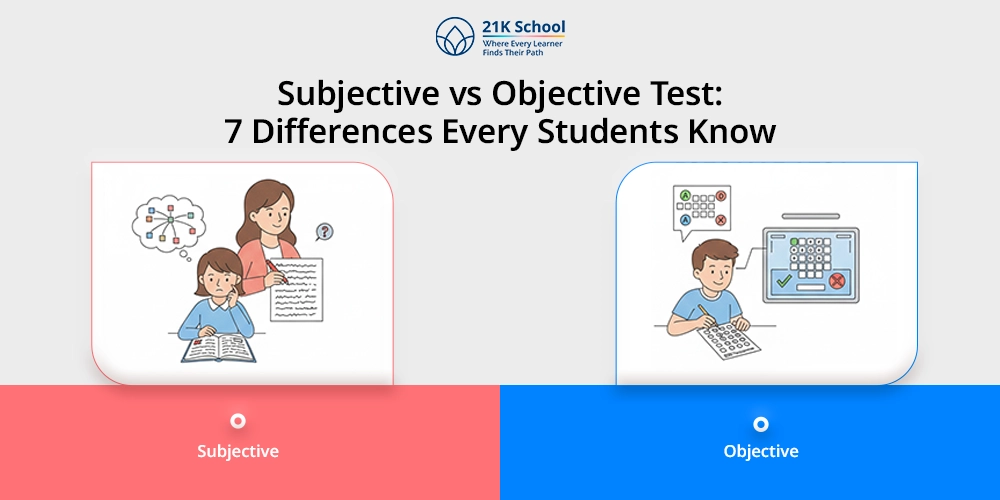
Tests have always been a part of our evaluation system since we have known learning and education .
So, you might be knowing that these tests are classified as subjective tests and objective tests.
Objective tests require less complex cognitive thinking, unlike subjective tests which involve higher-order thinking and comprehension.
In this article, we will understand subjective vs objective tests in a comprehensive manner.
Contents
What is a Subjective Test?
Subjective tests are focused on comprehension, analysis, clear expression of ideas, and skill demonstration of learners.
A subjective test is a form of testing that involves creativity and deeper thinking to curate an answer in long form.
Such tests can have a very broad spectrum for evaluating students’ responses, and thus, make it challenging for teachers to evaluate.
1. Common Types of Subjective Questions
Subjective questions include the following:
- Short answer questions: Answers in a few sentences.
- Open-ended questions: There can be several correct answers or interpretations.
- Analytical/problem-solving questions: Involve justification or reasoning.
- Case studies: Practice of concepts in the real world setting.
- Descriptive writing questions: Explanation-based answers.
- Essay questions: Descriptive, lengthy, and showing knowledge .
2. Characteristics of Subjective Tests
The following can be the features of subjective tests:
- Open-ended answers: There are no structured items/pre-set responses.
- Requires evaluator’s judgement: Scoring is dependent on interpretations of the evaluator.
- Evaluation of higher-order thinking skills: Analyzing critical thinking, creativity, logic, and communication.
- Time-consuming: It takes more time to write and evaluate it.
- Promotes thorough learning: Students describe the concepts in an elaborate manner.
- Limited possibility of guessing: The responses should be formed rather being chosen out of a few given options.
Comprehension, reasoning, and expressive skills are best tested through the use of subjective tests.
What is an Objective Test?
The objective test is one in which all questions can be given a specific and definite answer.
The aims of these tests are to make the scoring consistent and minimize subject interpretation by teachers.
Objective tests are aimed at recall, recognition, accuracy, and immediate assessment.
1. Common Types of Objective Questions
The following list of questions can be included in objective questions:
- True/False questions
- Fill-in-the-blank questions
- Matching-type questions
- One-word or one-line answer questions
- Multiple choice questions (MCQs)
2. Characteristics of Objective Tests
Objective tests generally have the following features:
- Fixed answers: Only one answer would be correct or best.
- Standardized or automatic scoring: Uses answer keys or computerized programs.
- Recall and comprehension: Focus on the fundamental knowledge and concepts.
- Covers extensive syllabus: It has numerous conceptual questions.
- Appropriate for larger groups: The best with competitive and standardized tests.
- Guessing is possible: MCQs or the True/False mean that students can guess the answer.
Subjective vs Objective Test: 7 Key Differences
The following table and bullet points will easily comprehend subjective vs objective tests, along with the bullet points descriptions.
| Feature | Subjective Test | Objective Test |
| Nature of Responses | Descriptive, open ended responses | Fixed, predetermined answers |
| Evaluation Process | Evaluator judgment, subjective scoring | Standard scoring through the use of an answer key |
| Skills Assessed | Critical thinking, analysis, synthesis, evaluation | Memorization, recognition, comprehension |
| Time Required | Takes longer to write and grade | Quicker to answer and grade |
| Guessing Factor | No scope for guessing | Guessing is possible |
| Coverage of Syllabus | Limited due to lengthy answers | Extensive coverage since the number of short questions is large |
| Suitability | For analysis of theoretical topics | For testing factual and procedural knowledge |
1. Nature of Responses
- Subjective Test: Students write descriptive and analytical answers.
- Objective Test: The students give short answers which are fixed.
2. Evaluation Process
- Subjective Test: In subjective tests, the test depends on the teacher and his interpretation.
- Objective Test: Definite answers are used as the means of scoring objective tests, which minimizes bias.
3. Skills Assessed
- Subjective Test: Subjective tests measure creative thinking , analysis, understanding, and language writing.
- Objective Test: The objective tests study memory, recognition, accuracy, and recall.
4. Time Required
- Subjective Test: Subjective ones take relatively longer to write and mark.
- Objective Test: The objective questions are quick to respond and score.
5. Guessing Factor
- Subjective Test: Subjective tests do not allow guessing since they need to be fully explained.
- Objective Test: With objective tests, guessing is possible particularly in MCQs and True/False ones.
6. Coverage of Syllabus
- Subjective Test: Limited syllabus coverage because of long answers.
- Objective Test: A larger portion can be assessed due to short questions in objective tests.
7. Suitability
- Subjective Test: Subjective tests can be suitable for theoretical subjects which are superior in languages, humanities, and arts.
- Objective Test: Objective tests can be used when there is a need to evaluate competitive exams, scientific facts, and standardized tests.
Concluding Comments
Though both subjective tests and objective tests are crucial for overall assessment of students, they both differ in many ways.
Subjective tests analyze the critical thinking and creativity of learners. They ask questions that are broad and involve interpretation of teachers.
In comparison to that, objective tests are highly quick to answer due to standardized and clearly defined answers. It is scored on the basis of answer keys without any chance of bias from the teacher’s side.
The knowledge of each type of assessment can help educators and students to better prepare and obtain better results in learning.
