

What is so crucial about the future of a country with regard to providing elementary education to all children?
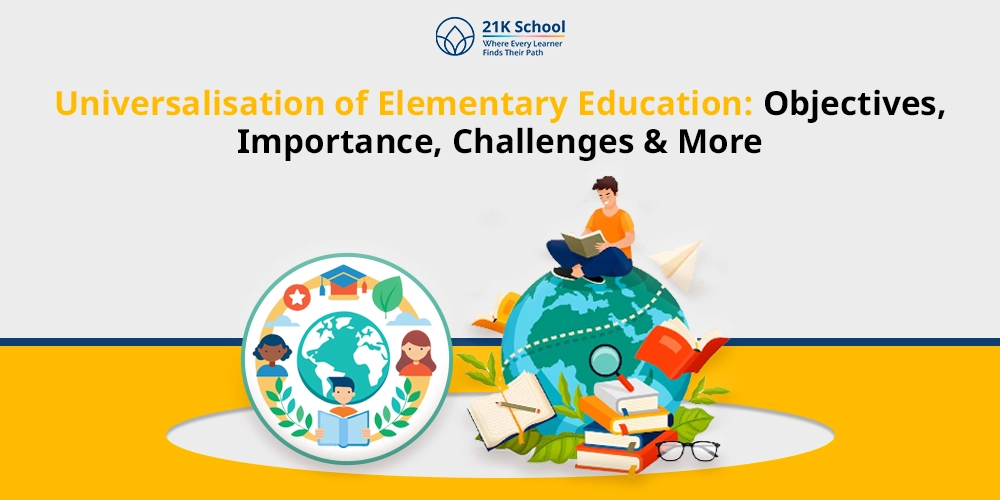
The development of any country lies in the universalisation of elementary education. Elementary education is considered to be the focal aspect of intellectual, social and moral development of the child.
The majority of countries have tried to ensure that every child in the country is able to receive basic schooling, irrespective of his or her differences.
The idea of universalising elementary education emerged according to the necessity to not only provide citizens with an equal chance of learning but also create an educated, skilled, and responsible society. It plays an important role in the assurance of literacy, equality and overall national development.
Contents
- What is Universalisation of Elementary Education?
- Objectives of Universalisation of Elementary Education
- Importance of Universal Elementary Education
- Government Initiatives and Programs to Promote Universal Elementary Education
- Stages of Universalisation of Elementary Education
- 5 Common Issues in Universalising Elementary Education
- Measures to Improve Universalisation
- Conclusion
What is Universalisation of Elementary Education?
Universalisation of Elementary Education is simply the effort to make elementary education free, compulsory and of good quality to every child who is usually aged between 6 and 14.
It aims at ensuring that every child has equal access to basic education regardless of social, economic or cultural considerations.
Its concept lies in enrolment, retention, and achievement in general, so that every child enrols in elementary schools and learns, acquires appropriate knowledge, skills, and values to develop as an individual and a national interest.
Objectives of Universalisation of Elementary Education
The pointers of the Universalisation of Elementary Education are directed at ensuring every child receives free, compulsory and quality elementary education. It is concerned with improving equality, general growth, holistic education and literacy of all children in society.
1. Providing Free and Compulsory Education to all Children
The implication behind this argument is primarily to ensure that all children receive an elementary education that does not drain the economy. Free education helps poor families to ensure that the children attend school, as compared to compulsory schooling, where parents ensure the children attend school.
It helps in increasing the school enrolment, and no school children experience any failure in their basic education.
2. Ensuring Equal Educational Opportunities
The purpose of education is to offer the same level of education to all children irrespective of their gender, caste, religion, economic status, and where they live.
All the children must obtain equal access to quality education. This assists in establishing an equal and balanced education system where every learner is in a position to learn and utilise their potential.
3. Promoting Literacy and Basic Skills
Another objective is to ensure that the children learn the elements of literacy and life skills.
Reading, writing, and arithmetic are a few of the things that are necessary in day-to-day life and are linked to elementary education. It also allows children to learn to communicate, think and problem-solving.
4. Reducing Social and Economic Inequalities
Higher elementary education helps in eradicating the inequality between different classes in terms of social and economic status. Poverty can be eliminated through education by providing every child with the chance to acquire education and improve the standards of living.
It provides the children with information and abilities that can enable them to gain greater opportunities and contribute towards social and economic growth.
5. Promotes Equity and Inclusion
The universal nature of elementary education promotes an inclusive learning opportunity where all children are accommodated in education. It ensures that the less privileged groups of people, like girls, children with disabilities and the representatives of the marginalised groups, are well educated.
This objective improves justice and equality, honours and respect, and equal participation to assist in making society more inclusive and peaceful.
Importance of Universal Elementary Education
Universal Elementary Education plays a critical role in the general growth of people and society. It assists in enhancing literacy levels, equality, minimising poverty and equipping children with knowledge and skills that will enable them to lead a better life in the future.
1. Promotes Literacy and Knowledge
Universal primary education also allows children to learn basic literacy and knowledge so as to be able to live normal lives. It inculcates such valuable skills as reading, writing and calculating numbers.
These abilities enable individuals to cognise information, communicate effectively and continue with their studies. A well-informed choice is a better way to make an informed decision, and a literate society can provide the country and society with a positive contribution to its development.
2. Helps in Social and Economic Development
Elementary education is essential in the social and economic development of a nation. Educated people are more capable of gaining better employment opportunities and rising in their living standards.
Education also makes people comprehend social values and duties, leading them to work on their community development and contribute to the economy in general.
3. Reduces Poverty and Unemployment
Education enables individuals to obtain information and professional skills that can help improve their work in later life. When children are provided with an elementary education, they are more likely to pursue higher education and attain sustainable jobs.
This will reduce the unemployment level and drive out the cycle of poverty, and individuals and families could achieve a higher standard of living.
4. Promotes Gender Equality and Social Justice
Education at the elementary level is universal, where girls and boys can get equal opportunities to learn. It helps in the eradication of gender, caste, religious and economic discrimination.
The education of all children would make society more inclusive and just. Education enables the empowerment of people, promotes equality of rights and fosters the growth of a balanced and fair society.
5. Builds Responsible Citizens
Elementary education allows children to acquire their place in society and understand what discipline is. It sensitises them on their rights and duties as citizens of a country.
Children are taught to cooperate, respect and be honest through education. Such features enable them to be responsible and active citizens who can be productive in society and nation-building.
Government Initiatives and Programs to Promote Universal Elementary Education
The government has introduced different initiatives to facilitate universal elementary education as it tries to secure free, compulsory and quality education to all children and enhance access, enrolment, retention and learning outcomes.
1. Sarva Shiksha Abhiyan (SSA)
Sarva Shiksha Abhiyan was launched so as to provide universal elementary schooling in India. It is mainly directed to impart free and mandatory education to children aged 6-14 years.
The programme targets upgrading schools, recruitment of teachers, and admission and retention of students, especially those who are in the disadvantaged groups.
2. Mid-Day Meal Scheme
The Mid-Day Meal Scheme was another programme which was implemented as a measure to minimise school dropouts and increase the nutritional status of children. In this programme, government and government-aided schools provide free meals to the students.
It helps to reduce the hunger situation in the classroom, increase school attendance and submission, and overall health and learning ability of children.
3. Right to Education Act (RTE)
The Right to Education Act offers free and mandatory education to all children between the ages of 6 and 14 years. It makes education a fundamental right and sets a minimum standard of schools, teaching staff, and facilities.
The act will also contribute to reducing the level of dropouts, and all children will be able to access quality elementary education.
4. Samagra Shiksha Abhiyan
The Samagra Shiksha Abhiyan is a programme which intends to improve the quality of school education from to pre-primary level to the senior secondary level.
It incorporates other earlier programmes like Sarva Shiksha Abhiyan and Rashtriya Madhyamik Shiksha Abhiyan. The programme will be useful in enhancing learning achievements, the development of infrastructure and the education of every child.
5. PM Vidyalakshmi Scheme
The PM Vidyalakshmi Scheme helps the students by providing them with financial support and simplified access to education loans. The plan helps students from poor financial backgrounds to study without financial difficulties.
It will assist in the dismantling of the fiscal obstacles and help more children and youth to pursue education and make improved careers.
6. Beti Bachao Beti Padhao
Beti Bachao Beti Padhao is one of these campaigns by the government that aims at improving the lives and education of girls. Improvement in the child sex ratio and enhancing the education of daughters in the families is one of the goals of the programme.
It not only generates awareness regarding the necessity to educate girls but also does its best to provide equal opportunities to girls in schools.
Stages of Universalisation of Elementary Education
The stages of Universalisation of Elementary Education give the fact that every child may enter schools, enrol, continue his/her education without leaving, and acquire basic knowledge that would give a stable foundation of lifelong development.
1. Universalisation of Provision
Provision is to be universal so that all educational facilities can be available and accessible to all children, irrespective of their geographical location. It entails setting up schools, classrooms, playgrounds and appropriate infrastructures, especially in the rural and remote regions.
They have enough trained teachers, educational resources and conducive environments. This phase eliminates physical, geographical and logistical obstacles where everyone in the society has a chance to enrol in elementary school without any interference.
2. Universalisation of Enrollment
Universalisation of enrolment is aimed at making all children of school-going age attend schools. Marginalised groups such as girls, economically weaker and children with disabilities are given special attention.
Sensitisation programmes, incentives and programmes of outreach motivate parents to take their children to school. Its aim is to get full enrollment, where each child will not be missing the education sector at the elementary level.
3. Universalisation of Retention
Retention that has been universalised makes sure that when children join the school, they remain in it till they finish the elementary level. Some of these measures are mid-day meals, scholarships, free textbooks, flexible study routine, and a conducive environment for learning.
Social, economic or cultural issues, such as the reduction of dropout rates, are also of priority. The stage will ensure that children have basic literacy, numeracy, and the necessary skills that will result in further studies and lifelong learning.
5 Common Issues in Universalising Elementary Education
Some of the issues that confront universalisation of elementary education include poverty, child labour, inexistent infrastructures, lack of teachers, gender disparity and high dropout rates, which hamper accessibility, retention, and quality education to all children.
1. Poverty and Child Labour
Poverty causes a significant number of children to be sent to work rather than be in school, thus it can be hard to get a universal education.
The families highly rely on the incomes of the children to survive, and this results in low enrolment and poor attendance, whereby children are unable to attain education to the elementary level and acquire the necessary skills to develop in future.
2. Lack of Infrastructure and Facilities
There is a lack of proper infrastructure in many schools, particularly in rural locations, in the form of classes, toilets, drinking water and libraries. Lack of proper facilities creates a poor learning environment that will not be enticed to attend school on a regular basis.
The resources are also not adequate to influence the quality of teaching, which restricts the general learning and retention rates among the students.
3. Shortage of Trained Teachers
There is a challenge of qualified and trained teachers that has influenced the quality of education in elementary schools. Poor learning outcomes are caused by overcrowded classes, staff not developing professionally and staff demotivation.
Children cannot have proper guidance, individual attention and efficient teaching because they lack proper teachers, and as a result, they are not allowed to advance in their studies.
4. Gender Inequality in Education
The girls usually fail to access education because of social and cultural biases, which do not allow them to attend school. Families can give preference to the education of boys over girls, particularly in rural settings.
Gender inequality denies girls their chances to get empowered, lowers the literacy rates of women and hinders the general social and economic growth.
5. High Dropout Rates
Children drop out of school even at elementary levels because of poverty, distance, family obligations or because they have no interest. Children are not able to learn basic literacy, numeracy and other life skills because of high dropout rates.
This undermines the goal of a universal elementary education and makes the government programmes and initiatives less effective.
Measures to Improve Universalisation
The measures to increase universalisation of elementary education are focused on bettering the infrastructural state of the schools, making school resources free, teacher training, communal and contribution of technology in education to ensure that all children are enticed, dealt with and retained successfully at school.
1. Improving School Infrastructure
A positive learning environment allows the learners to go through the provision of the appropriate classes, libraries, playgrounds, and sanitation facilities.
The improved infrastructure will facilitate consistency, reduction of dropouts, and overall learning activities, especially in remote and isolated areas, which will make education accessible and enticing to all kids.
2. Providing Free Textbooks and Uniforms
Free textbooks, stationery, and uniforms reduce the expenses of the financially disadvantaged young families.
This facilitates enrolment, attendance and retention, and every child will be able to access the same number of learning resources and opportunities, and this will assist in the realisation of the goal of universal elementary education.
3. Increasing Teacher Training Programs
Consistent training improves the skills of the teachers, classroom management and the teaching techniques.
Trained teachers are able to interact with the students in an effective way, provide for various learning needs, and enhance the learning results of the students, which makes education quality to all children.
4. Promoting Community Participation
The involvement of parents and communities will help to increase accountability and school attendance and reduce school dropouts.
Community participation generates awareness of the importance of education and ensures that the children, as well as the members of the marginalised groups, stay in school and are helped up to the elementary level.
5. Using Technology in Education
Digital classrooms and online resources through the use of e-learning tools improve the availability and quality of teaching.
Technology makes interactive learning available, helps bridge the gap in access between urban and remote schools, as well as providing access to schools that are far away, enhancing the learning methods in many elementary schools and improving the accessibility of education.
Conclusion
Elementary Education should be universalised in order to develop an educated, skilled, and responsible society. The provision of free, mandatory, and quality education to children promotes literacy, equality, social justice, and economic development.
Although there are such factors as poverty, gender disparity, and the lack of infrastructure, government policies, community participation, teacher education, and technology can be used to enable universal access, enrollment, retention, and learning, which will be a solid base of national development and personal growth.

You may also want to read