

Students often come up with a challenge that they spend too much time learning but the next day they forget everything.
But, have you ever thought about the right way to avoid these kinds of problems, especially when students are at an important phase of their educational journey.
If not, don’t worry because this is the right place to get the best solutions to this problem.
Active recall techniques include some of the useful ways through which students can boost retention, strengthen neural connections, improve understanding and many more.
Let’s begin with understanding what active recall really means.
Contents
What Is Active Recall?
Active recall, also popular as retrieval practice, is a learning technique which actively retrieves information from memory instead of passively reviewing it.
A simple example of active recall is a student closing the book and recalling the main points instead of reading the whole chapter multiple times to memories.
Through this method one can pull out the previous information from memory which helps in storing longer term.
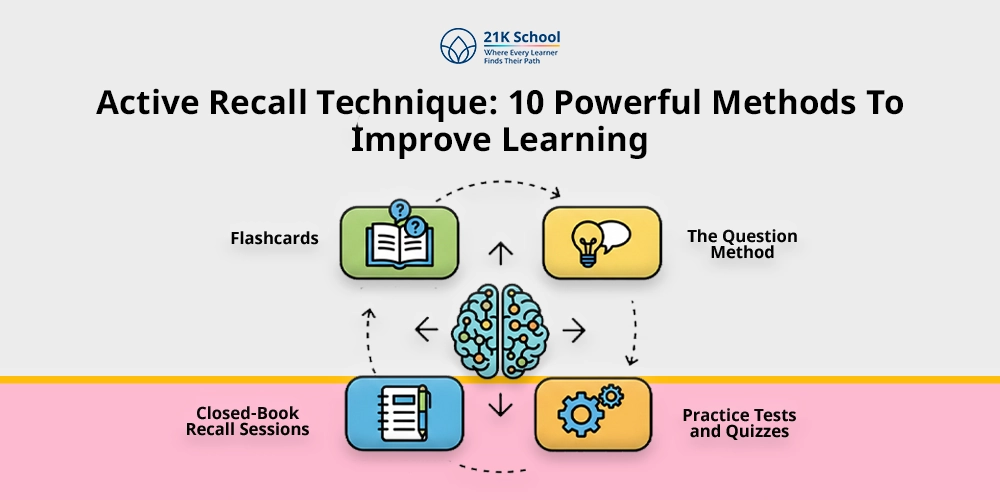
10 Useful Active Recall Techniques
Below points are 10 useful active recall techniques can be used to improve learning:
1. Flashcards (Digital or Physical)
Flashcards are effective active recall techniques used for vocabulary, definitions, formulas, and quick facts.
Here each card includes a question in front and answer in the back. One needs to recall the answer first then flip to confirm.
Some common tools are:
- Anki
- Quizlet
- Physical index cards
2. The Question Method
In the question method students rather than writing notes as statements, they convent it in question to remember.
For example:
Instead of writing “A matter is anything that has mass and occupies space.”
Write “What is matter?”
3. Practice Tests and Quizzes
One of the useful active recall for students is practicing tests and quizzes. Frequently practice can help in final exams.
One can use:
- Past year papers
- Self-made tests
- Online quizzes
- Timed practice sessions
4. Blurting Method
Blurting method is an amazing way in which students follow the steps in which they:
- First read
- Then close the book
- And write down everything you remember
It is an ideal self-assessment active recall technique.
5. Feynman Technique
It is one of the most popular techniques named after Nobel Prize-winning physicist Richard Feynman.
Here, students first choose a topic, explain it in simple and their own way, find where explanation is weak, re-learn it and simplify again.
It is useful for difficult subjects or chapters.
6. Closed-Book Recall Sessions
In closed-book recall sessions, students once read the content then close the book to recall from the memory.
They can also:
- Recite verbally
- Write summaries
- List important points
It works to build students in the memory.
7. Mind Mapping from Memory
Mind mapping means drawing diagrams to organise the information to enhance the memory while studying .
It helps students in avoiding the rote learning bundle of information. By drawing a mind map one can improve visualisation.
8. Verbal Recall / Teaching Someone
By teaching someone or loudly recalling information is also a form of active recall. Teaching often reinforces memory.
Students can teach peers, siblings, or self in the mirror.
9. Cornell Note Summary Recall
Another popular method known as cornell note summary recall. Steps to use this method:
- Write notes in the main section
- Create questions/cues in the left column
- At the bottom, write a summary
- During revision, try recalling the content using only the cue column
10. Active Recall Apps
Students can also use different Active Recall Apps that help in personalised learning .
Some common examples are Brainscape, Quizlet, Anki etc.
How Does Active Recall Work?
The information showcase how does active recall work:
1. Strengthens Neural Connections
When students repeat themselves by retrieving information from memory helps them to strengthen neural connections.
2. Fights the Forgetting Curve
Forgetting the information by the brain is natural. Through active recall one can practice testing to counter the forgetting process.
3. Creates Stronger Memories
To create stronger memories, students need to force themselves which directly helps in remembering it for a long time.
4. Improves Comprehension
The reconstruction of information in mind to pull out required data helps in deep understanding rather than fact memorising.
5. Highlights Knowledge Gaps
Students are often unable to recall points which showcase where the improvement needed. This highlights knowledge gaps that help to improve.
Conclusion
To become a faster and long lasting learner, students need to implement various techniques. One of the powerful names is active recall.
It is an ideal technique for everyone from school students to working professionals to improve memory power.
From flashcards to active recall apps each one is useful to retain information for the long-term. Go through a smart way of learning.

You may also want to read