

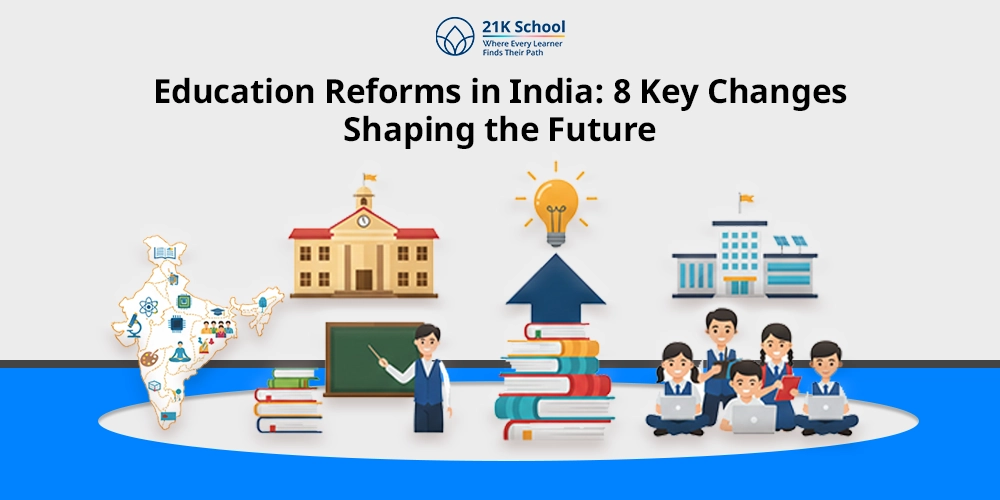
To shape students’ future education is an important part of life.
And to meet today’s needs, education reforms in India are a crucial step. Countries like India require education reforms to bridge learning gaps , improve the quality of education , and make learning more accessible for everyone.
With time there are many reforms introduced to guide students to compete at national and international level.
Further, we will go through all education reforms in India in detail.
8 Key Education Reforms in India
Explore 8 key education reforms in India includes:
1. National Policy on Education (NPE) 1968, 1986, 1992
National Policy on Education (NPE) is a framework for education in India which is evolving across decades to meet changing educational needs.
There are three important timelines including 1968, 1986, and 1992.
- NPE 1968: The Foundation
It is the first national education policy in India mainly focused on universal access, compulsory education for all, and the three-language formula.
- NPE 1986: Focus on Equality and Child-Centric Education
It aimed at making education a national priority with a focus on gender equality in education , access, and quality.
The key objectives are universal elementary education, removal of regional disparities, vocational education , and technology integration.
- NPE 1992: Revisions for Modernisation
It was a “modification” or “Programme of Action (PoA) 1992” under NPE 1986, not a separate policy that refers to the Modified National Policy on Education of 1992.
The main objectives are universalising elementary education, improving educational access and quality for disadvantaged groups, expanding vocational and higher education, and promoting lifelong learning .
2. Right to Education Act (RTE), 2009
Right to Education Act (RTE), 2009 is a landmark Indian law which states that free and compulsory education for children aged 6 to 14 years.
It also includes physical punishment or mental harassment” (Section 17) and mandated 25% reservation for economically weaker sections in private schools.
3. National Education Policy (NEP) 2020
National Education Policy (NEP) 2020 is a popular reform in Indian education. It transforms the education system by focusing on access, equity, quality, affordability, and accountability.
- A new curriculum system of 5+3+3+4 has been announced replacing the previous 10+2 system as part of the modern education approach.
- Foundational learning, multidisciplinary education , and experiential learning .
- Focus on mother tongue/regional language, recognising the importance of regional language in a child’s development.
- Flexibility in subject selection, teacher training through NCTE.
- Promote digital education , vocational training, and research universities.
4. Sarva Shiksha Abhiyan (SSA)
Sarva Shiksha Abhiyan (SSA) was operational from 2000-2001. The main aim of the program is to achieve Universal Elementary Education for all children in the 6-14 age group.
List of key objectives are:
- Improve the quality of elementary education.
- Providing quality teaching, teacher training, and life skills education .
- Gender equality especially for girl child education and disabled children, highlighting the importance of girls’ education .
- Computer education for digital literacy .
5. Rashtriya Madhyamik Shiksha Abhiyan (RMSA)
Rashtriya Madhyamik Shiksha Abhiyan (RMSA) focuses on secondary education (Classes 9 to 12).
The key objectives includes:
- Improve access, retention, and quality to address the problems of secondary education .
- Building labs, libraries, and classrooms
- Girls education through initiatives such as KGBVs.
- Improve enrollment in secondary education.
6. Samagra Shiksha Abhiyan
Samagra Shiksha Abhiyan covers pre-school to class 12 students where they get quality, equitable, and inclusive education .
The key objectives includes:
- Holistic development vocationalisation
- Quality education, ICT-enabled classrooms, and sports & arts
- Inclusive education for children with special needs
- Alignment with other policies like NEP 2020 .
7. Mid-Day Meal Scheme
The mid-day meal scheme is now known as PM POSHAN (Pradhan Mantri Poshan Shakti Nirman) which is designed to provide free, nutritious hot cooked meals to children in government and aided schools.
The scheme is ideal to promote students’ health and school enrollment.
8. Skill India Mission
One of the reforms under the Government of India initiative launched in 2015 known as Skill India Mission.
It provides market-relevant skills to the nation’s youth, underlining the importance of vocational education . The main objective is to increase employability and boost economic productivity.
Other Prominent Education Reforms in India
There are other prominent education reforms in India, one must go through:
1. Digital Education Reforms
Today digital literacy is a key to success and to meet the needs digital education reforms are crucial.
It helps in learning through technology also known as e-learning such as digital content, teacher training, online assessment etc. Major Initiatives under this reform are:
- DIKSHA platform for e-content
- SWAYAM for online courses
- PM e-VIDYA integrating all digital/online learning resources
- National Digital Library
2. Curriculum and Pedagogical Reforms
Curriculum and pedagogical reforms come under National Education Policy 2020. It aims to provide holistic, skill-based education , fostering critical thinking , creativity, and real-world readiness.
Some major changes In curriculum are:
- Introduction of 5+3+3+4 model
- Content Reduction for deep exploration
- National Curriculum Frameworks (NCFs)
- Integration of Indian knowledge
- Vocationalisation
Pedagogical shifts includes:
- Experiential learning
- Technology integration
- Active learning
- Multilingualism
3. Teacher Training and Professional Development Reforms
Teachers play a major role in educational outcomes that’s why teacher training and professional development reforms are important.
Key reforms include:
- Establishment of National Council for Teacher Education (NCTE) standards.
- Popular programs such as NISHTHA.
- Development of pedagogical skills, assessment literacy, and subject expertise.
4. Skill Development and Vocational Education Reforms
The main focus of skill development and vocational education reforms is integrating practical skills, bridging learning gaps, boosting employability, and promoting lifelong learning.
Students can become future-ready and confident for upcoming challenges, equipped with essential 21st century skills .
5. Inclusivity and Accessibility Reforms
Inclusivity and accessibility reforms are systemic changes in law, policy, infrastructure, and culture to promote equity and ensure no student is left behind.
In this way, both physical and digital barriers can be overcome to ensure full participation in society, reflecting the true benefits of education .
Conclusion
Understanding the education reforms in India helped you to explore the future of education in India and ideal ways to meet 21st century needs.
Each of these reforms are essential to make students learning effective. Implementation ensures quality learning, equal opportunity, holistic development through value education , and many more.
So, get ready for the future-ready learning with effective reforms in India.

You may also want to read