

In the 21st century, people understand the importance of education and the importance of education for every child.
With time, learning approaches evolve. Through these approaches, students have the opportunity to choose different ways such as distance education and regular education.
But, the question is which is better for a children’s educational journey?
To know the benefits and difference between distance education vs regular education let’s get into a detailed analysis.
Contents
What Is Distance Education?
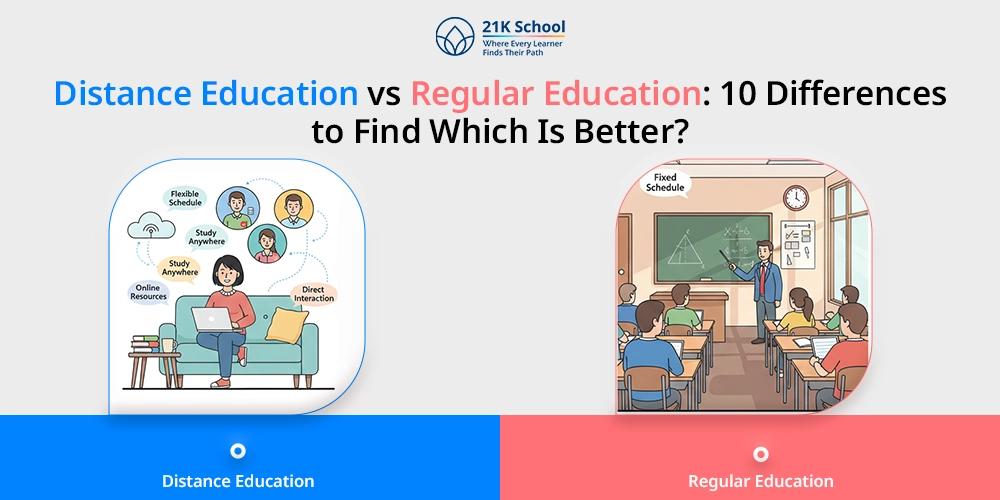
Distance education is one of the ideal and flexible learning approaches in which technology is used to gain knowledge.
To communicate technologies are used in the non-classroom setting. Using online learning management systems (LMS), video conferencing and e-learning modules, learning becomes easy.
It is ideal for teachers-students immediate communication. Distance education is popular for its flexible approach in which anyone from homemakers to working professionals can learn from anywhere.
What Is Regular Education?
Regular education simply means a traditional way of learning in which students learn on campus or in classroom-based sessions in the classroom.
In this approach students attend lectures, lab experiments, discussions in educational institutions with teachers and peers.
It is one of the oldest education systems used for academic growth and personal development.
Distance Education vs Regular Education: 10 Key Differences
Below are the distinctions of distance education and regular education in a table and then bullet points. So follow up for quick understanding:
| S No. | Particulars | Distance Education | Regular Education |
| 1. | Learning mode | Online / Remote | Classroom-based |
| 2. | Flexibility | Highly flexible | Fixed schedule |
| 3. | Student-teacher interaction | Limited / Virtual | Direct and frequent |
| 4. | Assessment methods | Online exams, assignments | Written exams, projects |
| 5. | Learning materials | Digital / Printed | Books, notes, labs |
| 6. | Cost of education | More affordable | Comparatively expensive |
| 7. | Learning environment | Home-based | Campus environment |
| 8. | Accessibility | Open to all locations | Location-dependent |
| 9. | Career Opportunities | Skill-based & flexible | Traditional career paths |
| 10. | Examples | Online degree programs | Full-time college degrees |
1. Learning Mode:
Distance Education: Distance education is based on:
- online classes
- recorded videos
- self-learning materials
Regular Education: Regular education is based on in-person classroom teaching with peers.
2. Flexibility
Distance Education: Distance education is highly flexible. Students can learn from anywhere in the world.
Regular Education: On the other hand, regular education needs strict adherence to school or college schedules.
3. Student-Teacher Interaction
Distance Education: In distance education, virtual collaboration is mainly preferred.
Regular Education: While real-time discussions and personal mentoring is offered in regular education.
4. Assessment Methods
Distance Education: The assessment method used by distance education are:
- online tests
- assignment
- internal assessments
Regular Education: In regular education, the assessment used include:
- classroom test
- viva
- practical tests
5. Learning Materials
Distance Education: Learning materials of distance education includes:
- e-books
- PDFs
- recorded lectures
Regular Education: Learning materials of regular education includes:
- Books
- Notes
- Labs
6. Cost of Education
Distance Education: Distance learning is more inexpensive, since it requires minimal infrastructural support.
Regular Education: Regular education is comparatively more expensive for students.
7. Learning Environment
Distance Education: In distance education, the learning environment depends on students’ self-discipline at home.
Regular Education: A disciplined academic atmosphere is maintained by teachers and students in the school.
8. Accessibility
Distance Education: As compared to regular education, distance education is highly accessible, especially in remote or rural areas.
Regular Education: While regular education needs physical presence on campus.
9. Career Opportunities
Distance Education: Distance Education is effective for students pursuing skill-based careers and promotions.
Regular Education: Regular education is ideal for:
- professional
- research-based
- campus placement roles
10. Examples
Distance Education: Some common examples of distance education include online degree programs and correspondence courses.
Regular Education: Some common examples of regular education include school education and full-time college degrees.
4 Key Benefits of Distance Education
Distance education is beneficial for flexible learning. Some of the common benefits include:
1. Usage of Digital Technology
To learn the use of digital technology, distance education is one of the ideal ways.
It is ideal to meet the requirements of modern learning and professional needs.
2. Self-Paced and Flexible Learning
Enrolling in distance education offers the opportunity of flexible and self-paced learning.
This means students learn at their own speed to achieve desired goals.
3. Global Accessibility
Distance education is globally accessible. It means students can learn from anywhere in the world with internet connection and digital tools.
4. Learn New Technology
With time 21st century education has evolved and learning new technology has become a necessity.
Through distance education students get familiar with new technology, software, and apps which are beneficial to compete in a changing world.
4 Key Benefits of Regular Education
There are numerous benefits of regular education for students. Some key points include:
1. Structured Learning Environment
Parents and students often choose regular classrooms and education to get a proper and structured learning environment.
From curriculum to syllabus each process is pre-designed for students.
2. Peer Support
Distance education often isolates students to connect with each other in real life.
One of the benefits of regular education is that students can connect with peers in real-life.
3. Face-to-Face Interaction
For students, social and personal development face to face interaction in regular education is ideal.
It fosters communication, teamwork , and relationship-building to boost their personal development.
4. Access to Campus Facilities and Labs
School campuses provide various physical facilities such as labs for experiment, playground for sports, and library for reading.
This helps students to build interest in different fields other than education.
Conclusion
Distance and regular education has its own benefits. Both are designed to fulfill educational needs of students.
Distance education is a virtually interactive technology driven model in which gives flexibility, collaboration, and immediate feedback.
On the other hand, regular education is a traditional approach mostly situated in classrooms ensures academic success. It offers direct or face-to-face interaction with teachers and students.
Choose the ideal way to make the educational journey impactful.

You may also want to read