

A healthy lifestyle enables a healthy mind as good health and education are interlinked with each other. Hence, in India, the government has offered several initiatives at different times to fulfill the healthy lifestyle needs of the students.
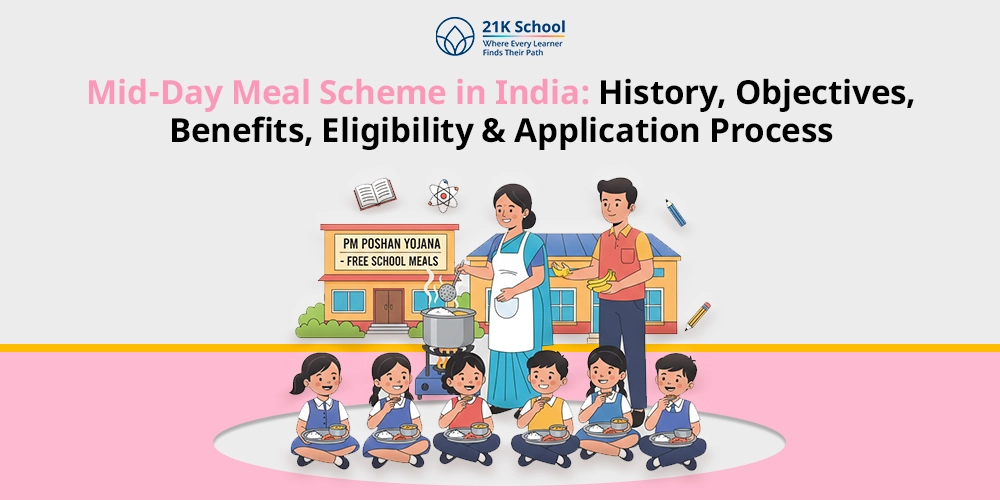
When it comes to nutrition, the Mid-Day Meal Scheme or PM POSHAN scheme is one of the most recognized efforts of the government in India.
Let us try to understand more on the Mid-Day Meal Scheme in this write-up. Starting here with a quick definition of what this scheme is all about?
Contents
- 1 What is a Mid-Day Meal Scheme?
- 2 History and Evolution of the Mid-Day Meal Scheme in India
- 3 6 Objectives of the Mid-Day Meal Scheme
- 4 5 Benefits of the Mid-Day Meal Scheme
- 5 Mid-Day Meal Menu
- 6 Eligibility Criteria and Coverage of the Mid-Day Meal Scheme
- 7 Application Process of Mid-Day Meal Scheme: 4 Key Step-by-step
- 8 Exclusions of Mid-Day Meal Scheme
- 9 5 Common Challenges in the Mid-Day Meal Scheme
- 10 Conclusion
What is a Mid-Day Meal Scheme?
The Mid-Day Meal Scheme in India now known as PM POSHAN or Pradhan Mantri Poshan Shakti Nirman which was launched nationally in 1995 as the NP-NSPE.
It is a government initiative proposed to provide free, hot, cooked meals to millions of government and government-aided school children daily.
History and Evolution of the Mid-Day Meal Scheme in India
A detailed information on the history and evolution of the Mid Day Meal Scheme (MDMS):
In the Beginning
- 1920: Introduced in a Corporation school in the Thousand Lights area by A. Subbarayalu Reddiar, briefly suspended in 1925. It was revived in 1927.
- 1941: Then Kerala launched its School Lunch Programme in 1941.
- In Mid-1980s: Various states such as Gujarat, Kerala, Tamil Nadu, and Pondicherry provided cooked food using their own fundings.
National Launch and Expansion Between 1990s and 2000s
- 1995: NP-NSPE is launched as a centrally sponsored scheme. It aims to provide dry rations.
- 1997 to 98: Later, NP-NSPE expanded to cover all blocks nationwide.
- 2001: In 2001, the Supreme Court mandated all states to provide cooked mid-day meals in government/aided schools within 6 months. They link it to education.
- 2002 to 2004: Between 2002 to 2004 most states implemented universal cooked meals for students.
Growth After 2004
- 2004: The MDMS changed to provide cooked meals for grade 1 to 5 class, including EGS/AIE centers, with added cooking costs.
- 2007 to 08: Later, it extended to upper primary such as grade 6 to 8.
- PM POSHAN: The name changed into Pradhan Mantri Poshan Shakti Nirman/PM POSHAN.
6 Objectives of the Mid-Day Meal Scheme
The primary objectives of the Mid-Day Meal Scheme includes
1. Nutritional Improvement
To improve nutrition in kids’ lives, Mid-Day Meal Scheme is ideal to meet daily needs. In this way, each kid receives proper food to strengthen their physical and mental health.
2. Increase Attendance and Retention
Food distribution is not the only purpose of the Mid-Day Meal Scheme. Regular visiting in school for classes helps in increase in students attendance and knowledge retention.
3. Address Classroom Hunger
Hunger often leads to student stress, less concentration, and retention power. By addressing classroom hunger the initiative ensures students become active and ready to learn without obstacles.
4. Promote Social Equity
Mid-day meals are a powerful scheme in which learners from different castes, religions, and backgrounds sit together to share food.
In this way, students learn about equality, togetherness, teamwork, collaboration, and build a positive personality.
5. Foster Good Habits
Through Mid-day meals students are able to learn healthy eating habits at a young age. They learn how nutrients are important and guide families to follow a healthy lifestyle.
6. Support Families
Families who come under low-income and unable to provide enough nutritional meals get Mid-Day Meal Scheme support to manage their lifestyle without disturbing monthly expenses.
5 Benefits of the Mid-Day Meal Scheme
For parents who are facing financial difficulties, the Mid-Day Meal Scheme is highly beneficial for them:
1. Better Health Concentration
Through the Mid-Day Meal Scheme students can improve their health by getting proper food.
It is beneficial for kids to avoid various health concerns at a young age. For example underdeveloped body, kawasaki, anemia etc.
2. Community Building
Through this initiative students from different caste, colour, community collaborate together to sit and share meals.
It is beneficial to learn tolerance, equality, and respect for diversity by breaking barriers like gender and caste.
3. Employment Generation
To prepare a Mid-Day Meal, schools offer employment opportunities especially to women in different states.
4. Calorie and protein norms by class
Through daily mails students can meet the requirements of the body which leads to proper growth of both mind and body.
The norms are designed in MDMS:
- Primary school students: 450 calories and 12 grams of protein per day.
- Upper primary school students: the target is 700 calories and 20 grams of protein per day.
5. Focus on hygiene and food safety
The food offered under the Mid-Day Meal Scheme/PM POSHAN is passed through regular monitoring. The authority make sure that:
- Meals are prepared in a clean area.
- Trained people for cooking
- Food safety
Mid-Day Meal Menu
To find specific menus of Mid-Day Meal Scheme/PM POSHAN, look for a specific state’s education department.
One can also visit central govt sites PM-POSHAN website for local weekly/monthly plans. Key components and recent trends consist:
- Nutritional Standards
Meals must meet:
- 450 calories/12g protein for primary educational students
- 700 calories/20g protein for upper primary students
- Ingredients Include
Seasonal vegetables, rice, pulses, oil or ghee, and condiments are standard. Some optionals are soy chunks, eggs, fish, chicken.
- State-Level Variation
Menus are mostly designed based on local preferences.
Eligibility Criteria and Coverage of the Mid-Day Meal Scheme
To avail the benefits of Mid-Day Meal Scheme, students should go through the eligibility criteria and coverage:
- Age criteria
In this scheme, kids should be between the ages of 6 and 14 years old.
However, the age criteria can vary depending on state and school policies.
- Students in Government and Government-aided schools
The Mid-Day Meal Scheme mainly targets those students who are successfully enrolled in primary to secondary level Government and Government-aided schools.
- Socio-economic criteria
A lot of families are unable to feed their kids the required amount of nutrients due to below-poverty-line (BPL) status or those from marginalized communities. These kinds of students get priority in the scheme.
- School attendance
To avail the benefits of the Mid-Day Meal Scheme, students need to maintain attendance in school by taking regular classes.
Application Process of Mid-Day Meal Scheme: 4 Key Step-by-step
Go through the step-by-step guide to apply in the Mid-Day Meal Scheme:
1. Enroll Your Child in School
Initial steps is to visit the school and enroll for PM POSHAN/Mid-Day Meal Scheme. Parents get all the details to fill the form correctly.
2. Provide Required Documents
The next step is to provide required documents to the school authority. Some common documents including:
- Birth certificates or age proof of the learner
- Bank account details
- Aadhaar card or other identification documents
- School registration certificate
3. Enrollment Verify and Approval
After successful submission authorities verify all the documents and match with the eligibility criteria. Parents need to wait for approval.
4. Automatic Inclusion
After approval, students need to maintain their attendance in school to get a daily meal. These meals are generally given under the school premises.
Exclusions of Mid-Day Meal Scheme
Exclusions of Mid-Day Meal Scheme includes:
- Kids who are attending secondary or higher education institutions are excluded from MDMS.
- Alternative meal programs are running in schools excluding the Mid-Day Meal Scheme.
- Learners studying in the private schools are unable to take the benefits of the government’s scheme.
5 Common Challenges in the Mid-Day Meal Scheme
Even there are lot of advantages, Mid-Day Meal Scheme face some common challenges like:
1. Quality and hygiene concerns
Parents are often concerned about the quality of food and hygiene of their children. Compromising can negatively impact kids’ health.
2. Irregular fund flow
Due to irregular flow of funds the Mid-Day Meal Scheme leads to delays in payments, operational interruptions etc.
It can also compromise the quality and nutritional value of the food served to kids.
3. Infrastructure gaps
There are various challenges faced by students like lack of cooking sheds, insufficient utensils and clean water to cook food.
4. Staff shortages
Staff shortages often lack the food distribution, delay in food delivery etc.
5. Food wastage
Planning and proper execution is important for MDMS. Improper planning often leads to food wastage, food shortage, and loss of quality.
Conclusion
In the 21st century, basic learning is necessary. There are various initiatives like the Mid-Day Meal Scheme that are ideal for kids towards education and also for childrens mental health.
It is important for students classroom learning , stay focused, grow healthier, and dream bigger. Go through the step-by-step application process of Mid-Day Meal Scheme for enrollment.
The scheme already helped a lot of students and is still guiding parents, students, and teachers to promote across India.

You may also want to read