

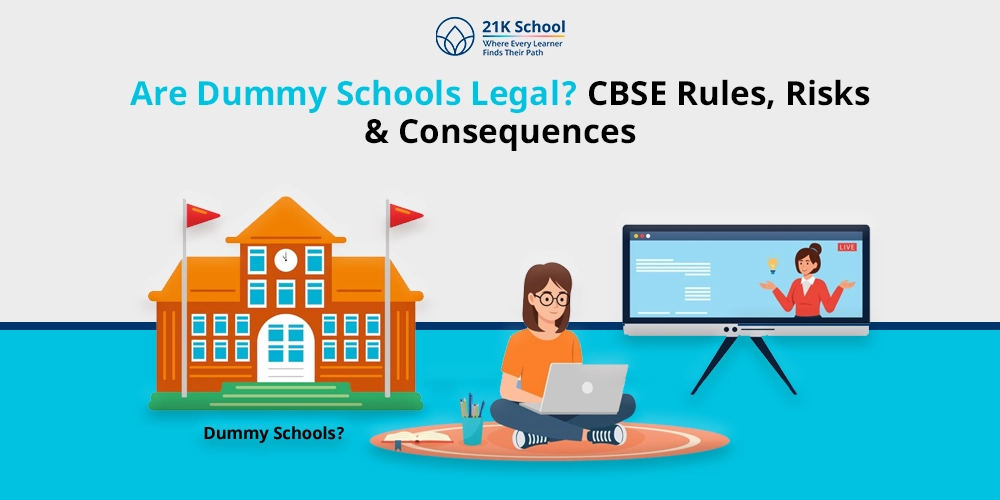
Dummy schools are gaining popularity among students with the consistent rise in the competition. Do you know what dummy schools are or are these even legal?
While there are several schools affiliated by CBSE and other boards, still many prefer to go ahead with the dummy schools with little or no information about these schools.
Read on to learn about the actions taken by the government against dummy schools and the consequences of studying in them.
Contents
- 1 What Are Dummy Schools?
- 2 Are Dummy Schools Legal Under CBSE Rules? Legal Status
- 3 Why Do JEE and NEET Aspirants Opt for Dummy Schools?
- 4 Legal Risks and Consequences of Dummy Schools
- 5 Government Actions and Recent Developments in case of Dummy Schools
- 6 Regular vs. Dummy School: Which Is Better?
- 7 Concluding Comments
What Are Dummy Schools?
Dummy schools are formally registered schools that provide fake attendance to students and hence they don’t need to attend regular classes. Students undergoing competitive exams like JEE or NEET prefer these schools over regular ones.
Here, the student only visits school to take board examinations and compulsory practical examinations. Dummy schools are prevalent in Class 11 and 12 after which the students have to give engineering and other medical entrance exams. Such practices have been increasing in coaching hubs including Kota, Hyderabad, and Delhi because of the tight study routine of the coaching institutes.
It should be mentioned that the term dummy school is not a legal term. It is an informal term to refer to a system in which schooling is mostly on paper as opposed to engaging in actual academic activity.
Are Dummy Schools Legal Under CBSE Rules? Legal Status
Dummy schools are registered legally under CBSE but fail to stay compliant to the CBSE rules. CBSE has a set criteria of compulsory 75% attendance of each student who is admitted in the schools and only provides relaxation in a few exceptional scenarios.
If CBSE has confirmed that some schools have been showing irregularities in attendance and still submitting proper records, it might charge penalty or disaffiliation from CBSE board.
In case a student is not taking classes, but is still marked present, the school would be considered breaking the CBSE laws.
In recent years, CBSE has issued circular warning schools against encouraging dummy admissions and has been on inspections to confirm compliance.
Although, there is no specific rule in the Indian law prohibiting the work of a dummy school, the practice of working against the norms of attendance or keeping fraudulent records may lead to regulatory actions.
Why Do JEE and NEET Aspirants Opt for Dummy Schools?
Several JEE and NEET aspirants choose dummy schools due to intense competition, coaching-centric culture, and other reasons like:
1. Rising Competition
Examinations such as JEE and NEET receive lakhs of applications annually, while the seats in universities remain limited.
The stress to score the highest in these exams forces students to spend numerous hours studying. The perception that attending school on a daily basis wastes precious preparation time is common.
2. Focus on Coaching Centre Culture
India has also established a great coaching culture, particularly in the cities eminent for competitive exams’ coaching.
Coaching institutes have classes of 6-8 hours per day, as well as assignments and mock tests. Balancing between school and coaching becomes difficult, which is why students prefer to attend dummy schools.
3. Perceived Academic Efficiency
There are students and parents that believe that the syllabi offered in schools are similar to the academic content of entrance exams.
They assume that coaching centers offer more exam-oriented and more focused teaching as opposed to classroom instruction.
4. Social Pressure
When peers within a community or coaching batch select a dummy school, others might follow the same path because they fear they might miss out. Social pressure and parental expectations are also a great factor.
Legal Risks and Consequences of Dummy Schools
The legal risks and consequences of dummy schools cover violation of attendanc rules, student disqualification, and other like:
1. Violation of Attendance Rules
CBSE is very rigid about its attendance rules except for some exceptional cases. Any schools which are caught submitting falsified attendance reports can be inspected, fined, or denied affiliation with CBSE.
2. Student Disqualification
Students who get admission in dummy schools might be denied their admit cards required for taking board exams.
This would be because CBSE doesn’t allow students with less than 75% attendance to sit in exams, except for a few considerable cases.
3. Lack of Documentation
Poor attendance records may pose an issue when verifying documents to be used in higher education admissions.
Professional institutions and universities usually check the school records of candidates prior to admission.
4. Ethical Concerns
Being enrolled in school without attending classes raises ethical concerns with regards to academic integrity. Education is not only to develop the child in an academic manner.
Extracurricular activities, sports, and social interaction are also needed for learners, all of which may be lacking in dummy schooling.
Government Actions and Recent Developments in case of Dummy Schools
In recent years, regulatory bodies have been stricter in preventing dummy schooling by taking firmer actions.
The Central Board of Secondary Education has forced the affiliate schools to operate as true educational establishments and not as registration centers of examinations.
The enforcement of attendance and academic norms has been done through inspections carried out in some areas.
Certain schools were even warned of irregular attendance systems. Exam-based learning is also discouraged in the larger structure of the National Education Policy 2020.
It focuses on integrated learning, experiences, acquisition of skills, and balanced development.
This vision is opposed to that of dummy schools which pays attention to the competitive exams only and not on other aspects.
Moreover, learning institutions are rapidly investing in e-attendance solutions and with stricter reporting processes to ensure compliance.
Regular vs. Dummy School: Which Is Better?
Here are some distinctions that might assist you in deciding the better one between regular or dummy schools.
| Basis of Comparison | Regular School | Dummy School |
| Attendance | Minimum requirement is 75% attendance for each student | No particular attendance requirement as records are fake |
| Primary Focus | Proper academic learning and overall development of students | Clearing competitive exams and get admission in favourite universities |
| Classroom Learning | Learning designed by teachers as per syllabus of different boards | No classroom learning. Classes only takes place in coaching institutes |
| Extracurricular Activities | Higher rate of participation | Almost negligible level of participation |
| Social Interaction | Social interaction with teachers, peers, and other non-teaching staff. | Reduced social engagement |
| Skill Development | Holistic development through teamwork and communication skills. | Concentration and academic skills improved |
| Legal Compliance | Fully compliant with CBSE/state board rules | Are recognized but non-compliant with CBSE attendance rules |
| Stress Levels | Lower stress levels due to balanced routine in schools and tuitions | High academic pressure due to exam-centric routine |
| Time for Competitive Prep | Limited but manageable with proper planning | More dedicated time for coaching and self-study |
| Risk Factor | Low risk regarding board eligibility | Risk of attendance-related issues or regulatory action |
| Long-Term Development | Encourages all-round growth and broader exposure | Desired results in highly competitive exams |
| Best Suited For | Students seeking balanced education and overall growth | Students strongly focused on competitive exam preparation |
Concluding Comments
Dummy schools are illegal under CBSE bylaws due to attendance fraud. Still there is no particular law against that.
But, these schools might face serious disciplinary issues and may be denied affiliation with CBSE, if found involved in distorting attendance.
However, dummy schools enable students to put more time and effort towards competitive exams and score high.
Students feel less involved in social interactions that limits holistic development of learners.

You may also want to read