

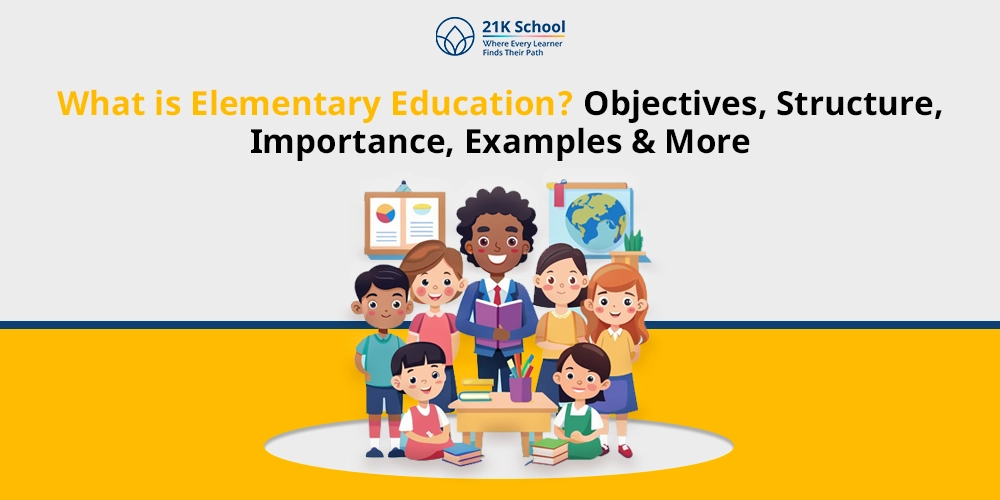
Formal schooling is an essential part of children’s life where they learn everything from reading, writing to social skills.
The first formal stage of education is “Elementary Education” which helps children to develop social, emotional, and cognitive skills at a young age.
The main aim of elementary education is to foster critical thinking, creativity, and moral values. To understand everything about elementary education, you are at the right place.
Here, we will explore all the needful information about elementary education from its objectives, importance, challenges to common myths to avoid. Let’s begin with a meaning.
Contents
- 1 What is Elementary Education?
- 2 Objectives of Elementary Education
- 3 History of Education System at Elementary Level in India
- 4 Importance of Elementary Education
- 5 Structure of Elementary Education in India
- 6 Curriculum in Elementary Education
- 7 Teaching Methods Used in Elementary Education
- 8 Government Initiatives to Improve Elementary Education
- 9 Difference Between Elementary and Secondary Education
- 10 Challenges in Elementary Education
- 11 Elementary Education Example
- 12 Conclusion
What is Elementary Education?
Elementary education is also popular as primary education in various regions in India. It is the first and crucial stage of formal education of a child.
The elementary education journey starts with ages 6 to 14 (Classes 1-8 in many systems). The aims of elementary education are:
- Building fundamental literacy, numeracy, and social skills.
- Basic knowledge in science and social studies.
- Serving as a vital foundation for future learning.
Objectives of Elementary Education
Elementary education focuses on students’ development in the initial stage of their life. Given below are some of the key objectives of elementary education in India.
1. Basic Literacy and Numeracy
Elementary education in which students acquire knowledge of basic literacy and numeracy is a foundation of learning.
It includes basic skills like reading, writing, and mathematical abilities which helps learners in all future learnings.
Literacy and numeracy together promote high levels of education. Children develop strong reading and mathematical abilities to understand complex problems in future grades.
2. Holistic Child Development
Holistic development of a child is one of the objectives of elementary education. Through which students can grow intellectually, emotionally, physically, and socially.
Providing formal education by enrolling in elementary school encourages them to participate and develop skills like problem-solving skills, teamwork, and leadership.
Understand the benefits of student leadership in elementary schools.
3. Universal Access and Equality
Universal access and equality play a major role in people’s lives and elementary schools provide a positive environment to learn regardless of their socio-economic background, gender, or location.
The Government of India also promotes equal and quality elementary education to remove the barriers of society.
Elementary education is not limited to learning but also to reduce illiteracy, poverty, and social inequality in society.
4. Character Formation
Elementary education directly helps in students character formation. Children learn moral and ethical values including honesty, respect, responsibility, kindness, and discipline.
Children with morals and ethics can create a positive environment for themselves and others. This also helps them in building good habits like socialising and a sense of responsibility.
5. Socialization and Citizenship
Enrolling in elementary school is important for students to become members of society. Students interact, collaborate, and gain trust to settle down in the environment.
There are various activities like group projects, classroom discussions, and community events which engage students with each other. In this way one can experience and understand each other’s feelings or opinions.
History of Education System at Elementary Level in India
The history of the education system at elementary level in India is divided in many parts. Starting from ancient and medieval periods to the modern era.
Given below is an overview of history of education system at elementary level in India:
- Ancient and Medieval Period
Gurukuls are popular places in ancient India in which students leave with teachers to learn various subjects including basic life skills, religion, philosophy, and ethics. Later in the Buddhist period, learning centres became popular.
Maktabs and madrasas were established in the medieval period where students get religious teaching with basic reading and writing.
- Colonial Period (19th–20th Century)
During the Colonial Period, education was transformed significantly in India. Some key points to consider:
- Promoted Western-style education
- Introduction of English-based education system
- Focus on higher education and administrative training
- The Hunter Commission for primary education
- Post-Independence Period (1947–1990s)
In 1947–1990s, the government promoted education in India for all children. The Indian Constitution included Article 45. It was a Directive Principle of State Policy.
It helps in providing free and compulsory education to children. With time several educational reforms and committees worked to improve the education system in India. The Kothari Commission is one of the popular initiatives.
- Modern Era (2000s–Present)
In the modern era, the government passed the 86th Constitutional Amendment, which made education a fundamental right under Article 21-A.
The Right of Children to Free and Compulsory Education Act was introduced to provide free and compulsory education to every child between the ages of 6 and 14.
- National Education Policy 2020
Today, the National Education Policy 2020 promotes elementary education by focusing on students:
- Foundational literacy and numeracy skills
- Early childhood education
- Mother tongue and local language
- Technology integration
Importance of Elementary Education
For child overall development elementary education plays a key role by offering a foundation for future growth. A strong elementary education system promotes both academic and personal development.
Some key points to understand the importance of elementary education in child’s life are:
1. Fundamental Academic Skills
To develop fundamental skills including reading, writing, and basic mathematics. This creates interest in different domains to motivate them for higher education.
Students learn various things from how to read and write sentences to introduction of different subjects like science, social science mathematics etc.
2. Holistic Development
Enrolling in elementary school helps children to develop holistically. It simply means students are not only limited to academic success but also develop overall.
They learn how to solve a mathematical problem, they can also choose subjects of their interests. For example, sports, art, music, drawing etc.
Holistic education is a powerful technique to learning which nurtures all aspects of a student’s development.
3. Character and Value Formation
Development of character and value formation is important from a young age to ensure students are in a good environment.
Enrolling in elementary school offers a positive learning environment to each student
It focuses on students’ character building and value formation from early childhood which helps to learn the importance of honesty, respect, responsibility, and kindness.
4. Lifelong Learning and Adaptability
Elementary education is an initial stage of lifelong learning. From this stage students explore and continue finding their interested areas which promote higher education.
By learning key skills like critical thinking, communication skills, problem-solving and adapting changes in the environment ensure continuous education.
5. Health and Economic Growth
Elementary education is not only limited to academics but also improves public health and economic development.
It is not only important for personal reasons but also for strengthening community.
Structure of Elementary Education in India
The structure of elementary education in India consists of primary education and upper primary education which focus on building students’ foundational literacy, numeracy, and cognitive development.
1. Primary Education (Class 1 to 5)
Primary education is represented as an initial phase of formal education. It is a compulsory and formal schooling for children aged 6 to 11 years.
Primary education strengthens students’ foundation and acquires the necessary skills. However, there are many online primary schools that focus on English numeracy, critical thinking and language as their main areas of learning.
- Primary stage: Classes 1 to 5
- Focus on: Basic literacy, numeracy, and environmental studies.
2. Upper Primary Education (Class 6 to 8)
Upper primary education is a stage that follows primary education. It covers the age group of 11 to 14 years old children.
Upper primary education provides a more comprehensive curriculum helps students to build the foundational knowledge acquired in primary school.
Students in upper primary education focuses on specialised subject teaching, developing critical thinking, and preparing students for more complex, subject-focused, and academic, or vocational learning.
- Upper primary stage: Classes 6 to 8
- Focus on: Introduction of subjects like science, mathematics, and social studies.
Curriculum in Elementary Education
The education curriculum is designed to promote students’ academic foundation and holistic development. In this stage students learn how to read, write, and solve questions effectively.
However, it is not limited to academic performance but also provides an environment to learn various skills including communication, teamwork, critical thinking, creativity, and social interactions.
In the curriculum in elementary education teachers introduce various subjects like science, social science, and mathematics to develop each student’s interests and choices.
The curriculum of elementary education in India is based on NCERT. The body helps in designing learning material and modern teaching methods for elementary school students.
Teaching Methods Used in Elementary Education
Understanding everything about elementary education is not enough. Students, parents, and teachers need to understand the right teaching methods used in elementary education to get desired results.
Go through some of the popular teaching methods used in elementary education by teachers:
1. Inquiry-Based Learning
One of the popular techniques known as inquiry-based learning is an approach that creates a student-centred learning environment where they feel confident in asking questions.
The approach is ideal to increase students:
- Knowledge and curiosity
- Analytical thinking
- Independent learning skills
For classroom engagement, implement effective self-motivation activities for elementary students.
2. Kinesthetic/Hands-on Learning
Through kinesthetic or hands-on learning students focus on various physical activities and practical experiences.
The hands-on learning is beneficial to students:
- Improves memory retention
- Boosts self-esteem
- Hands-on application of knowledge
- Increases students engagement and learning motivation
3. Game-Based Learning
Another teaching method used in elementary education is game-based learning. It uses fun and educational games to make learning interactive.
In this way, students participate in classroom learning and gain the necessary information through games. Some common games include:
- Educational Video Games
- Simulation Games
- Role-Playing Games (RPGs)
- Puzzle and Strategy Games
To know more, go through some of the educational online games for elementary schools.
4. Project-Based Learning (PBL)
Project-Based Learning (PBL) is a teaching method in which students gain information and skills by working on complex, real-world problems or challenges over an extended period of time.
The method helps in reshaping the future of education by offering a dynamic and engaging learning environment.
5. Technology-Based Learning
Technology has become a vital part of the modern education system. From learning through educational apps to digital textbooks everything is based on technology.
Using technology in education improves student learning and gives them useful tools and techniques to become digitally literate.
Government Initiatives to Improve Elementary Education
To promote elementary education in India, the government introduced various initiatives. Given below are some government initiatives for elementary education:
1. Sarva Shiksha Abhiyan (SSA)
Sarva Shiksha Abhiyan (SSA) is the flagship scheme/program launched in 2000.
It is a government initiative aimed to ensure that all children between the ages of 6 and 14 had access to free and compulsory education.
2. Right to Education (RTE) Act, 2009
Right to Education (RTE) Act, 2009 is a popular initiative aimed at free and compulsory education for children aged 6 to 14. It includes a 25% reservation in private schools for EWS.
It promotes quality and inclusive education for disadvantaged groups. Under this act, the government takes responsibility to provide education to students.
3. NIPUN Bharat Mission
The NIPUN Bharat Mission is a government of India initiative which aims that every child achieves foundational literacy and numeracy skills by the end of Grade 3.
This mission focuses on:
- Improving early childhood education
- Strengthening teacher training
- Developing high-quality learning materials
4. Mid-Day Meal Scheme (PM POSHAN)
The Mid-Day Meal Scheme is now popular as PM POSHAN (Pradhan Mantri Poshan Shakti Nirman). The scheme promotes school nutrition programs. In this scheme, students studying in government and government-aided schools get free meals.
The scheme reduces hunger and supports better concentration by providing nutritional food daily.
Difference Between Elementary and Secondary Education
Following is a quick table showcasing the key difference between elementary and secondary education:
| S. No. | Aspects | Elementary Education | Secondary Education |
| 1. | Age | 5–11/12 (Kindergarten to Grade 5 or 6). | 12–18 (Middle to High School, typically Grades 6-12). |
| 2. | Curriculum Focus | Elementary education focuses on basic skills such as reading, writing, and arithmetic. | Secondary education introduces specialised and in-depth studies. For example, algebra, chemistry, literature, and foreign languages. |
| 3. | Assessment | Progress, participation, and skill development. | Formal, high-stakes assessments such as exams, projects, and standardised tests. |
| 4. | Teacher Role | Generalist (Teaches all subjects). | Specialist (Teaches one subject). |
| 5. | Independence | Low, requires high monitoring. | High, encourages self-study. |
Challenges in Elementary Education
Despite various benefits and initiatives, elementary education still has some challenges which can impact the learning of students. Some common points include:
1. Lack of Infrastructure
Elementary education lacks the proper infrastructure for effective learning. The problem is often faced by rural and remote area children.
However, many elementary schools don’t have proper areas for libraries, laboratories, toilets and sanitation facilities.
This can create an uncomfortable situation which leads to less attendance or interest in learning. It’s important to create a safe and secure environment for all.
2. Shortage of Trained Teachers
Teachers are the primary requirement for elementary education of students. A qualified and trained teacher can offer the right environment to grow better.
But, shortage of trained teachers can affect the quality of education and interest of students in the classroom.
3. Learning Gaps Among Students
The learning gap is one of the challenges students face when they are unable to understand concepts due to various reasons including differences in learning pace, lack of individual attention, or disruptions in schooling.
If it is not addressed early by teachers and parents, students need to deal with academic challenges like low performance.
4. Dropout Rates
Enrollment in elementary schools offers various benefits. But, dropout rates are still a concern in some regions.
Some common factors are economic challenges, family responsibilities, lack of interest in studies etc.
5. Digital Divide
In the 21st century, technology in education is a benefit for parents, teachers, and students. Promoting digital literacy ensures quality education.
However, the unequal access to digital technology and internet connectivity popularly known as digital divide is one of the challenges which can impact students’ virtual learning.
Elementary Education Example
Understanding elementary education can be easy by exploring some real life examples:
- A child in elementary school learns how to greet each other and understand the behaviour to approach teachers and classmates.
- Students in elementary school learn how to create a solar system project by grouping with classmates to learn skills like collaboration, teamwork, and time management.
- An elementary school student learns how to resolve maths puzzles, for example total cost of apples or apply mathematical concepts to real-life situations.
Conclusion
For students, elementary education is a new step towards discovering the world. This is a foundational stage shaping the future of individuals and society.
Teachers can start with simple fun learning activities including reading, writing, and mathematical understanding, which support all future learning.
A strong elementary education system ensures growth and development from an early stage. Hopefully, the information helped to understand the importance of elementary education for students.

You may also want to read