

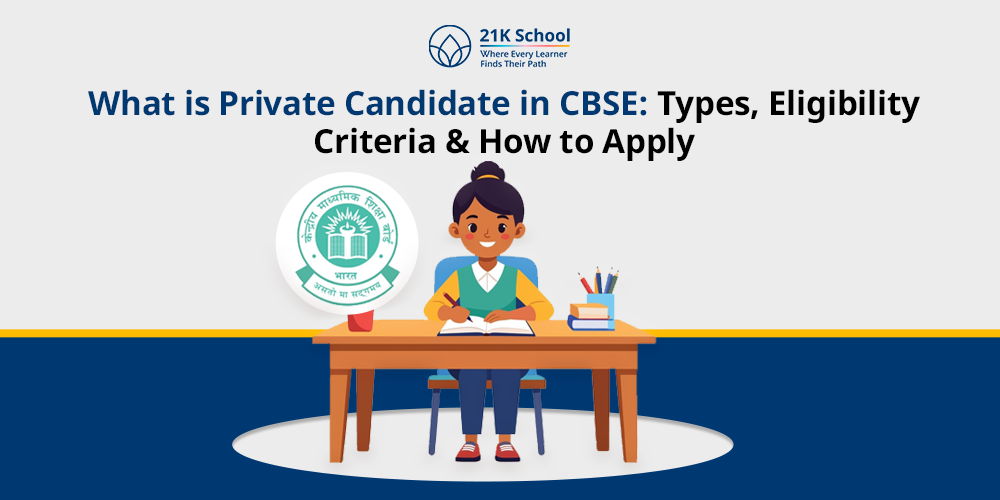
CBSE enables some of the learners to take exams and study as private candidates. But what is a private candidate in CBSE?
The CBSE information regarding private candidates is already available in detail on the CBSE official site.
We will handhold you on what the concept is, the procedure of application, types, requirements and documents to apply as a private candidate.
Contents
- 1 What is a Private Candidate in CBSE?
- 2 Who can Apply for a Private Candidate in CBSE?
- 3 4 Types of Private Candidates in CBSE
- 4 Private Candidate vs Regular Candidate in CBSE
- 5 CBSE Private Candidate Eligibility Criteria
- 6 Application Process for Private Candidates in CBSE
- 7 Documents Required for Private Candidates
- 8 CBSE Private Candidate Rules
- 9 Important Dates for CBSE Private Candidates 2026
- 10 Examination Pattern for Private Candidates
- 11 Admit Card for Private Candidates
- 12 4 Advantages of Being a Private Candidate
- 13 4 Disadvantages of Being a Private Candidate
- 14 Fee Structure for Private Candidates
- 15 5 Tips for Private Candidates to Prepare Effectively
- 16 Final Thoughts
What is a Private Candidate in CBSE?
Privately referred candidates: these are candidates who pass the examinations of the boards of Class 10 or 12 but are not students of a school affiliated to the CBSE.
The private students do not need to attend classes at school, internal exams administered by the school or a 75% attendance, unlike the regular students.
They, however, administer the same exams as those of the boards. A similar syllabus is applied in these tests, and those students who have studied privately are given certificates that are equally recognised in the country.
This school system is advantageous to those learners in need of flexibility, second opportunities and academic improvement, though they cannot be educated within a rigid school model.
These are special learners who are teachers, physically challenged women and women who have passed their class 10/ equivalent through the CBSE board or any other recognised board, but due to one reason or another need special help, not to attend school on a regular basis.
Who can Apply for a Private Candidate in CBSE?
CBSE limits the type of learners who can be private candidates. Neither does it admit totally new pupils who have no previous performance under CBSE, or any other board.
Students who have already registered or taken CBSE tests can apply and must get a classification into one of the categories to be used as a private candidate.
These are the ones that have either failed their board exams, would prefer getting better grades, applied to take compartment exams or even study other courses.
CBSE says that students must be 14 years of age in Class 10. It does not have any strict age condition when it comes to the applicants, but the applicants must be academically qualified.
The candidates are also required to pass Class 11 of a recognised board in Class 12 and should have met the requirements of continuation.
4 Types of Private Candidates in CBSE
CBSE categorises the private candidate into four wide categories based on the reason why one opts to take the test.
1. Improvement Candidates
On passing the board exams, but scoring not very well, applicants are free to become a private candidate. They are considered to be the improvement candidates. They are able to rewrite a subject or subjects in order to achieve better grades.
This can be good in most occasions with the students, who want good percentages in college admissions tests or competition tests.
2. Compartment Candidates
The compartment candidates are those students who have been unsuccessful in one or two subjects in the board exams. CBSE allows them to write them again, and not necessarily start the year.
They can submit as private candidates (Essential Repeat) in case they fail the examination of the compartments as well.
3. Essential Repeat Candidates
The repeated candidates who have had the highest scores had failed in certain subjects, and they had no opportunity to pass even after repeated efforts.
Such students have to reappear in all the subjects needed as private students.
4. Additional Subject Candidates
They may also enrol subject candidates in students whose grades are good, but who wish to add another subject to his/her academic history.
Additional subjects mostly demanded by learners who desires to be qualified to take up certain courses or career fields.
5. Teachers
CBSE can employ teachers who are at least two-year-old graduates of a CBSE-affiliated school and also have passed one of the Senior School Certificate Examinations. They must also have graduated or passed the relevant examination at least two years ago, as well.
6. Women Candidates (Delhi-Specific)
The focal group will be a group of women residing in the National Capital Territory of Delhi who are more than 2 years of age, completed Class 10 or above at least two years ago.
7. Physically Handicapped Students
Members of this group are those that have completed Class 10 or beyond at least twice but are somehow handicapped that they are unable to attend school in a usual manner. These candidates should have received privately tutoring.
Private Candidate vs Regular Candidate in CBSE
As you all know, the regular and the private candidates are quite different. Their difference is indicated in the table.
| Feature | Private Candidate | Regular Candidate |
| Enrollment | Not enrolled in school | Enrolled in CBSE-affiliated school |
| Mode of Study | Self-study or coaching | Classroom-based learning |
| Attendance | Not required | Mandatory |
| Internal Assessment | Limited or separate | Conducted in school |
| Practical Classes | At designated centers | In school labs |
| Guidance | Self-managed | Teacher support available |
| Flexibility | High | Limited |
| Fee Payment | Direct to CBSE | Through school |
CBSE Private Candidate Eligibility Criteria
The students would have to fulfil some of the eligibility criteria that CBSE had established in order to be a private candidate.
In the past (or must fall under such categories as improvement, compartment, essential repeat or additional subject), the candidates must have passed the board exams of CBSE.
They should have actual qualifications in the form of a past class 10th marksheet or certificates.
The process of selection of subjects should be presented with regard to the CBSE notifications, and submission of the applications should be punctual.
Those teachers who have not done CBSE class 10 or any other board recognised are not allowed to apply.
Application Process for Private Candidates in CBSE
In order to be a student under his special application, one has to undergo the following steps:
1. Visit the CBSE Website
The applicants would be required to pay a visit to the official CBSE site.
Next, proceed to the part of Privately Candidates and mark in the application forms.
3. Fill in Personal Details
The form should be filled by the candidate with the right personal and academic details such as previous roll numbers and subjects of interest.
All information has to be correct, and any mistakes can result in problems in the future.
4. Upload Necessary Documents
Upon filling in the information, the candidates will be supposed to submit the necessary documents, which will include mark sheets, photographs and identification documents.
5. Pay the Examination Fee
It is also mandatory that the candidates submit the documents and pay the examination fee using the online payment systems.
6. Download and print the Confirmation Page
Finally, the candidate will also be required to download and print out his/her confirmation page, which they will use in the future.
Documents Required for Private Candidates
They are just some of the main documents that the applicants need to submit to ensure that they are qualified to be employed.
They may be old mark sheets or pass certificates since they may prove their history of study.
The candidates will also be required to submit an up-to-date passport-sized photograph and signatures in the given format. It has to have identity checks, and this is achieved by an authentic government ID.
In addition, the applicants applying in and through some of the categories, such as the compartment or improvement, are expected to provide supporting documents.
It should be noted that all the documents should be properly uploaded.
CBSE Private Candidate Rules
CBSE has come up with some rules which must be taken into consideration by the private applicants.
The candidates are forced to undertake their exams in exam centres that are indicated by the CBSE.
The subjects will be scheduled to complete class 12 practical exams in the given time, which will be used in practical activities. The candidates will be required to come to the examination centre with the admit card and a genuine ID.
Applicants should ensure that they have all the information and submit an application because, in some cases, the information can not always be corrected after the application has been received.
The individual candidates will have to adhere to the entire policies, syllabus and exam pattern. Disqualification may be caused by any violation.
Important Dates for CBSE Private Candidates 2026
It can be expected that the admission process of the CBSE private students in the 2026 session will begin in September 2025.
The last application was 9th October to 30th October 2025, where they had to fill their applications without paying a registration fee.
A complete process during early stages is recommended to prevent last-minute problems.
CBSE offered a late deadline from 3rd October till 11th November 2025. Those who apply late will be allotted this time to make their applications but subjected to some extra charges.
In February, 2026, the admit cards of the privatised applicants will be made available. They have to be downloaded on the official site and checked by the candidates.
The question papers to be given to the candidates of the private board of CBSE will probably be between the months of February to April in the year 2026. The information about the timeline will be announced by CBSE.
In May 2026, academic results are to be announced. With the use of roll number and the date of birth, the candidates will be able to see their scores on the Internet.
Examination Pattern for Private Candidates
The pattern of the CBSE examination of the private candidates is the same as of the regular candidates.
CBSE is exactly the same in giving the question paper and marking scheme to both the private and regular candidates.
The tests are an outcome of the existing CBSE syllabus. Question papers can be multiple-choice, short and long-answer in nature.
The length of each of the papers will be 3 hours and will be graded on the basis of the regular pupils.
Since the privates will also be subjected to practicals, they will have to do an exam in the accredited CBSE test centres.
Their marks are calculated based on their performance in the following: practical, viva and in project/ record books.
Admit Card for Private Candidates
CBSE privates are provided with the admit card by the official CBSE site. The private students have to download the admit card themselves, as opposed to other students.
In most cases, the admit card is issued during February, and the admit card is an important document which has details like the roll number of each candidate, examination centre, subjects to be administered and a schedule of the examination.
It is advisable to have a printed copy of the test admit card and ID at the test centre.
Candidates have to confirm all the details in the admit card prior to the procedure and guidelines.
4 Advantages of Being a Private Candidate
A private candidate gets the following 4 advantages in CBSE schools:
1. Flexibility
One of the most outstanding capabilities of the private candidates is flexibility. The students have the opportunity to study at their own pace , not being limited by a school timetable.
This will provide them with an opportunity to focus on their personalised learning plan and timeline.
2. Second Chance
The other benefit is that it is a second chance for such students who wish to rewrite their papers or pass their subjects which they have failed in the past. Academics and a career can be achieved in large part due to this prospect.
3. No School Dependency
Schools do not rely on private candidates in terms of attendance, assignments, and internal tests. This independence provides them with opportunities to show their best in preparing for their exams .
4. Focused Preparation
It would also give the students time to work on it with particular focus, as students can only focus on the aspects it needs to improve. This simplifies their studying.
4 Disadvantages of Being a Private Candidate
Private candidates have the following disadvantages:
1. Lack of Guidance
The absence of instructions is one of the main drawbacks, as the students are deprived of personal access to teachers to clarify their questions or elaborate on complicated ideas.
2. Self-Discipline Required
The other challenge is that it requires a high level of student discipline . The absence of structure allows students to stay at their own level of motivation and consistency.
3. Limited Practical Exposure
Individual candidates might not have much practical experience as well, particularly in the science subjects, as they do not have regular school labs and practice.
4. Isolation
Isolation could be a problem. Lack of peer interaction can also have the same impact of demotivation, and it can also lead to the demise of normal competition, which tends to magnify the performance of learners.
Fee Structure for Private Candidates
CBSE charges the private students in standard terms in terms of exam fees per subject, practical fees and certain other charges in case of late submissions. The charge can, however, be subject to change every year.
It is estimated that the average cost that may be charged per subject by a candidate is ₹320.
On applied subjects, there are other fees charged. In case of late submission of the application, the cumulative fee will be ₹2000.
We recommend that the students follow the official announcement of CBSE in order to ascertain the real charges which they would be obliged to pay in the 2026 session.
5 Tips for Private Candidates to Prepare Effectively
Since the private candidates will be deprived of the assistance of the educators, they will have to listen to a few simple rules that will help them to pass the tests:
1. Create a Study Plan
The personal candidates should be structured to provide them with a fine study program. Having a certain study routine will result in being able to cover all the subjects practically, with a sufficient amount of time to edit.
2. Use Official Resources
Formal material like NCERT textbooks and CBSE sample papers is highly desirable since they are covered in the pattern and syllabus of the exam.
3. Practice Regularly
Regular revisions have the capacity to make a new learner successful. The past years’ question papers and practice tests are best solved to increase the speed, accuracy and confidence.
4. Stay Consistent
Consistency is an important aspect of preparation. The most optimum incidence sessions, which are shorter in duration, are more desirable than irregular and longer incidence sessions.
5. Seek Help When Needed
It will be through the help of coaching and mentors that the students will no longer fear going online to clarify the questions and consolidate their knowledge.
Final Thoughts
Learners who fail all the exams or even take exams privately without being assigned to CBSE schools are termed as privately controlled.
The only qualifications these candidates need are past academic qualifications from CBSE or any other affiliated board schools. They might include teachers, females and the physically challenged as well.
Though the privates are not enrolled in schools on a regular basis they are supposed to be well-learned on their own and perform better.

You may also want to read