


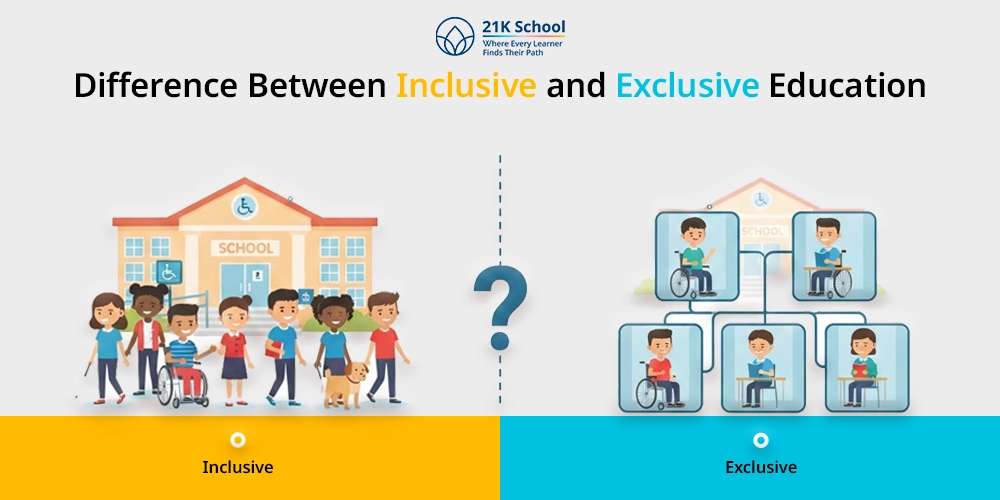
You might be well aware of inclusive education that supports children to study in general classrooms.
But what is exclusive education ? Well, as the name suggests exclusive education caters to students who learn in special settings that are specifically designed for them.
Parents and teachers, who want to efficiently aid these specially abled children, need to know the difference between inclusive and exclusive education.
This article will provide all the benefits, key features, focus, role of teachers, and much more to understand what would be best for these kids.
Contents
- 1 What is Inclusive Education?
- 2 Key Features of Inclusive Education
- 3 What is Exclusive Education?
- 4 Key Features of Exclusive Education
- 5 12 Difference Between Inclusive and Exclusive Education
- 5.1 1. Definition
- 5.2 2. Goal and Focus
- 5.3 3. Benefits
- 5.4 4. Examples
- 5.5 5. Learning Environment
- 5.6 6. Approach to Diversity
- 5.7 7. Curriculum and Teaching Methods
- 5.8 8. Role of Teachers
- 5.9 9. Social Interaction and Development
- 5.10 10. Impact on Learners with Disabilities
- 5.11 11. Assessment and Evaluation
- 5.12 12. Long-Term Social Impact
- 6 Conclusion
What is Inclusive Education?
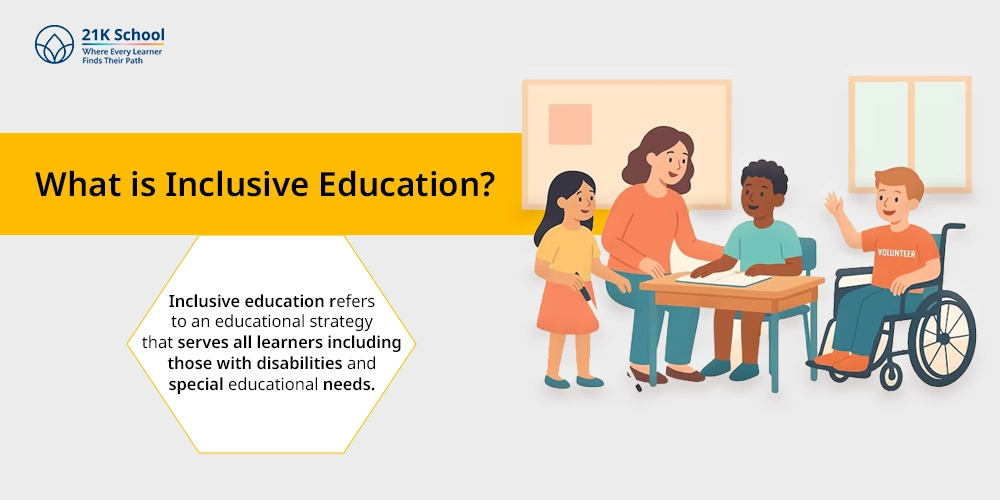
Inclusive education refers to an educational strategy that serves all learners including those with disabilities and special educational needs.
It is delivered in regular schools as well as general classrooms.
It is based on the concept that all children deserve a quality education irrespective of the differences.
Inclusive education involves schools adjusting their environment, curriculum , teaching, and assessment strategies to the varying needs of the learners.
Key Features of Inclusive Education
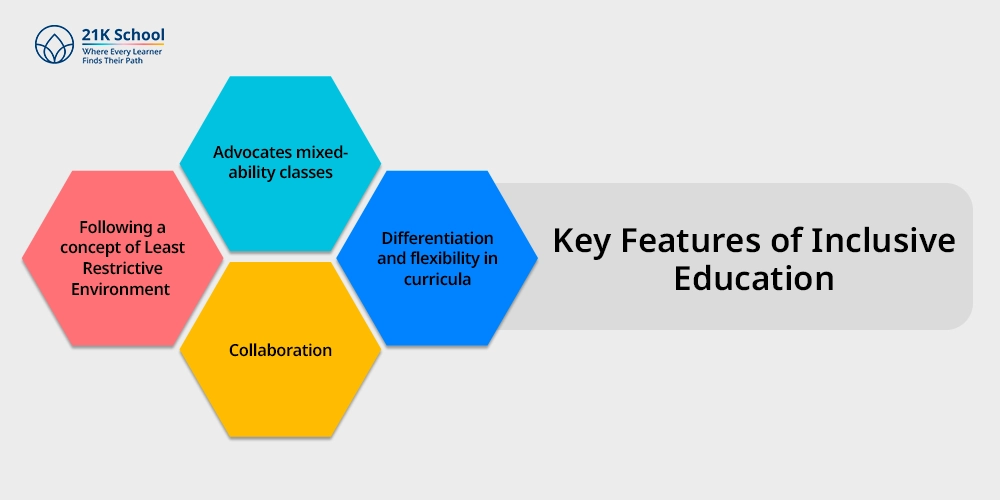
Inclusive education is based on equality, involvement, diversity, and mutual respect.
- It advocates mixed-ability classes where the learners help and learn from each other.
- Differentiation and flexibility in curricula are some of the teaching methods used by the teachers to meet individual needs.
- Collaboration is another important characteristic. Teachers collaborate with special educators, counselors, parents, and communities to have a holistic approach.
- It functions by following a concept of Least Restrictive Environment where disabled students are taught with non-disabled children for their optimum growth.
In such classrooms, special settings are only used when really required.
What is Exclusive Education?
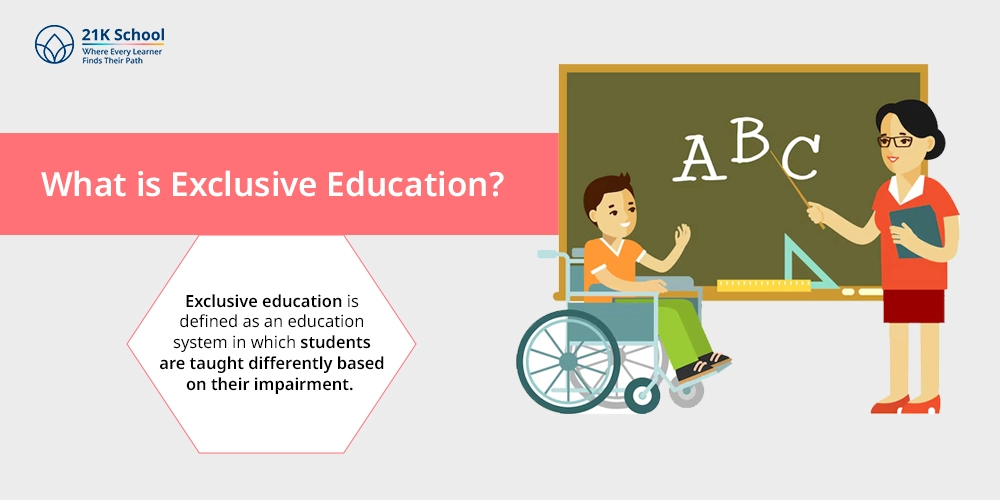
Exclusive education is defined as an education system in which students are taught differently based on their impairment.
In this system, education is not offered in a universal manner but selectively.
Exclusive education presupposes that some learners need to have special environments, which cannot be offered efficiently in regular classrooms.
Consequently, children with disabilities might attend special schools and less academically bright students might not attend the high networking schools.
Key Features of Exclusive Education
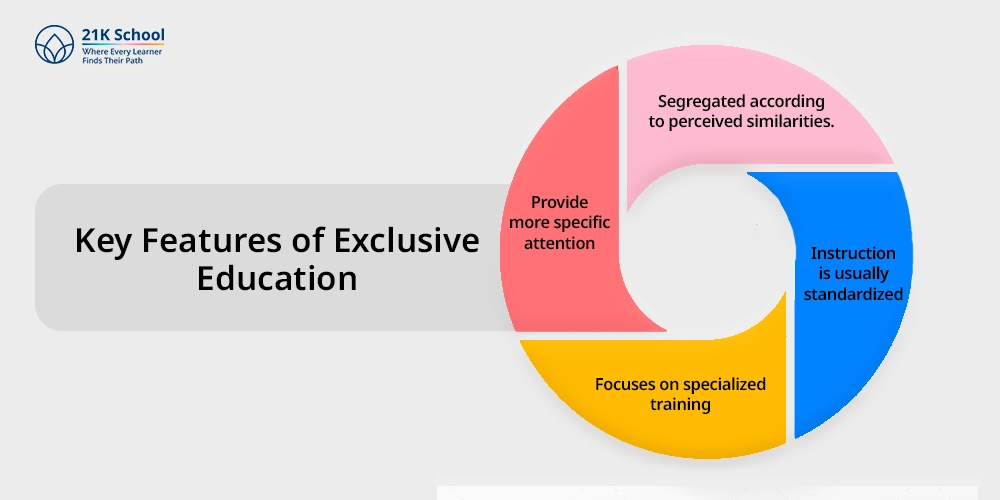
Segregation and selectivity are characteristics of exclusive education.
- Students are segregated according to perceived similarities and instruction is usually standardized according to a specific group of learners.
- The system focuses on specialized training and restricts the interaction with other peers.
- Although exclusive education might provide more specific attention, it can also strengthen labeling and stigma.
This can influence self-esteem and social development of learners.
12 Difference Between Inclusive and Exclusive Education
Now, let’s understand the specific differences between inclusive and exclusive education with the help of a table and some bullet points:
| Aspects | Inclusive Education | Exclusive Education |
| Definition | Inclusive education is the method of learning to include every learner in general classrooms and foster interaction and equality. | Exclusive education is the education system that separates learners based on the abilities, background, or abilities and are taught differently. |
| Goal and Focus | Cater to learners from all backgrounds with inclusivity | Deliver tailored education to varied learners |
| Benefits | Boosts participation, peer learning , collaboration, and empathy for every student. | Provides personalized learning specific to the students |
| Examples | Collaborative learning methods and differentiated instruction in general classrooms | Special schools and other programs for specially-abled children. |
| Learning Environment | Mixed-ability classrooms | Separate classrooms or schools |
| Approach to Diversity | Diversity seen as strength | Diversity seen as a challenge |
| Curriculum and Teaching Methods | Flexible and adaptive | Fixed and group-specific |
| Role of Teachers | Facilitators and supporters | Instructors for specific groups |
| Social Interaction and Development | High interaction among learners | Limited interaction |
| Impact on Learners with Disabilities | Promotes inclusion and dignity | May lead to stigma |
| Assessment and Evaluation | Continuous and formative | Standardized and rigid |
| Long-Term Social Impact | Builds inclusive society | May unintentionally reinforce inequality |
1. Definition
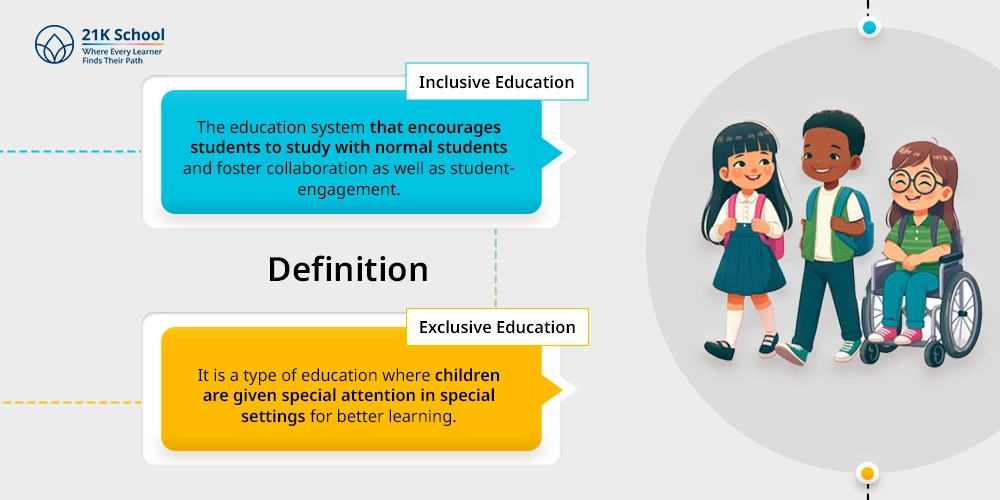
- Inclusive Education: Inclusive can be defined as the education system that encourages students to study with normal students and foster collaboration as well as student-engagement .
- Exclusive Education: It is a type of education where children are given special attention in special settings for better learning and support.
2. Goal and Focus
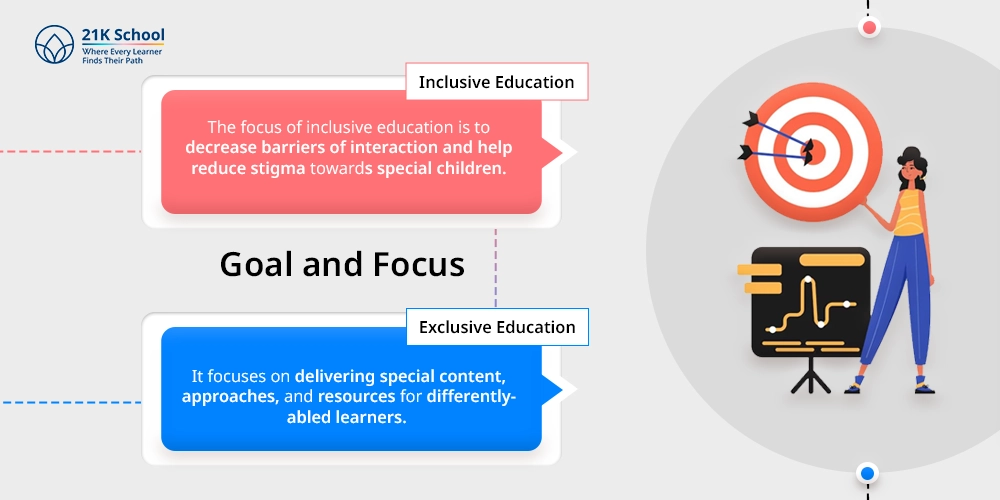
- Inclusive Education: The focus of inclusive education is to decrease barriers of interaction and help reduce stigma towards special children.
- Exclusive Education: Exclusive education focuses on delivering special content, approaches, and resources for differently-abled learners.
3. Benefits
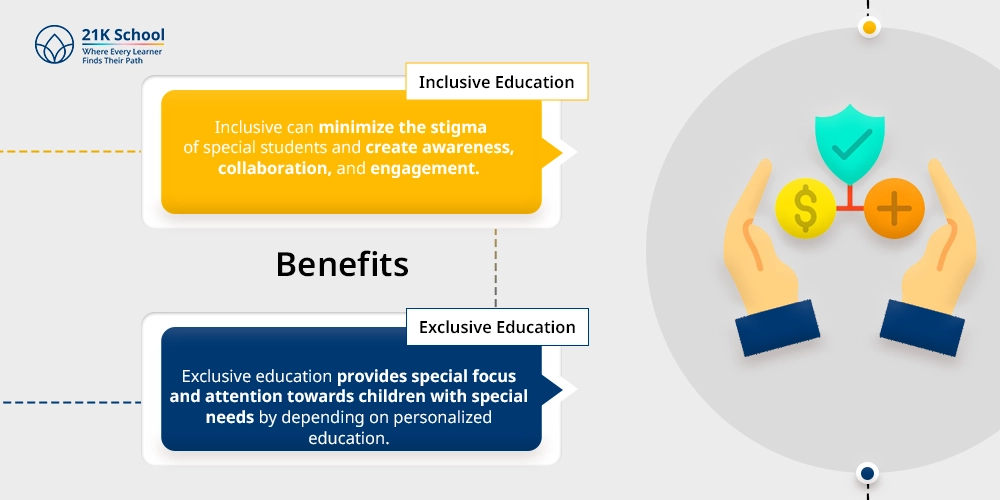
- Inclusive Education: Inclusive can minimize the stigma of special students and create awareness, collaboration, and engagement in all learners.
- Exclusive Education: Exclusive education provides special focus and attention towards children with special needs by depending on personalized education.
4. Examples
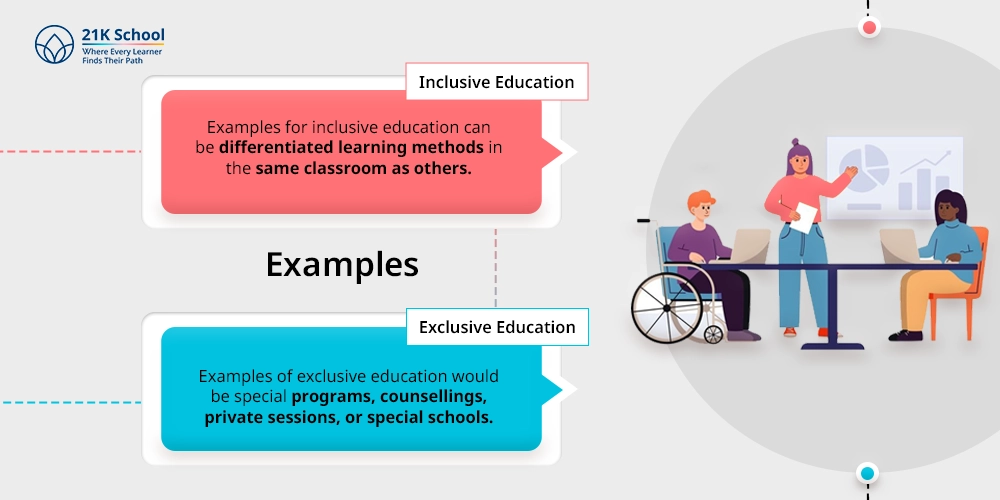
- Inclusive Education: Examples for inclusive education can be differentiated learning methods in the same classroom as others.
- Exclusive Education: Examples of exclusive education would be special programs, counsellings, private sessions, or special schools.
5. Learning Environment
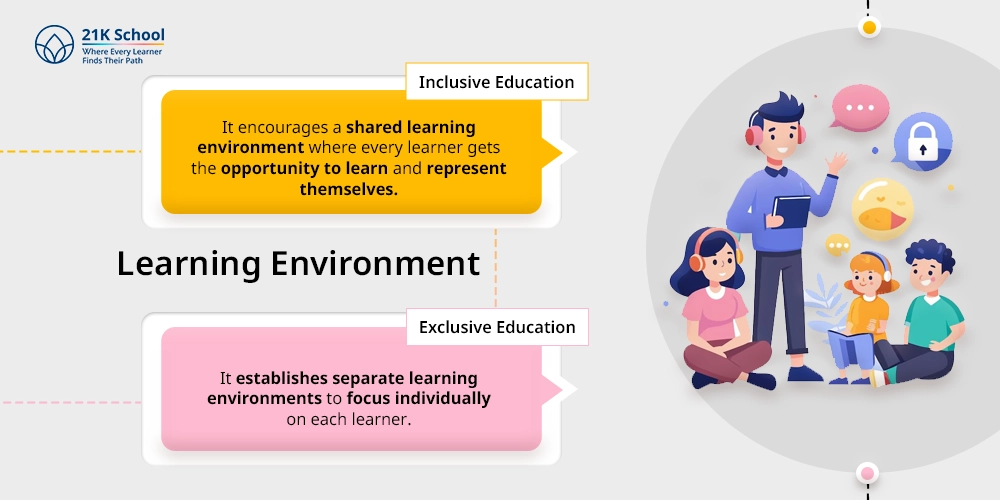
- Inclusive Education: Inclusive education encourages a shared learning environment where every learner gets the opportunity to learn and represent themselves.
- Exclusive Education: Exclusive education establishes separate learning environments to focus individually on each learner.
6. Approach to Diversity
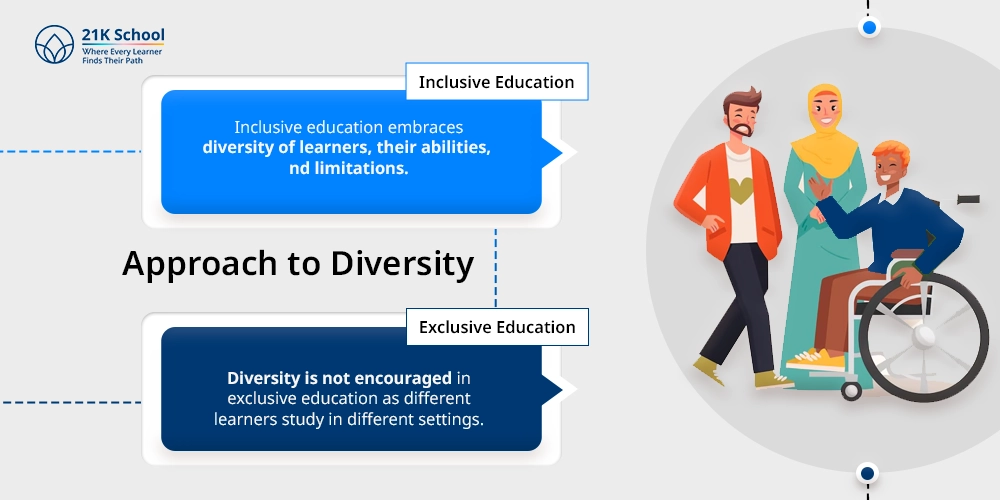
- Inclusive Education: Inclusive education embraces diversity of learners, their abilities, and limitations.
- Exclusive Education: Diversity is not encouraged in exclusive education as different learners study in different settings.
7. Curriculum and Teaching Methods
- Inclusive Education: Inclusive education is based on the adjustment of curricula to an individual, which works as Individual Educational Plans (IEPs).
- Exclusive Education: Exclusive education is based on having a standard curriculum for each learner.
8. Role of Teachers
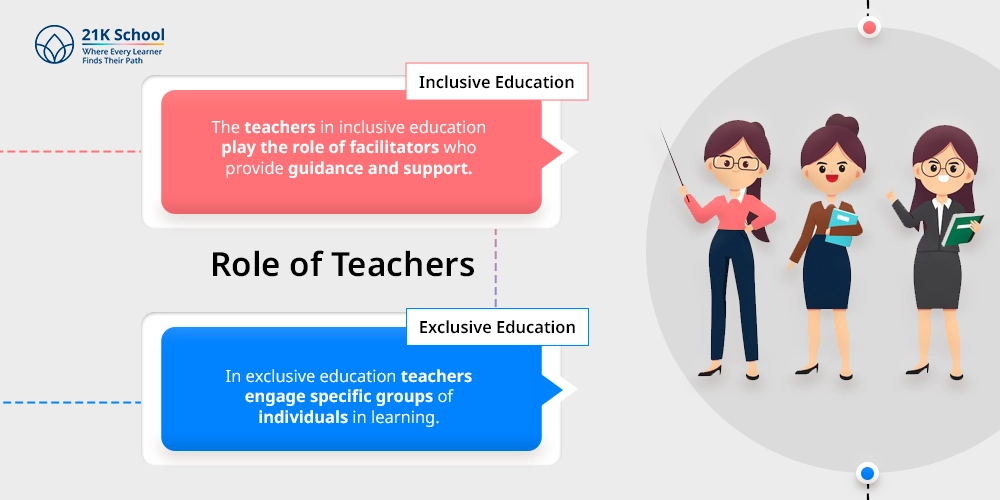
- Inclusive Education: The teachers in inclusive education play the role of facilitators who provide guidance and support for learning.
- Exclusive Education: In exclusive education teachers engage specific groups of individuals in learning.
9. Social Interaction and Development
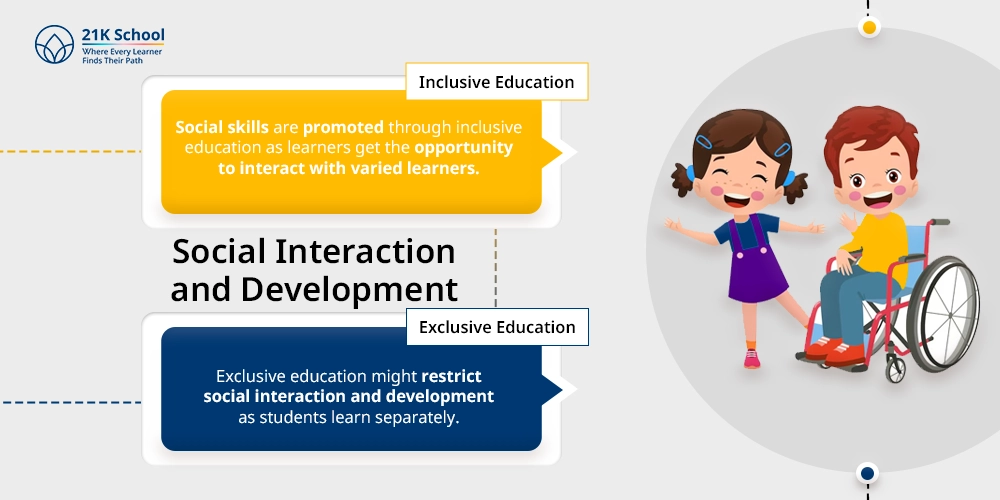
- Inclusive Education: Social skills are promoted through inclusive education as learners get the opportunity to interact with varied learners.
- Exclusive Education: Exclusive education might restrict social interaction and development as students learn separately.
10. Impact on Learners with Disabilities
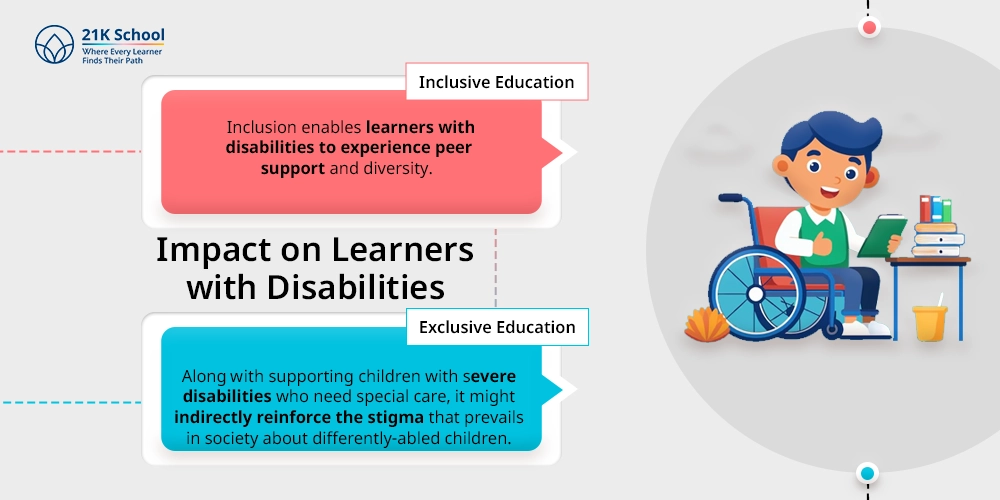
- Inclusive Education: Inclusion enables learners with disabilities to experience peer support and diversity while having quality education .
- Exclusive Education: Along with supporting children with severe disabilities who need special care, it might indirectly reinforce the stigma that prevails in society about differently-abled children.
11. Assessment and Evaluation
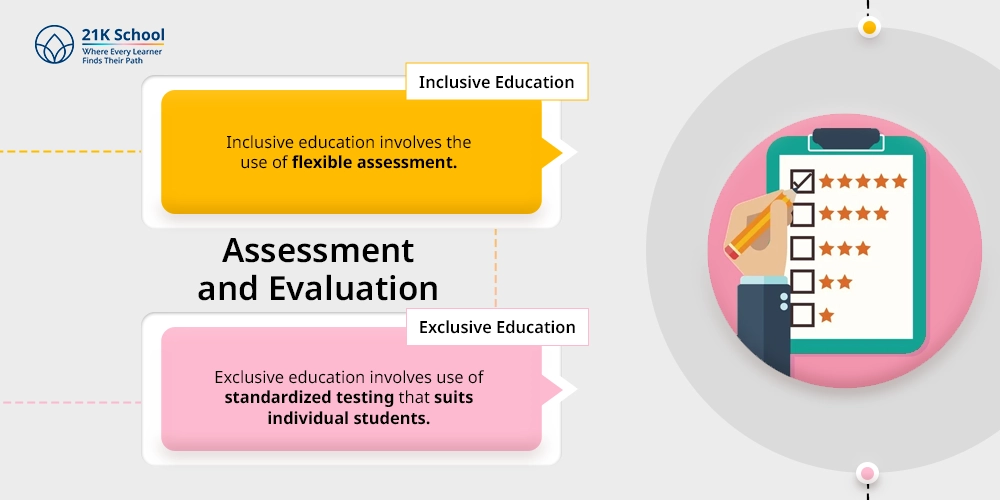
- Inclusive Education: Inclusive education involves the use of flexible assessment .
- Exclusive Education: Exclusive education involves use of standardized testing that suits individual students.
12. Long-Term Social Impact
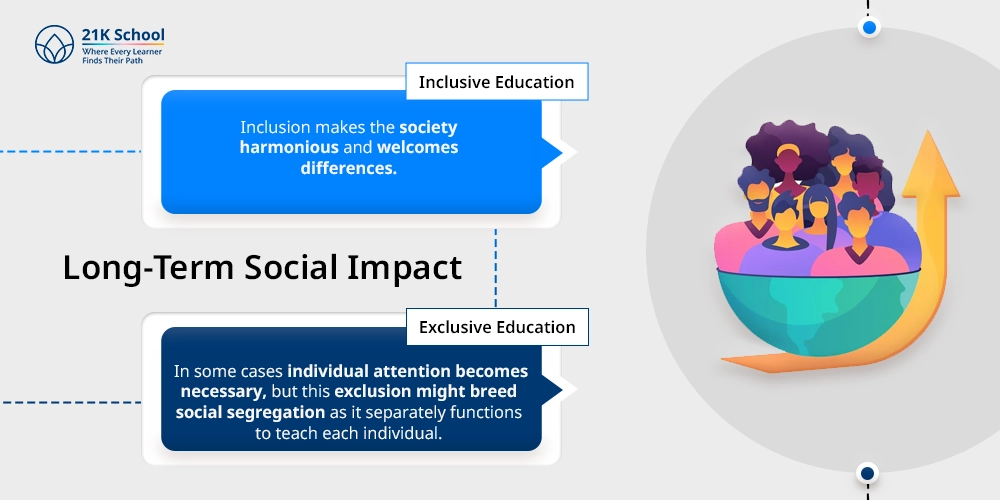
- Inclusive Education: Inclusion makes the society harmonious and welcomes differences by also impacting the mentality of the general public towards special needs children.
- Exclusive Education: In some cases individual attention becomes necessary, but this exclusion might breed social segregation as it separately functions to teach each individual.
Conclusion
Inclusive education and exclusive education are different in the way they provide learning to special needs learners.
The former focuses on inclusivity and importance of collaboration among young learners, while exclusive education aims to give personalized assistance in structured settings.
Since exclusive education might result in segregation and stigmatization, inclusive education should also be brought into practice accordingly.

You may also want to read
CBSE Passing Marks Out of 100: Theory, Practicals & Grading
- Last updated on: 20 Mar, 2026
- 7 min read