

Did you know that the selection of a right board is so important for the educational journey of a child?
If you are someone looking for an international board for global exposure and higher education abroad then you are at the right place.
This guide takes you on the journey of complete information on the Pearson Edexcel board. Let’s begin.
Contents
- 1 What Is the Edexcel Board?
- 2 Edexcel Curriculum: Programs and Levels
- 3 Edexcel Grading System Explained
- 4 Edexcel vs Cambridge IGCSE: Key Differences
- 5 Edexcel vs CBSE vs IB: 5 Key Difference Between
- 6 Edexcel Recognition and University Acceptance
- 7 Edexcel Schools in India
- 8 How to Prepare for Edexcel Exams Effectively? 3 Common Techniques
- 9 3 Limitations of Edexcel Curriculum
- 10 Conclusion
What Is the Edexcel Board?
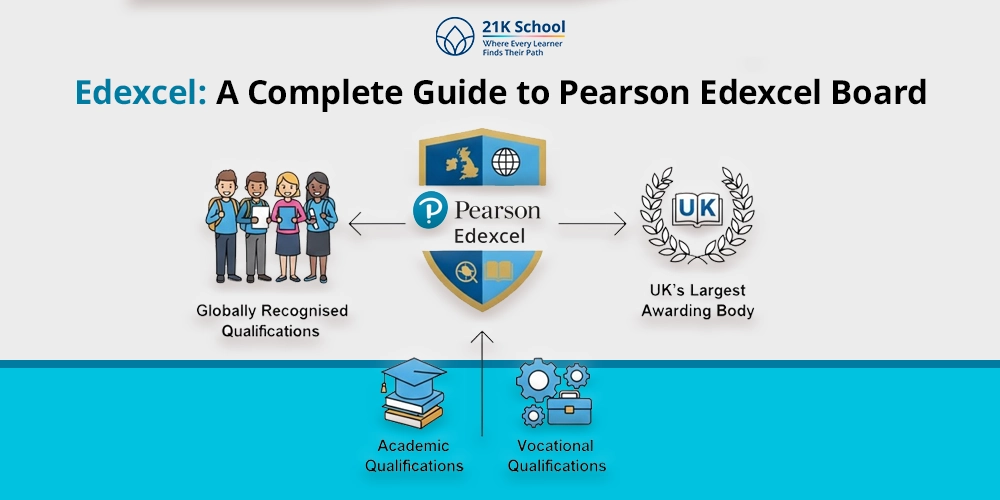
Edexcel board is also popularly called Pearson Edexcel. It is the UK’s largest awarding body which provides globally recognised academic and vocational qualifications to students.
Some popular qualifications Edexcel board provides are:
Edexcel Curriculum: Programs and Levels
Edexcel curriculum helps students to discover the facilities the board offering at different stages of learning:
1. Edexcel Primary Curriculum
In the initial stage the primary curriculum of Edexcel represents a foundational learning for students.Here, students focus on subjects like English, Mathematics, and Science. It is an important part of learning which promotes students’ overall growth.
For example, activity-based learning , concept clarity, and early development of critical thinking is a primary way of learning.
2. Edexcel Lower Secondary
The lower secondary curriculum in the next stage of students development. The objective of this stage is better subject knowledge and structured assessments .
Here, students can learn freely, improve analytical thinking , and academic discipline .
3. Edexcel IGCSE
Edexcel IGCSE/International General Certificate of Secondary Education is a 2 year popular course equivalent to Class 9 and 10 in students aged between 14 to 16 years.
However, some international schools begin IGCSE at age 13 (year 9), taking exams at the end of Year 10.
4. Edexcel International A Level (IAL)
Pearson Edexcel International Advanced Levels (IAL) are qualifications that offer subject flexibility and modular structure and additionally remain comparable to UK AS/A levels. Here, students can opt either full-time or part-time.
For full-time option, students can go with any three of the following subjects:
- Mathematics
- English Language
- English Literature
- History
- Chemistry
- Business/Business Studies
- Accounting
- Geography
- Physics
- Economics
- Psychology
- Biology
- Information Technology
- Applied ICT
- Law
- Spanish
- French
Edexcel Grading System Explained
The Edexcel grading system provides detailed analysis of students’ performance. The board primarily uses the 9-1 scale for GCSEs and International GCSEs.
For International A-Levels, traditional A* to E scale is used. Explore everything in detail through table:
1. Edexcel IGCSE and International GCSE Grading
| Grade | Meaning |
| 9 | Exceptional performance |
| 8 | Very high achievement |
| 7 | Excellent |
| 6 | Strong pass |
| 5 | Good pass |
| 4 | Standard pass |
| 3 | Below standard |
| 2 | Low achievement |
| 1 | Very low achievement |
| U | Ungraded |
2. Edexcel A Level Grading System
“The A-Level grading system in the UK ranges. Edexcel A Levels uses old grading scales (letter grades).
| Serial Number | Grade | Description | Status |
| 1. | A* | Highest achievable grade | Pass |
| 2. | A | Excellent | Pass |
| 3. | B | Very good | Pass |
| 4. | C | Good | Pass |
| 5. | D | Satisfactory | Pass |
| 6. | E | Minimal acceptable | Pass |
| 7. | U | Unclassified (below E) | Fail |
Note: The A-Level grading system has a 6-grade passing scale (A* to E) plus U (ungraded/fail) = 7 levels.
3. Modular vs Linear Assessment of Edexcel
In Edexcel, students get the advantage to choose between modular and linear assessment .
If a student chooses the modular then exams split into units, can retake individual papers. While in linear, all exams at the end of the course.
Edexcel vs Cambridge IGCSE: Key Differences
Check out the quick and easy comparison table that highlights the difference between Edexcel vs Cambridge IGCSE:
| S No. | Particulars | Edexcel IGCSE | Cambridge IGCSE |
| 1. | Exam Board | Pearson Edexcel (UK exam board) | Cambridge Assessment International Education (University of Cambridge) |
| 2. | Global Recognition | Widely accepted internationally; good UK and Commonwealth recognition | Extremely well-recognided worldwide; often considered the benchmark for international schooling |
| 3. | Syllabus structure | Edexcel IGCSE offers a more flexible syllabus with optional units in some subjects. | Cambridge IGCSE offers comprehensive and structured syllabi with clear learning goals . |
| 4. | Grading System | Here the grading system used is 9 to 1 grading (aligns with UK GCSE). | Here the grading system used is A* to G grading (Cambridge IGCSE); some syllabi offer 9 to 1 options. |
| 5. | Teacher Support and Training | Training resources from Pearson | Extensive teacher support, examiner reports, curriculum updates |
| 6. | Content Focus | More application-based questions in some subjects | Focusing on understanding concepts and theory |
| 7. | Recognition in India | Accepted by CBSE schools offering IGCSE; may need equivalency for some Indian universities | Widely accepted and easier for equivalency with Indian boards |
Edexcel vs CBSE vs IB: 5 Key Difference Between
To choose the right board for student, must check out the comparison table between Edexcel vs CBSE vs IB given below:
| S No. | Particulars | Edexcel | CBSE | IB |
| 1. | Governing Body | It is conducted by Pearson Edexcel (UK-based). | It is governed by the Central Board of Secondary Education (India). | It is run by the International Baccalaureate (Switzerland). |
| 2. | Curriculum Focus | It focuses on concept-based, application-oriented, flexible subject choices. | It is structured and theory-focused with strong fundamentals. | It focuses on holistic, inquiry-based learning focusing on critical thinking. |
| 3. | Assessment Pattern | The assessment pattern used here is external examinations with modular and linear options. | The assessment pattern used here is board exams with internal assessments. | The assessment pattern used here is internal assessments, extended essays, projects, and exams. |
| 4. | Global Recognition | It is widely accepted by UK, US, and European universities. | It is mainly recognised in India; accepted abroad with conditions. | It is highly recognised worldwide by top global universities. |
| 5. | Student Workload | The Edexcel board has a moderate workload. | CBSE board has a Moderate workload. | IB board has a high workload. |
Edexcel Recognition and University Acceptance
The Edexcel is recognised and accepted by major universities worldwide. Some popular names are Russell Group, US Ivy League/MIT, Australian Go8 University of Toronto etc. Visit the official website to know more.
Students can also visit Pearson’s official website to get information about lists of recognised institutions and guidelines for progression.
Edexcel Schools in India
There are various Edexcel schools available in India. Here is a list of top Edexcel schools in India ranking for students who desire to enroll in upcoming years:
- Dhirubhai Ambani International School, Mumbai
- The International School Bangalore (TISB), Bengaluru, Karnataka
- Bombay Cambridge International School, Mumbai
- The British School, New Delhi
- 21K school , Online School, Bengaluru, Karnataka
- Calcutta International School, Anandapur, Kolkata
- Aklavya International School, Thengaithittu, Puducherry
- The White School International, Kozhikode, Kerala
- Hebron School, Ooty
- International School of Hyderabad
To find out the nearby options to take admission in Edexcel school in India, go through the official Pearson qualifications website which provides detailed information based on the country, city, and qualification.
How to Prepare for Edexcel Exams Effectively? 3 Common Techniques
Edexcel exams need strategic preparation and smart study techniques. To prepare effectively students should go through following techniques:
1. Study strategies
Use application-based strategies to make learning easy. Some common ways to prepare:
- Breakdown tasks in small
- Understand the syllabus and assessment objectives
- Using mind maps, diagrams, summarising technique
- Use active learning strategies
2. Time management tips
Time management plays a key role in Edexcel exams. Students can start with:
- Realistic study time table
- More time to high-weightage topics
- Pomodoro technique for study
- Include time breaks, revisions and mock tests.
3. Use of past papers
Edexcel past year papers for exams are an ideal way of preparation. It is beneficial for understanding exam patterns, question formats, answer structuring, frequent questions etc.
3 Limitations of Edexcel Curriculum
Along with the advantages of the Edexcel curriculum, there are some kinds of limitations too. Let’s have a look at the limitations of the Edexcel curriculum to know how to use it.
1. Higher academic cost
Due to high academic costs Edexcel education is out of reach for some families. High costs mainly includes:
- Higher school tuition fees
- Exam registration charges
- Expenses of international textbooks and resources
2. Limited school availability in some regions
Edexcel schools are limited in some regions as compared to other boards. This can impact the students’ desire for enrollment.
3. Transition challenges from national boards
Transition challenges from national boards are also a limitation parents and students deal with. But, with proper guidance and adaptation time, students are able to adjust successfully.
Conclusion
Edexcel board/Pearson Edexcel is one of the popular UK based international qualifications which is widely accepted worldwide.
The Edexcel follows a formal examination structure for students. The board also helps students to achieve the academic goal and build future career paths.
In the end, understanding every detail about the Edexcel board from its meaning, advantages, grading system, and the comparison with other boards help you to select and learn on the right board.

You may also want to read