


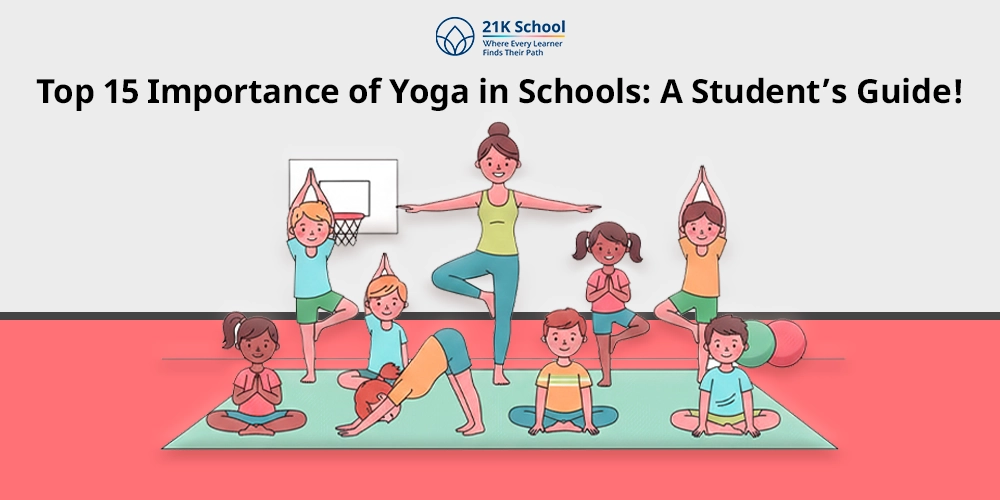
Have you ever wondered why yoga is a very important part of the development of students?
Yoga is an activity that can be introduced in schools since it enables the learners to remain healthy and remain relaxed, and focused. Simple breathing exercises and stretching would help the students, since in this manner, the stress of the students can be alleviated.
Mindfulness, emotional control and confidence are also taught in yoga, functioning as vital extracurricular activities that prepare students to face difficulties. The repeated habit will help the students to develop healthy habits that will propel the learning and well-being processes.
Contents
- 1 Importance of Yoga in Schools- Top 15 Reasons
- 1.1 1. Reduce Stress and Anxiety
- 1.2 2. Enhance Memory
- 1.3 3. Promotes Quality Sleep
- 1.4 4. Improve Academic Performance
- 1.5 5. Enhances Concentration and Attention
- 1.6 6. Promotes Good Health
- 1.7 7. Promotes Flexibility
- 1.8 8. Emotional Well-being
- 1.9 9. Social Development
- 1.10 10. Boost Emotional Stability
- 1.11 11. Improves Poor Posture
- 1.12 12. Promotes Discipline
- 1.13 13. Promotes Mindfulness
- 1.14 14. Reduces Anger and Frustration
- 1.15 15. Increased Self-Confidence
- 2 Final Thought
Importance of Yoga in Schools- Top 15 Reasons
Yoga is also a beneficial practice in schools because it can assist students to remain in a healthy state, both physically, mentally, and emotionally. It relaxes them, keeps them centred and well and increases their learning and stress management capabilities.
Through rudimentary movements and awareness, yoga will create an excellent atmosphere where students will be capable of growth, performing and being their best.
1. Reduce Stress and Anxiety
Another thing is that yoga enables them to relax their minds through deep breathing and easy poses that reduce the stress hormone, resulting in relaxation. Frequent training makes the children resistant to the pressure of school, study stress , and being able to contain the emotional state that cannot be controlled, and to stay psychologically stable.
This will make this comfortable, cheerful, and create a positive learning environment , which would aid in better learning and overall health.
2. Enhance Memory
Yoga boosts the memory by raising oxygen and blood flow to the brain. Meditative breathing boosts concentration and posture, stimulates childrens mental health and alertness.
All these effects together enable students to process the information better, retain the knowledge longer and accurately remember the lessons, helping to improve academic performance and even develop their cognition with the course of time.
3. Promotes Quality Sleep
Yoga is known to relax the body, ease physical tension, calm the nervous system, which allows students to fall asleep quickly and sleep better.
Sleep enhances memory, mood, and energy levels, which help children remain focused and engaged at school. Regular sleep also promotes sound development and the overall mental health of students .
4. Improve Academic Performance
Yoga is associated with a positive relationship with academic performance as the person is more focused, less stressed, and clear-minded. The regular practice would help the students focus more and problem-solving and handle exam-related stress .
Its benefits will lead to improved knowledge , grades and effective learning patterns, which can be used in the future in school.
5. Enhances Concentration and Attention
Yoga also teaches the learner to be conscious of their breathing and movements. This will enhance their attention span and reduce distraction in the classroom.
Having better attention allows such students to concentrate on studies , perform their duties more accurately and engage in their lessons more vigorously, leading to better learning performance and academic confidence.
6. Promotes Good Health
Yoga assists in overall physical fitness because it enhances body flexibility, muscle strength, and fights against illnesses. It makes children develop good bodies, better postures and healthy lifestyles, which prevent the possibility of falling ill.
Students gain the benefits of being better energised, able to better digest and live an active lifestyle through practice all day and night in order to bring about a wellness life.
7. Promotes Flexibility
Through frequent practising of yoga, flexibility and mobility are boosted since yoga stretches the muscles, joints and tendons. It will help the students to move in all directions, eliminate the stiffness of the muscles, and reduce the risk of injuries during sports or play.
The greater flexibility also contributes to better posture, balance and coordination, resulting in the development of gross motor skills and confidence.
8. Emotional Well-being
Yoga will promote tolerance and stress reduction, relaxation. The learners get to control and decode their emotions, and therefore, the emotional burden decreases, and the self-esteem increases.
Yoga assists in seeking inner peace in terms of breathing and mindfulness , and allows children to solve problems more efficiently and feel good about this, which is beneficial to the healthy development of emotions.
9. Social Development
Team yoga enhances teamwork, collaboration and communication. Students are taught to respect other people, to be persistent and to help people.
It is these experiences that are shared and which lighten the friendship and ease tensions, helping students make friends at school and creating a less hostile classroom environment.
Yoga has produced social skills , thus resulting in improved relations and community spirit.
10. Boost Emotional Stability
Yoga teaches people how to control their emotional states through breathing powerfully, awareness of the present and being comfortable. This reduces the fluctuations in mood as well as temper tantrums and helps children to behave calmly whenever they find themselves in a stressful circumstance.
Emotional stability leads to better classroom behaviour, self-control and helps in building a healthy parent-teacher relationship and peer connections.
11. Improves Poor Posture
Yoga is beneficial in tightening the core muscles and correcting the posture of the body, which would enable the students to sit properly even when there are long periods of sitting. It reduces backache, neck strains and curves, causing the spine to be healthier.
The correct posture assists in improved breathing, focus and general body fitness, which makes the students more at ease and attentive in school.
12. Promotes Discipline
The discipline , habituality and accountability are encouraged through regular yoga exercises. Students become familiar with the way to be patient, committed, and to practise regularly.
These habits result in better classroom behaviour, time management and academic discipline in order to facilitate children to be organised and be better students.
13. Promotes Mindfulness
Mindfulness is another characteristic developed in yoga, and this is acquired through education to be here.
This will eliminate overthinking and make them more aware, and enable children to think rationally about situations. Through mindfulness, there is the improvement of emotional intelligence , increased visualisation, and encouragement of a calm, attentive state of mind during the learning process.
14. Reduces Anger and Frustration
Yoga helps the students to calm themselves and at the same time to relax the nervous system through controlled breathing and relaxation. This reduces anger, emotional frustration and reaction.
Relationships and classroom behaviour are also facilitated better by yoga to allow a peaceful attitude, control emotions and patience, and provide healthy ways of addressing emotions.
15. Increased Self-Confidence
One can develop self-confidence using yoga, as it helps in building physical and mental health. The practice will strengthen, improve the flexibility and posture, and this will make the students feel more confident and at ease in their bodies.
Breathing exercises, meditation and mindfulness reduce stress and negative self-talk, enabling students to focus on studies with a positive approach to thinking.
Final Thought
Yoga is a positive exercise that enables the students to grow physically, mentally and emotionally. It helps them to be relaxed, focused and healthy and therefore, education becomes enjoyable and easy.
The students will be disciplined , have control of their emotions and good habits with practice that will result in good performance at school and their health.
By introducing yoga in the schools, the teaching personnel can offer a relaxing atmosphere, enabling the students to cope with stress and acquire confidence, in addition to acquiring skills that can change their lives.

You may also want to read