

Do you know that learning different languages is beneficial for students’ growth?
Language is a fundamental part of students’ lives from communication to social inclusion. But in today’s competitive world, learning a single-language is not enough.
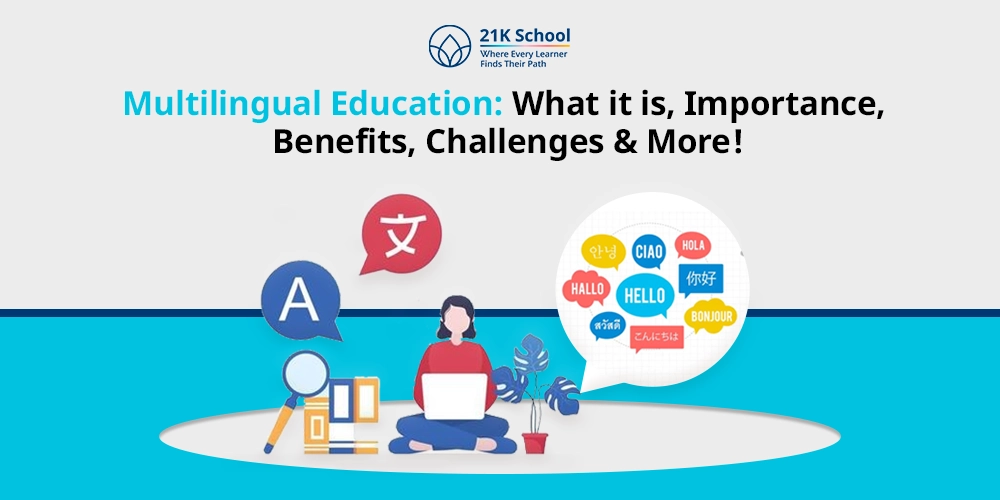
Multilingual education is a powerful approach in which students learn multiple languages. It transforms classrooms into inclusive, effective, and future-ready learning spaces.
This article provides a detailed overview of multilingual education, including its importance, types, examples, benefits and much more.
Contents
- 1 What is Multilingual Education (MLE)?
- 2 Multilingual Education in India
- 3 Importance of Multilingual Education
- 4 6 Types of Multilingual in Education
- 5 Examples of Multilingual Education
- 6 5 Differences Between Bilingualism and Multilingualism
- 7 5 Benefits of Multilingual Education
- 8 5 Challenges of Multilingual Education
- 9 7 Key Strategies to Promote Multilingual Education
- 10 Ending Note!
What is Multilingual Education (MLE)?
Multilingual education (MLE) is a learning technique in which two or more languages are used as mediums of instruction.
Implementing multilingualism in education improves students’ comprehension, strengthens cognitive development, and promotes linguistic diversity.
Multilingual education is not limited to gaining language skill; it involves overall development of students.
In a multilingual education system, students initially start with their mother tongue or first language and later continue with regional, national, and international languages.
Multilingual Education in India
In India, multilingual education (MLE) plays an important role especially in students’ foundational education. It is also promoted by the National Education Policy 2020 (NEP).
India is a linguistically diverse country which offers a vast array of languages from scheduled to mother tongues. This diverse environment encourages multilingualism in education.
Multilingualism in the education system in India helps people in cultural preservation, national unity, and global competitiveness. That’s why education system in India promote:
- Three-Language Formula
- Mother tongue or regional language at least till Grade 5 or 8
- Multilingual exposure from early childhood
Importance of Multilingual Education
Multilingual education helps students improve academic performance and personal development. Hence, the importance of multilingual education for students might include:
- Better understanding of concepts, especially in early childhood.
- Learning more than two languages improves students’ memory, problem-solving, critical thinking skills, and mental flexibility.
- Multilingual education often reduces student drop rates in school by making education accessible in different languages.
- MLE is important for students to deal with global challenges.
- To preserve indigenous and regional languages, MLE plays a crucial role.
6 Types of Multilingual in Education
There are various ways to learn multilingualism in education that help students to balance both academic and personality development.
Key types of multilingual in education are:
1. Mother Tongue-Based Multilingual Education (MTB-MLE)
In education, students use their mother tongue as a primary medium of instructions to start and with time move to other languages.
Mother Tongue-Based Multilingual Education (MTB-MLE) is a popular type used by educational institutions in India.
Key Features:
- Strong foundation in first language
- Smooth transition to additional languages
- High effectiveness in early grades
2. Dual Language/Two-Way Immersion
Dual language also known as two-way immersion includes two languages (for example Hindi + English) in the same classroom for better understanding.
In this way, students can use their desired language to resolve challenges.
Key Features:
- Instruction equally divided between two languages
- Students learn from each other
- Promotes bilingualism and biliteracy
3. Immersion Programs
Learners in immersion programs use entirely or mostly prefer a second or foreign language. Also, explore the benefits of learning a second language or foreign language.
Key Features:
- High exposure to the target language
- Focus on content learning through another language
- Can be full or partial immersion
4. Transitional Bilingual Education
One of the popular types of transitional bilingual education is commonly used in migrant education programs.
Here, learners use the native language for instruction in the first 2 to 3 years. While simultaneously introducing the regional language or Hindi/English and with time transition fully to the second language.
Key Features:
- Short-term use of mother tongue
- Goal is fluency in the dominant language
- Less focus on maintaining the first language
5. Maintenance/Heritage Language Education
Maintenance/heritage language education is a type used to maintain and strengthen the heritage or minority language.
In this way, students learn about their culture and become involved in the community.
Key Features:
- Strong focus on cultural identity
- Long-term bilingualism
- Community involvement
6. Content and Language Integrated Learning (CLIL)
Content and Language Integrated Learning (CLIL) involves teaching academic subjects through a second or foreign language.
Key Features:
- Simultaneous learning of content and language
- Common in secondary and higher education
- Focus on practical language use
Examples of Multilingual Education
Tribal and Regional Language
States like Odisha, Chhattisgarh, and Andhra Pradesh implement Mother Tongue-Based Multilingual Education (MTB-MLE) for tribal learners using local languages in early grades.
Three-Language Formula
Through three-language formula schools promote multilingual education where students learn:
- Mother tongue/regional language
- Hindi or English
- Another modern Indian or foreign language
5 Differences Between Bilingualism and Multilingualism
The main difference that makes bilingualism and multilingualism different include the following criteria.
| Number | Particulars | Bilingualism | Multilingualism |
| 1. | Meaning | The ability to use two languages | The ability to use more than two languages |
| 2. | Number of Languages | 2 language | 3 or more language |
| 3. | Scope | Limited language exposure | Broader language exposure |
| 4. | Role in Education | Focuses on developing proficiency in two languages | Focuses on maintaining and promoting linguistic diversity |
| 5. | Examples | Hindi + EnglishEnglish + Spanish | Hindi + English + Tamil English + FrenchGerman |
5 Benefits of Multilingual Education
Including multilingualism in education offers various benefits to students. It goes beyond language learning. Some key benefits one must know are:
1. Cognitive Development
Multilingualism in education is beneficial because a student who speaks more than one language develops cognitive abilities.
Learning multiple languages stimulates an individual’s brain to enhance their memory for studying, problem-solving, and critical thinking skills.
2. Cultural Preservationf
As we know, India has a diverse culture and community who live together to safeguard their traditions.
Languages play an important part in preserving specific cultures. Multilingual education strengthens cultural pride and self-identity and beliefs.
3. Academic Outcomes
Including multilingual education in curriculum is not only helpful in personal growth but also academic excellence.
Students begin with their mother tongue which enhances foundational literacy and numeracy and later learn second and third languages to enhance academic performance.
By learning different languages, students understand complex concepts, analyse data, and excel academically.
4. Global Readiness
Through multilingual education students prepare for international education, employment, cross-cultural communication, and global collaboration.
In this way students expand their careers and look for new opportunities to meet their future needs.
5. Improved Social Skills
Through multilingual education students can improve their social skills including communication, empathy, and active listening.
These skills are essential for students’ personal and professional success. Social skills help students to connect with people and adapt to new environments.
5 Challenges of Multilingual Education
Implementation of multilingual education often comes with various challenges such as:
1. Teacher Shortages and Training Needs
Due to shortage of teachers and training needs students are unable to learn multiple languages. This can also impact their academic growth.
2. Resource and Material Shortages
Resource and material shortages are one of the major challenges to learn different languages. Some common resources include textbooks, teaching materials, and assessment tools.
3. Policy Gaps and Implementation
Lack of policy gaps and wrongly implementation of multilingual education leads to learning difficulties.
4. Emotional and Cognitive Load
Due to lack of multilingual education in schools students can experience cognitive fatigue and emotional challenges.
5. Curriculum Balance
Curriculum and assessment difficulties such as implementation of multiple languages in students’ educational journey is a kind of challenging task.
7 Key Strategies to Promote Multilingual Education
Parents and teachers can promote multilingual education through various key strategies. It helps them to align learning effectively.
7 key strategies to promote multilingual education are:
1. Implement Mother Tongue-Based Instruction
In the initial step implementation of mother tongue based instruction is highly beneficial. It is recommended by teachers in early grades to promote:
- foundational literacy
- comprehensive learning
- cognitive development
In this way, students can gain knowledge easily, boost confidence, preserve linguistic and cultural identity.
2. Encourage Translanguaging
Teachers can use strategies like translanguaging in which students use their full linguistic repertoire in order to empower them.
For example, a student speaks in English and writes in native language for better understanding. Encourage translanguaging in the classroom between bilingualism and multilingualism.
3. Create Inclusive Environments
By creating inclusive learning environments parents and teachers can reduce learning differences in multilingual education.
Learning in a safe and positive space encourages students to learn multiple languages. It improves students engagement, confidence, and social integrity.
4. Engage Families and Communities
Beyond classroom learning, students can engage with families and communities for multilingual education.
Some key ways include:
- Parent-children collaboration to learn languages
- Involve community members and resources
- Include language-based activities
5. Use Technology
Technology integration in education is a powerful tool to support multilingual learning. In this way, one can bridge language gaps.
Some common strategies includes:
- Multilingual educational apps and e-books
- Audio-visual resources in multiple languages
- Translation and speech-support tools
- Online platforms for collaborative learning
6. Differentiated Assessment Practices
Through differentiated assessment practices students can easily learn multilingual education. Rather than depending on one assessment use multiple approaches to become proficient.
This encourages students’ participation, confidence, and provides a more accurate picture of student learning.
7. Teacher Training and Development
Teachers play an important role in promoting multilingual education in the classroom. Effective training and development of teachers ensures students’ professional growth.
To become well-trained, teachers need to understand language acquisition processes and classroom strategies for effective learning.
Ending Note!
Learning new languages in the educational journey is a powerful approach that helps students from early childhood. Multilingual education is significant in the fast growing world of education.
By understanding the benefits of learning multiple languages, major challenges to overcome and effective strategies that help in reaching desired goals.
Also, explore various benefits of learning a new language.

You may also want to read