


Parents, teachers, and schools play a major role in shaping children’s education. And in modern education learning in classrooms is not enough.
Kids also need a positive learning environment at home. To understand and provide the right facilities, collaboration between parents and teachers is essential.
That’s why parent teacher meeting or PTM has become one of the effective ways through which parents and teachers bridge the educational gaps.
Let’s explore everything one should know about parent teacher meetings.
Contents
- 1 What is a Parent Teacher Meeting?
- 2 Importance of Parent Teacher Meeting
- 3 Points to Discuss in Parent Teacher Meeting
- 4 5 Benefits of Parent Teacher Meeting
- 5 5 Key Purpose and Objectives of Parent Teacher Meetings
- 6 4 Types of Parent Teacher Meetings
- 7 5 Role of Parents in Parent Teacher Meetings
- 8 5 Role of Teachers in Parent Teacher Meetings
- 9 How to Prepare for a Parent Teacher Meeting?
- 10 5 Common Challenges in Parent Teacher Meetings
- 11 5 Tips to Make Parent Teacher Meetings More Effective
- 12 Conclusion
What is a Parent Teacher Meeting?
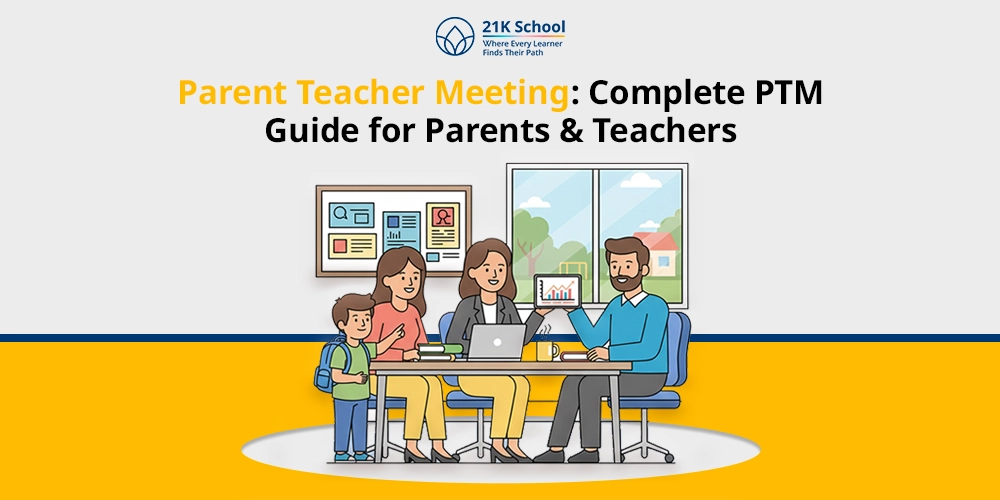
A parent teacher meeting (PTM) is one of the most important formal meetings held between parents and teachers by schools.
Here, parents and teachers discuss students’ academic performance, behavior, emotional development, and overall progress.
These kinds of meetings help both parents and teachers to understand students’ needs in both classroom and home. To know more let’s get into the importance of PTM.
Importance of Parent Teacher Meeting
Parents-teacher meetings play an important role in students’ growth and development. Some key importance of PTM are:
1. Strengthens Parent-Teacher Communication
PTM is an effective platform where parents and teachers can have open communication about students’ progress, strengths, challenges etc.
It helps in strategising the further academic needs of students.
2. Encourages Holistic Child Development
Getting good marks is not enough in education. A child should have good behavioral patterns, emotional well-being, social skills , and learning habits.
And to address all these PTM meetings is an ideal way for parents and teachers.
3. Aligns Expectations
PTM are important for parents, teachers and students to align their academic and personal goals.
It helps students to understand the priority objective of learning.
4. Builds Trust and Transparency
PTM builds trust and transparency between school, teachers, and parents.
Parents trust the working of the school system and teachers make sure children are getting the right guidance at school and home.
Points to Discuss in Parent Teacher Meeting
Some common points to discuss in parent teacher meeting includes:
1. Academic Progress
Discussion on academic performance includes strengths and weak areas, test scores, assignments, subjects progress, and classroom participation.
2. Observing Behavior
Talk about kids behavioral observation such as discipline and classroom behavior, how they interact with peers and teachers, emotional responses and learning adaptability.
3. Attendance and Participation
Teachers and parents discuss students’ attendance and classroom activeness and participation in different activities.
4. Areas for Improvement
One of the reasons for PTM is to understand the area of improvement to guide children towards the right pathway in future.
5. Parent Concerns and Feedback
Parents also have other concerns at home related to the child which can be resolved by discussing with teachers and feedback.
PTMs are important for sharing effective ways to handle concern.
5 Benefits of Parent Teacher Meeting
Mentioned below points are top 5 benefits of parent teacher meeting or PTM:
1. Academic Growth
To understand about the academic growth of child, PTM meetings are crucial where they get information on:
- assessment results
- classroom engagement
- students progress over time
2. Emotional and Social Development
Teachers often observe students’ behavior in the classroom with others. Later, they discuss with their parents accordingly.
This helps to identify students’ needs and timely support if needed.
3. Early Identification of Learning Difficulties
Every student and their learning style is different. For example, some are active participants, others can be slow learners , special children, or need extra help to perform better.
Early identification of learning difficulties is beneficial to adjust learning in the classroom and home environment.
4. Enhances Awareness About Modern Teaching Techniques
Parents-teachers collaboration in PTM helps in enhancing awareness about modern teaching techniques .
In this way, parents are able to adapt required techniques at home to improve kids skills .
5. Promotes Accountability Among Students
PTM promotes accountability among students by ensuring that their progress is monitored by both teachers and parents.
5 Key Purpose and Objectives of Parent Teacher Meetings
Go through the 5 key purposes and objectives of parent teacher meetings to support children at school and home.
1. Understanding a child’s academic progress
One of the main purposes and objectives of parent teacher meetings is to understand a child’s academic progress.
Teachers help to showcase a clear picture of the monthly, quarterly or annual progress.
2. Identifying Strengths and Learning Gaps
To identify strengths and learning gaps, PTMs are an ideal platform where parents and teachers can go for open communication.
Discussion about strengths and how to work on weak areas ensure progress in future.
3. Discussing Behavioral and Emotional Development
Other than academic performance parents and teachers also discuss students behavior and emotional development in the classroom.
Addressing patterns regularly at school and home to help in nurturing their emotional intelligence is crucial for personality development.
4. Setting Realistic Academic Goals
Setting realistic goals is one of the priorities for parents, teachers, and students to work smartly. To do so teachers and parents collaboration offers support for learning.
5. Building a Collaborative Support System
Building a collaborative support system around children is the ultimate goal of parent teacher meetings.
In this way, students learn effectively and work on weak areas for academic and personal success.
4 Types of Parent Teacher Meetings
There are different types of parent teacher meetings schools conduct to support parents, teachers, and students:
1. Individual PTM
Individual PTM simply means one-on-one interaction between a student’s parent and teacher. It is one of the ideal ways to discuss in-depth progress and behavior.
Individual PTM is beneficial because parents can ask questions freely without any distractions.
2. Group PTM
Group PTM means a bunch of parents visit to get updates on students academic performance, curriculum updates, teaching methods etc.
It is an ideal way to curriculum orientation, addressing common academic concerns, and sharing general school updates.
3. Online / Virtual PTM
Through online or virtual PTM parents and a panel of teachers can connect digitally to discuss common concerns.
Online PTM is effective for those who are unable to visit school due to several reasons like traveling etc.
4. Orientation PTM
Orientation PTM are mainly conducted at the start of the academic year to talk about academic structure, curriculum, assessment methods etc.
In this way, parents are able to understand school policies, rules, expectations from parents and students.
5 Role of Parents in Parent Teacher Meetings
Parents play an important role in parent teacher meetings. Some key points include:
1. Preparing Questions in Advance
Before visiting PTM parents prepare themselves for questions related to child behaviour, academics, mental health , physical development etc.
They make sure to ask maximum questions to understand their child’s needs.
2. Being Open to Feedback
PTM meetings are all about discussing strengths, weaknesses, and areas needed for improvement. That’s why parents should be open to take feedback and implement it at home.
3. Sharing Home Observations
Parents should open and prepare to share home observations related to child progress.
By sharing insights such as learning habits, emotional behavior, screen time etc help both parents and teachers to strategies accordingly.
4. Supporting Learning at Home
After the classroom, learning at home is the next best place. That’s why parents should provide a positive learning environment to support children.
Parents can discuss the right ways to implement at home.
5. Maintaining a Positive Attitude
PTMs can be conducted by school in a group, virtually or one-to-one session. Parents should prepare and maintain a positive attitude towards everyone.
5 Role of Teachers in Parent Teacher Meetings
Teachers play an important role in parent teacher meetings. Some key points include:
1. Presenting Constructive Feedback
Teachers should present constructive feedback including strengths, interests, weak areas and how to improve.
This will help students in future growth and development.
2. Using Data and Examples
With the help of data and examples like homework , projects or assignments teachers should highlight the progress.
3. Listening Actively to Parents
PTMs are two-way conversations in which participation by speaking and listening is crucial for teachers and parents.
In this way both parents and teachers trust each other for students’ better future.
4. Suggesting Personalised Improvement Plans
Through PTM teachers can suggest personalised improvement plans.
By sharing effective learning techniques teachers can help parents to create an effective environment at home.
5. Maintaining Empathy and Professionalism
By maintaining empathy and professionalism teachers can understand parental concerns and emotional reactions.
How to Prepare for a Parent Teacher Meeting?
Parents and teachers are often concerned about how to prepare for a PTM.
For Parents:
1. Review Report Cards and Notes
Before visiting parents should review report cards, teacher remarks, previous feedback etc to set objectives and prepare the important questions.
2. Observe Child’s Habits at Home
Monitoring kids’ habits at home helps to understand how to enhance learning. Parents can give detailed information in PTM to get guidance.
3. List Concerns and Questions
Parent teacher meetings are useful to list out different concerns and questions related to their child.
For Teachers:
1. Prepare Student Performance Records
Before visiting teachers should prepare student performance records, maintain academic records, assemble attendance data, allocate assessment results, and details on classroom observations.
2. Identify Improvement Areas
Each student and their needs are different. That’s why teachers need to prepare solutions to guide parents.
3. Keep Recommendations Ready
In parent teacher meetings, one needs to make sure to provide realistic solutions or suggestions for students’ academic and personal progress.
5 Common Challenges in Parent Teacher Meetings
Parent and teacher meetings often face challenges to participate in PTM. Some common challenges are:
1. Time Constraints
Due to time constraints detailed discussion becomes difficult which leads to short-term conversations and unresolved concerns.
2. Communication Gaps
Communication gaps between teachers and parents often become a challenge which lead to misunderstandings or lack of clarity.
3. Emotional Reactions
Discussion related to weakness, low grades/attendance or bad behavior leads to emotional breakdown of parents.
This can wrongly impact the flow of conversation and solutions.
4. Language Barriers
Parents and teachers often feel confused if the language is different. This can mislead the needful discussion.
5. Unrealistic Expectations
Unrealistic expectations like instant improvement or comparing their child with others can negatively impact a student’s future learning environment.
5 Tips to Make Parent Teacher Meetings More Effective
Maximising the impact of PTM is beneficial. Some common tips to make parent teacher meetings more effective are:
1. Active Listening
Through active listening without interruption helps both parents and teachers to understand each other’s perspective to improve students’ learning.
2. Focus on Solutions, not Blame
PTM is an ideal way to focus on academic and personal solutions of students instead of blaming each other.
The solution opens new opportunities for students.
3. Setting Achievable Goals
Instead of creating unrealistic or imaginative goals, collaborate to create achievable goals for students.
Starting with small and simple goals are helpful to achieve long-term goals.
4. Follow-Up After the Meeting
After PTM parents and teachers should follow the agreed plans, review progress, and make changes when required.
5. Maintaining Regular Communication
By maintaining regular communication both parents and teachers continue and prevent last-minute concerns during PTMs.
Conclusion
Parent teacher meeting is a transformative way that offers the right pathway to parents, teachers, and students towards learning.
By active participation and implementing effective strategies both parents and teachers ensure students get the right environment to learn.
