

School plays a major role in students’ lives. From learning new concepts to overall development schools creating a space for their future careers.
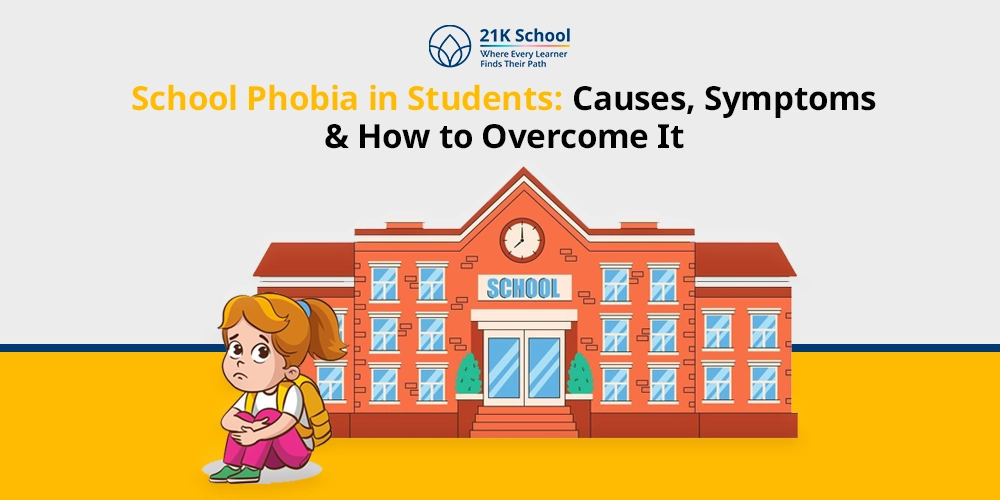
But do you know some students feel frightened or scared when they go to school. This term is known as school phobia in students.
School phobia in students is severe anxiety about attending school. This is due to separation anxiety, bullying, academic struggles etc.
To understand in-depth, one must discover everything about school phobia in detail. Let’s begin what it really means.
Contents
- 1 What is School Phobia?
- 2 4 Causes of School Phobia
- 3 4 Common Signs and Symptoms of School Phobia
- 4 How School Phobia Affects a Child? 3 Way Impact
- 5 School Phobia: 4 Effective Treatment and Management Strategies
- 6 5 Key Roles of Parents and Teachers in Overcoming School Phobia
- 7 4 Easy Activities and Techniques to Reduce School Phobia
- 8 4 Prevention of School Phobia
- 9 Conclusion
What is School Phobia?
School phobia is also popular as school refusal or avoidance. It is a condition in which kids experience extreme fear to attend school.
It is a serious psychological concern often seen in children at early education. of preschool, kindergarten, and first grade. In this condition, students feel scared or frightened to go school.
School phobia is a common childhood behavior problem negatively impacting students’ lives.
4 Causes of School Phobia
School phobia develops due to different reasons. Some common causes of school phobia include:
1. Psychological causes
Psychological causes are one of the main reason of school phobia in which children avoid going to school due to:
- Separation anxiety
- Fear of failure or exams stress
- Academic pressure
- Low self-esteem
- Any traumatic experiences
Family-related causes are one of the major reason in which kids feel anxious about separation due to:
- Overprotective parenting
- Family conflicts
- Loss of a loved one
- Illness or health issues
- Inconsistent routines
School-related causes trigger kids for school phobia. Some key reasons are:
- Bullying by peer
- Fear of teachers
- Learning challenges
- Sudden change of school
4. Social and environmental causes
Social and environmental causes leads to school phobia because kids feel:
- Difficulty in making friends
- Overuse of screens
- Fear of social judgment
- Cultural or language barriers
4 Common Signs and Symptoms of School Phobia
Recognising the common signs and symptoms of school phobia help parents and teachers to detect early:
1. Emotional symptoms
Some common emotional symptoms include:
- Excessive fear or panic before school
- Crying spells or emotional outbursts
- Irritability or mood swings are common emotional symptoms of school phobia and are closely linked to broader student mental health concerns.
- Feelings of sadness or helplessness
2. Physical symptoms
Some common physical symptoms include:
- Stomachaches, abdominal pain, nausea, and vomiting
- Headaches and dizziness
- Sweating, shaking, tremors, and hyperventilation
- Frequent urination or bathroom trips
- Extreme fatigue
3. Behavioral symptoms
Some common behavioral symptoms include:
- Refusing to go to school
- Clinging to parents
- Frequent tantrums in the morning
- Avoidance behaviors
4. Academic symptoms
Some common academic symptoms include:
- Decline in academic performance
- Lack of concentration
- Incomplete assignments
- Fear of exams
How School Phobia Affects a Child? 3 Way Impact
School phobia affects a child in different ways. It deeply impacts socially, emotionally, and academically. The top 3 way include:
1. Emotional impact
School phobia in children depends on various emotional factors which lead to mood swings, anxiety, stress, and many more.
Emotional regulation is important to reduce the risk of school phobia of students.
2. Academic impact
Academic impact is one of the reasons which affect children badly. They struggle to face educational challenges.
Academic pressure increases the school phobia which can affect performance and avoid going to class.
3. Social impact
School provides an environment for effective learning and social gathering. Students often avoid school due to exposure.
Lack of social exposure leads to isolation, reduced teamwork, and collaboration abilities.
School Phobia: 4 Effective Treatment and Management Strategies
To regain confidence and overcome school phobia, one needs to discover effective treatment and management strategies in detail:
1. Parental strategies
Parents play an important role to overcome school phobia. By creating a positive environment to learn and play, teachers can gain students’ trust.
Major parental strategies are open communication, avoid overprotection, calm morning environment, and create an effective routine.
2. Teacher and school strategies
Teacher and school strategies are different and should be student-centered learning to reduce fear of going to school
Some helpful strategies to use are:
- Understanding attitude
- Creating safe space
- Parents-teachers collaboration
- Shorter school hours to enforce good habits
3. Psychological interventions
Other than parents and teachers guidance students need professional support to avoid school phobia. Some common psychological interventions include:
- Cognitive Behavioral Therapy
- Exposure and play therapy
- Family counseling
4. Medical support
School phobia is a serious psychological concern which often needs to be addressed and medical support if needed.
Medical support helps in connecting with psychiatrists, short-term medication facility, monitoring, and treatment.
5 Key Roles of Parents and Teachers in Overcoming School Phobia
To overcome school phobia, both parents and teachers need to collaborate. Some easy ways of overcoming school phobia are:
1. Open communication
To build trust and make the environment safe, open communication is important. Parents should encourage free talk, open-ended questions, and share emotions.
Teachers can create a classroom learning environment supportive and connect with parents to resolve problems. This helps in reducing anxiety in students.
2. Avoid punishment or force
Parents and teachers should avoid punishment or forcing kids to attend school. This can impact negatively and leads to school phobia.
Using a supportive and positive approach reduces pressure and resistance.
3. Consistent routines
By creating consistent routines both school and home help kids to stay consistent mentally. This helps them to avoid school-related stress.
4. Early identification
Early identification through signs and symptoms help both parents and teachers to understand and customise students’ needs.
This helps in faster recovery and prevents long-term academic and emotional issues.
5. Non-threatening teaching methods
Using non-threatening teaching methods help students to get familiar with the school environment. Some common ways like:
- Positive reinforcement
- Active participation
- Appreciate effort
4 Easy Activities and Techniques to Reduce School Phobia
Reducing school phobia requires effective activities which help kids to learn and grow in a safe environment. The goal is to reduce anxiety.
1. Relaxation and breathing exercises
Start with relaxation and breathing exercises which help in calming. Some common relaxation techniques include:
- Balloon breathing
- 5-5 breathing exercise
- Progressive muscle relaxation
2. Storytelling and role play
Storytelling and role play is beneficial for reducing anxiety and depression. The activity is ideal to engage students for a longer time.
Some simple examples include:
- Create stories with favorite characters
- Use dolls and puppets
- Role-play common scenarios
3. Confidence-building activities
Including confidence-building activities both at home and school help students to build confidence and self-esteem, which are key pillars of holistic child development.
Teachers can encourage students to set small goals, practise positive self-talk, and learn new skills.
4. Gradual desensitisation techniques
Gradual desensitisation techniques help students to systematically and slowly expose themselves to school.
The technique is mainly used to decrease, or normalise, the body’s response to particular sensations. It is an effective approach to reduce children’s school phobia.
4 Prevention of School Phobia
Prevention of school phobia is better than treatment. That’s why students need support from home and school. Check out key strategies to prevent of school phobia:
1. Healthy school transition practices
Some important times such as starting a preschool, taking transfer, or moving to higher classes often have school phobia.
However, healthy school transition practices help students to reduce fear and stay positive. Some effective practices include:
- Introduction of school routines
- Short school visits in early days
- Allow comfort objects like favourite toy
2. Emotional resilience building
To overcome challenges, anxiety, or stress, emotional resilience building is important. In this way, students manage to avoid school phobia.
Some key ways to build resilience in childrens are:
- Let kids identify and express emotions
- Encourage problem-solving skills
- Use positive self-talk
3. Balanced academic expectations
By balancing academic expectations parents and teachers help students to make the learning environment more enjoyable and effective.
Key strategies to use are:
- Set appropriate learning objectives
- Appreciate efforts
- Make a schedule to play, study, and extracurricular activities
- Avoid comparison with others
4. Parent-school coordination
Parent-school coordination is essential for students to overcome fear of going to school. This collaboration mirrors the broader role of school in child development.
Support from both sides by maintaining regular communication, sharing issues, becoming consistent, and taking professional help reduce fear and anxiety.
Conclusion
School phobia is a serious condition which needs parents and teachers attention and support.
To overcome school phobia, one should go through causes, signs, and ways to help children overcome fear of school.
Implementation of different strategies and activities by teachers at school and parents at home helps children return to school with confidence.

You may also want to read