

Sequencing is a crucial part of children’s understanding of this world and how things navigate in order.
If you want to teach your kids sequencing in a way that stays with them, you can read the following article that has simple and fun sequencing activities.
Either it is through story strips, cooking, picture cards, or board games, your child needs to learn sequencing to comprehend events as they occur.
This can also improve their analytical thinking and cognitive skills as well.
Contents
What are Sequencing Activities for Kids?
Sequencing activities are the exercises that enable children to learn and determine the sequence in which events take place.
These activities make the kids put parts of a story or task in a logical order like beginning, middle, and end, which is also essential for building strong reading habits .
Children are able to grasp links between events because of their cognitive ability of sequencing.
Piaget’s theory of cognitive development says that, like any other cognitive process, children would learn sequencing after a certain age only.
It also improves the development of language in which children learn to articulate events in an understandable and coherent manner.
As an example, while explaining the process of making a sandwich or while narrating a story, children can develop sequencing by listing events in their order.
The sequencing may be either visual or verbal.
These activities are frequently applied in preschool and are useful to older children who have to enhance their comprehension or organization capabilities.
10 Sequencing Activities for Kids
The following list has some great and fun learning activities to understand sequencing in kids:
1. Picture Cards
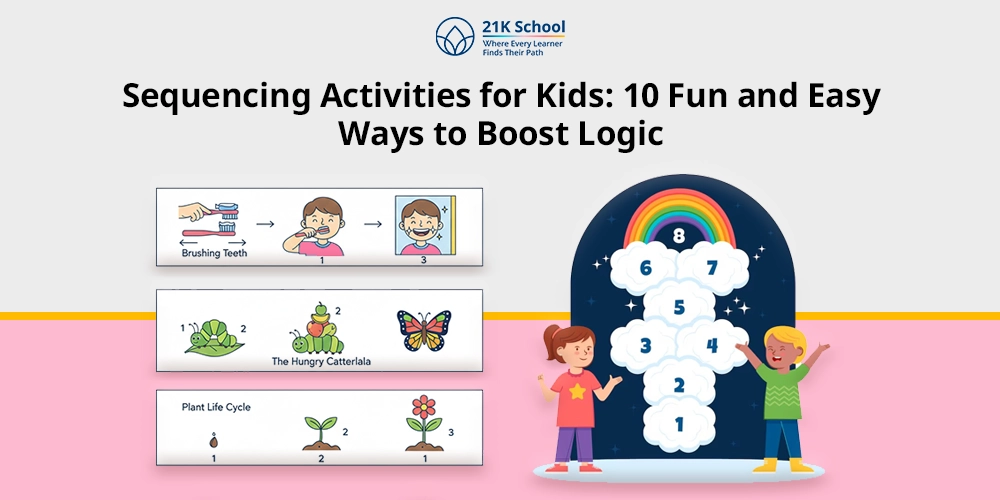
Some educational cards that can depict various phases of an event or a process are called picture cards. These cards assist children in knowing how things or events are arranged in the logical order, thereby strengthening their cognitive learning .
- How to do it: In order to conduct this activity, one should give children a stack of picture cards which depicts the sequence of actions during a regular task like brushing of teeth or planting a seed. Shuffle the cards and ask the child to arrange them in the right sequence starting with the beginning to the ending. Once they have arranged the cards, tell them to explain the order in steps serially. Add more cards if the child is older.
- Skills enhanced: This process improves visual learning , reasoning, word-formation, narration as well as concentration.
2. Story Strip Activities
Story strip activities presuppose the division of a story into individual illustrated frames, making them useful reading activities for kids . Children then arrange the strips in the right order and reconstruct the narrative in a proper way.
- How to do it: To accomplish this task, give students some story strips, which are printed and request them to cut down the separate scenes. They are supposed to set the scenes in a sequence according to their perception. Now, they have to think which event took place first, second, and at last. When they narrate the story again based on these arrangements, you can notice their creativity and understanding level.
- Skills enhanced: Story strips can enhance critical thinking of the child engaged in storytelling, their reading skills, narration, language, and ability to comprehend a story.
3. “First, Next, Last” Worksheets
“First, Next, Last” worksheets are simple ways that can teach children about sequencing in three phases. It is easy to practice.
- How to do it: Provide a child with a work sheet, where there are three images or brief descriptions of an event. Now, it is on them to decide what comes first, middle, and then in the last. Following this, they would tell the steps and paste them in the right sequence. You can make them explain the order orally or by writing brief sentences.
- Skills enhanced: This can improve your child’s organizational abilities and basic sequencing.
4. Cooking or Baking
Cooking simple dishes with your kids can actually improve your bonding with them, while also teaching them sequencing and the importance of following instructions — a key part of learning through play . This is because children can learn to follow the steps of cooking.
- How to do it: Select an easy and kid-friendly recipe like making a fruit salad or sandwich. Go step-by-step in the instructions and make the child follow the recipe. As soon as the cooking task is finished, ask them to draw or write the steps in the correct order to remind them of what they learnt.
- Skills enhanced: The cooking process also contributes to the ability to follow the instructions, improves fine-motor skills control, basic knowledge of math and science, and helps to solve real-world problems.
5. Sorting Daily Activities
Arranging daily activities can make children learn the sequence of daily routine and how time can impact the course of other events.
- How to do it: Give children a bunch of image-cards with everyday activities like waking up, having breakfast, brushing their teeth, or attending school. Request them to sort out the cards in a sequence in which these activities take place. Discuss how and why reached this order of sequence.
- Skills enhanced: The activity has the power to build up a sense of time-management and organization. Children would also learn communication skills and the importance of daily routines.
6. Pattern Beads or Shapes
Pattern beads or shapes can depict sequencing using repetition or growing patterns, so that children can practice sequencing objects by color, shape, or size — a great hands-on activity for preschoolers .
- How to do it: Give your child different kinds of pattern beads or shape beads. Demonstrate a particular pattern like small to big, two shape beads one after another. Tell them to arrange the beads as such and see their sequencing enhance.
- Skills enhanced: The given activity can teach mathematical intelligence, ability to recognize patterns, fine-motor coordination, and problem-solving , all of which are part of higher-order thinking skills .
7. Story Dice
Story dice is a type of creative tool used to allow children to construct stories by sequencing chosen pictures, when the dice is rolled.
- How to do it: Ask the child to roll a story dice. This will unveil pictures or symbols. Make them put the images in the sequence in which they want to tell the story. After they come up with the sequence, challenge them to retell the story or write the story.
- Skills enhanced: This practice can enhance creative thinking , storytelling, reasoning for sequences, verbal skills, and written communication.
8. Life Cycle Sequencing
Life cycle sequencing involves plots of growth or development, like in the frog life cycle, and is commonly used in early childhood education . This can guide children to comprehend natural developmental stages in the proper sequence.
- How to do it: Give illustrations of each stage of a life cycle to children. Shuffle the cards and request them to create a sequence of the stages starting with the very first and ending with the very last one. The children can also enjoy the opportunity to make drawings or a simple booklet to demonstrate their knowledge .
- Skills enhanced: The activity might boost scientific knowledge of the kids along with their categorization skills and visual thinking routine .
9. Board Games and Card Games
Board games as well as card games, can involve players to learn multi-step rules. Thus, they can be used to teach sequencing.
- How to do it: Choose card games like UNO or board games like Snake and Ladder. Encourage children to take the next necessary steps and ask the strategy behind each game outcome.
- Skills enhanced: Skills enhanced: These games improve analytical skills , memory, turn-taking, socialization, and attention.
10. Digital Sequencing Apps
The apps of digital sequencing include interactive drag and drop activities that can allow children to practice sorting of events. These might also consist of completing story scenes and solving puzzles based on sequences.
- How to do it: Choose an app that is kid-friendly and deals with sequencing skills. Get the child to manage the digital tasks, e.g. putting pictures in the right order or finding the right sequence of events in the story. Make them tell you what they are doing and why they took a specific order. Most apps can give instant feedback, allowing children to be able to correct them and learn on their own.
- Skills enhanced: Digital literacy , problem-solving skills , reading comprehension, visual sequencing, and self-directed learning capabilities are developed in this activity.
Conclude It All
Since sequencing is basic to understand fundamentals of all lessons including lifecycles, cooking, managing study time-table , etc., children should learn it.
They can learn and practice sequencing from an early age through multiple sequencing activities for kids that include story dice, picture sequencing, board games, and “First, Next, and Last” worksheets.
Once the kids understand how and why sequencing works, they can do many of their works efficiently and also improve their reading skills later on — ultimately boosting critical thinking activities for kids .
Therefore, you should ensure that your kids practice these activities daily to prepare children for the future .

You may also want to read