

Education in the 21st century has come to a more advanced level. With time learners are looking for unique learning styles to improve academic performance .
Today with changing learners’ needs, powerful concepts like SMART learning are transforming education for everyone. SMART learning is essential to meet the needs of modern education .
Below we will discover what SMART learning is, its benefits, effective strategies, challenges, and tips for successful learning.
Contents
- 1 What is SMART Learning?
- 2 Benefits of SMART Learning
- 3 SMART Learning Strategies for Students
- 4 Step-by-Step Guide: Implementing SMART Learning
- 5 SMART Learning Challenges and Solutions
- 6 SMART Learning Tips for Success
- 7 Digital Tools for SMART Learning
- 8 SMART Learning vs Traditional Learning
- 9 Conclusion
What is SMART Learning?
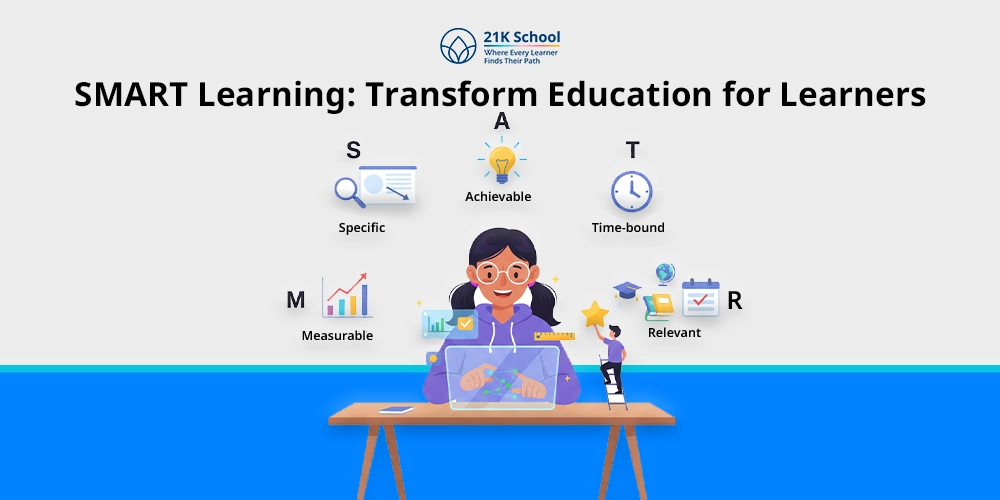
SMART learning is a combination of five components such as specific, measurable, achievable, relevant, and time-bound.
These components together help to create more personalised, interactive, and effective learning experiences.
SMART stands for:
- S stands for Specific:
The objective of learners should be specific, clear, and goal-oriented.
- M stands for Measurable:
Through different tools progress should be tracked frequently.
- A stands for Achievable:
Learning goals should be realistic and achievable.
- R stands for Relevant:
The objective must focus on academic growth, career-oriented, and professional goals.
- T stands for Time-bound:
Each goal should be time-bound. This means one needs to complete and review them on time.
Benefits of SMART Learning
SMART learning helps learners to redefine educational goals. Some common benefits of SMART learning:
1. Personalised Learning Experience
Through personalised learning students can experience effective customised methods based on their pace, preferences, and progress.
Through various digital tools one can analyse performance and modify lessons and exercises. For example, Duolingo and Coursera are effective apps.
2. Improved Engagement and Motivation
Implementation of SMART learning helpful for students engagement and motivation.
Through videos, animations, and simulations, lessons become fun and easy to learn.
3. Accessibility and Flexibility
SMART learning includes benefits like accessibility and flexibility. It helps in breaking down geographical barriers and allows learning from anywhere.
For example, using AI-powered assistance to gain desired knowledge.
4. Real-Time Feedback and Assessment
Learners who implement SMART learning in daily learning get the opportunity to gain real-time feedback and assessment .
It is an ideal way to understand the difficulties and work on concepts for improvement.
5. Teamwork through Digital Collaboration
One of the benefits of SMART learning is teamwork through daily digital collaboration.
Here, learners connect and motivate collaborative learning to enhance personal growth and academic achievement.
SMART Learning Strategies for Students
Given below strategies helpful SMART learning that offers a right mindset and success:
1. Goal Setting
Setting realistic goals by using SMART learning components is one of the effective strategies learners need to implement.
Instead of saying I want to learn a new language, say I will practice daily one hour to learn a new language. Learn the benefits of learning a new language .
2. Active Learning Techniques
Using active learning techniques while studying is an effective strategy for long-term engagement.
Some popular ways like summarise notes, ask questions, peer learning etc for students deeper understanding and retention.
3. Study Habits and Learning Environment
By creating a positive learning environment and study habits such as less distractions, regular breaks, practice tests etc help in structured learning.
For example, a student is creating a study timetable by including realistic daily tasks, breaks, and revision strategy .
4. Note-Taking and Memory Aids
With digital tools for note-taking learners can organise their lessons and to increase memories techniques like concept maps , spaced repetition etc are ideal methods.
5. Self-Assessment and Reflection
Evaluating self-progress by self-assessment helps learners to understand which tools and strategies worked well.
It helps in enhancing self-awareness and accountability in learners over time.
Explore top self-awareness activities for students .
Step-by-Step Guide: Implementing SMART Learning
Phase 1: Assessment and Self-Analysis (Week 1)
- Current skill and knowledge evaluation
Initially start by understanding the strengths and weaknesses. Learners can improve current skills and evaluate knowledge through performance analysis.
- Learning style identification
Learners must determine which learning style suits the best visual, auditory, reading/writing, or kinesthetic.
- Available resources inventory
List out materials, digital textbooks , online courses, mentors, apps, devices and internet connection.
- Motivation and purpose clarification
Identify the objective of learning for self-motivation. It can be career advancement, exam preparation, or personal growth.
- Baseline performance documentation
Track the performance to evaluate the progress in future. This will help in maintaining consistency and academic growth.
Phase 2: Goal Setting and Planning (Week 1-2)
- Writing effective SMART learning goals
Write effective SMART learning goals that align with the future needs and long-term goals .
- Breaking down large objectives into milestones
Dividing big tasks into smaller ones help in achieving daily tasks and boost confidence .
- Creating action plans and timelines
Create weekly, monthly or quarterly action plans and set a timeline to progress.
- Resource allocation and scheduling
Allocate needful resources like books, digital tools etc and schedule time to use them effectively.
- Accountability system establishment
Share your goals and objectives with others for accountability and track progress.
SMART Learning Challenges and Solutions
SMART Learning offers effective learning opportunity, but it also comes with challenges one must address:
1. Digital Divide
Digital divide means some students often face challenges of unstable internet connection and less availability of devices.
Solution: Government initiatives and organisations corporate social responsibility can bridge the learning gaps .
2. Over-Reliance on Technology
Students over-reliance on technology like excessive screen time can negatively impact learning.
Solution: A simple solution like balance on daily activities. For example, time-bound learning and outdoor activities can be beneficial.
3. Data Privacy Concerns
Due to unauthorised acquisition of virtual data students are often worried about personal information safety.
Solution: Through various trusted platforms and devices one can protect their information. Two-factor authentication can be a helpful approach.
4. Need for Proper Training for Teachers and Students
Lacking the ability to use digital tools efficiently is one of the challenges students face while learning.
Solution: Regular training and use can improve digital literacy and confidence to handle tools.
SMART Learning Tips for Success
Given below are five SMART learning tips ideal to achieve long-term success in modern learning:
1. Stay Consistent and Use Digital Tools Daily
Students need to stay consistent and use digital tools daily. It helps them to engage in fun learning activities .
Some common examples of digital tools are Google Calendar, Notion etc.
2. Set Achievable Micro-Goals
Setting achievable and realistic micro-goals help learners to gain their desired goals.
One can break big objectives into smaller ones to reduce burden. This will encourage them to reach the milestone with confidence.
3. Mix SMART Learning with Real-World Practice
To understand the concepts and implement solutions of problems combining SMART learning with real-world practice is essential.
For example, involving real-life projects as a team to get environmental solutions.
4. Track Progress through Analytics Dashboards.
For learners, SMART learning offers various advantages like use learning management systems (LMS) and educational dashboard to analyse problems and find solutions.
In this way, one can track their performance through applications, identify areas of improvement and plan accordingly.
SMART learning promotes students in online discussions, peer learning , and virtual classrooms .
In this way, students collaborate and share their knowledge online without distractions. Regular sharing also increases retention power.
Digital Tools for SMART Learning
For effective implementation of SMART learning given below are crucial digital tools for learners:
1. Goal Setting and Planning
Google Calendar, Trello, and Todoist are some ideal tools for Goal Setting and Planning where learners can set goals, schedule deadlines and track progress.
2. Progress Tracking
For progress tracking, learners can use Notion or MyStudyLife. It helps them to organise everything from combining notes to managing assignments.
3. Learning Management
Khan Academy, Coursera, edX etc are some of the popular e-learning platforms ideal to learn from anywhere and access recognised certificates.
4. Templates and Worksheets
Learners can use SMART goal template and weekly study planner to define clear objectives and daily tasks.
5. Recommended Reading and Further Learning
For continuous learning learners can go through books, courses, and podcasts for personal growth and digital learning .
Some recommendations include:
- Books such as Mindset: The New Psychology of Success.
- Podcasts like The Future of Education .
SMART Learning vs Traditional Learning
Quick difference between SMART learning and traditional learning :
| S No. | Particulars | SMART Learning | Traditional Learning |
| 1. | Method | SMART Learning uses different methods. For example, videos, interactive exercises, and online resources. | Traditional learning uses a lecture-based approach. Here, teachers take lectures in the classroom and students listen carefully. |
| 2. | Pace | Here, students learn at their own pace. | Students must keep up with the pace of the whole class. |
| 3. | Assessment | Quizzes, simulations, peer reviews etc are some popular assessment methods of SMART learning. | Standardised tests and examinations to gain academic achievement. |
| 4. | Learning Environment | Students work with various digital tools. | Students connect with peers and teachers. |
| 5. | Accessibility | Highly accessible to everyone. | Less or limited accessible. |
Conclusion
For the future of education, SMART learning is a powerful opportunity combining personalised learning, data analytics, and digital tools.
In this way, learners ensure their educational journey becomes impactful and positive by using techniques like theory and practice connection, collaborative learning.
With time SMART learning approaches help students and teachers achieve learning goals with confidence and dedication.

You may also want to read