

Are you someone exploring the real meaning of learning?
If yes, then you are at the right place. Learning is a continuous process which offers the opportunity to acquire skills, knowledge, values, and so on. It improves physical and mental abilities.
In students’ lives, learning is a transformative process to help children from a young age. This article here will help you to understand everything about learning from meaning to theories.
Contents
- 1 What is Learning?
- 2 5 Key Characteristics of Learning
- 3 What is the Learning Process?
- 4 4 Theories of Learning
- 5 4 Types of Learning Styles
- 6 Importance of Learning in Education
- 7 The PACT Learning Cycle
- 8 Role of Technology in Learning
- 9 How to Improve Learning Skills?
- 10 Learning Outcomes
- 11 Different Challenges in Learning
- 12 Conclusion
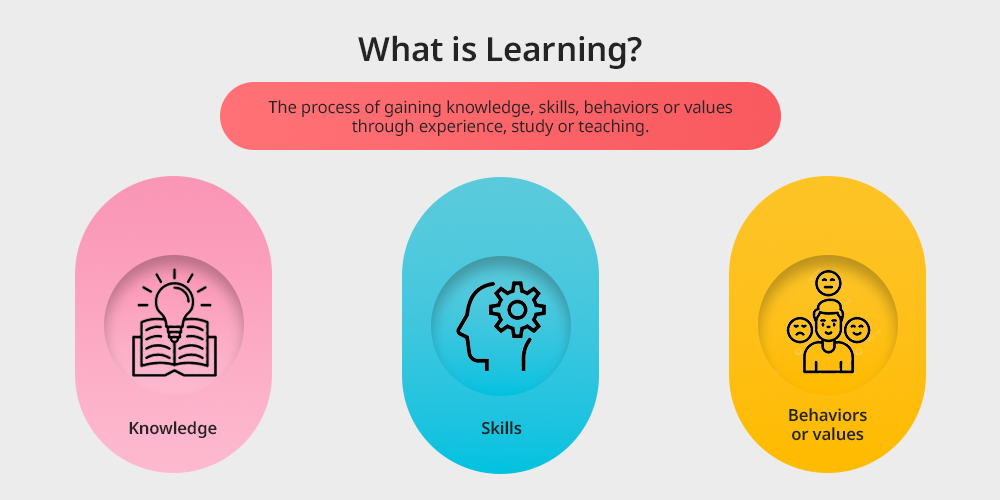
What is Learning?
According to B.F. Skinner “Learning is a process of progressive behavior adaptation”.
It is an active and lifelong procedure which helps individuals in gaining new knowledge, behaviors, skills, attitudes, or preferences through experience, study, or instruction.
However, in the 21st century it is not limited to studying multiple textbooks, students need deep understanding, skills,
behavior, and values. It helps individuals to stay strong and confident in today’s rapidly changing world.
5 Key Characteristics of Learning
Thorough learning students can easily grasp the educational ideas and link them with what they know in life. Some key characteristics or features of learning are:
1. Active and goal-directed
Learning is an active and goal-directed process not only limited to classrooms. From a young child recognising the voice to an adult practicing bicycle they are in the learning phase.
Deep understanding requires active participation instead of passive participation of students to achieve desired goals.
2. Experience-based
Learning includes doing, observing, practicing, and reflecting which offers experience to handle challenging situations.
Children through learning deal with real life problems and find solutions which promote experiential learning theory which offers meaningful exposure to the changing world.
3. Individualized and universal
Learning is individualized and universal because students learn naturally from birth to their death. However, the learning style and speed of each student is different and unique.
That’s why modern education promotes personalised learning to meet the needs of students.
4. Transferable
Learning is transferable, for example, a learner who is learning maths problems can apply physics to understand theories.
Transfer of learning increases thinking skill, promotes innovation, and connects different subjects to increase knowledge.
5. Adjustment/problem-solving
Learning encourages adjustment in a new environment. In this way, one can explore opportunities to become academically strong.
What is the Learning Process?
To recognise how the learning process works effectively in education, go through the quick points:
1. Access to information
It is the initial stage in which receiving or actively seeking new information through various areas such as from a lecture, reading book or any data.
Here students become curious to know which builds the foundation of learning something new.
2. Processing information
The next step is processing the information received earlier by organising, analysing, and interpreting.
In this stage, the brain reconstructs the framework with all the data from prior knowledge to new information. It promotes better understanding, innovation, discussion, and asking related questions.
3. Putting the information into practice
After understanding and analysing the information of a particular topic it’s time to put the information into practice.
Application in real life is essential for deeper understanding. For example:
- Solving problems
- Carrying out science experiments
- Completing classroom projects
- Writing essays
- Using a new skill
4. Evaluation of the learning process
The next and the most important stage is evaluation of the learning process.
By regular evaluation of students teachers can assess the outcome of the learning experience. Some of the common ways of learning are self-assessment, peer feedback, and reflection.
4 Theories of Learning
In education, learning theories are effective approaches to help people understand the ways of learning effectively. The 4 popular learning theories are:
1. Behaviorism Theory
In learning, behavior plays a crucial role. The theory of behaviorism was developed by psychologists named:
- B.F. Skinner
- John B. Watson
- Ivan Pavlov
It is one of the popular methods of education to shape the learners behavior through encouragement and practice.
By focusing on the quantifiable results and well-organised learning methods which help parents and teachers to design a student-centered curriculum.
Implementation of basic principles of behaviorism in education help teachers and parents promote good behaviors and discourage unwanted ones.
For example, behavior modification programs encourage and learn various methods to improve their academic performance and behavior.
2. Cognitivism Theory
Cognitivism theory is also known as Cognitive Learning Theory was pioneered and developed primarily by Swiss psychologist Jean Piaget.
It focuses on people’s mental processes such as a student’s thinking, understanding, memory, memory, and problem-solving skills.
Including Cognitivism theory helps students in various areas like:
- Grasping concepts
- Promotes knowledge retention,
- Improves problem-solving skills
- Continuous learning.
3. Constructivism Theory
A modern approach often used by teachers is known as Constructivist Learning Theory.
Some of the key contributors include:
- Jean Piaget
- Lev Vygotsky
- Ernst von Glasersfeld
It helps students to actively construct their own knowledge based on experiences. Constructivism promotes deep understanding, student engagement and helps to gain confidence for active participation.
In this way, learners learn out of the box and interact with the real life situations to gain maximum knowledge and experience.
For example, inclusion of various project-based learning activities in daily life promotes constructivism learning.
4. Experiential Learning Theory
Experiential Learning Theory (ELT) is another popular way of learning.
It was developed by David Kolb and the theory includes four stages of Kolb’s cycle:
- Concrete Experience
- Reflective Observation
- Abstract Conceptualization
- Active Experimentation
Kolb’s learning cycle is to enhance students’ learning experience and offer an effective logical sequence.
For students exposure to the real world including field trips in education is beneficial.
4 Types of Learning Styles
Each learner and their learning style is different. Some learn through visuals, others by reading or writing. Given below are 4 different types of learning style:
1. Visual
Visual learning style is an amazing approach in which students learn through pictures, charts, graphs, maps, and diagrams to retain the maximum information.
Some key learning methods teachers can use are:
- Mind maps
- Highlight tests
- Flowcharts
- Educational videos
- Infographics
2. Auditory
Auditory learning style means learning through listening. Listening to information such as discussions, storytelling, debate, and explanations promotes better understanding and memory retention.
Some key learning methods teachers can use are:
- Group discussions
- Podcasts
- Recorded lectures
- Verbal repetition
- Question-and-answer sessions
3. Reading/Writing
Through reading textbooks and writing answers students are able to improve their cognitive abilities. It is one of the simple yet effective styles of learning.
Some key learning methods teachers can use are:
- Writing summaries
- Using dictionaries and glossaries
- Rewriting classroom notes
- Reading reference books
4. Kinesthetic
Kinesthetic listening style states that students can learn best by doing. Involving students in physical activities and hands-on learning offers an interactive environment to learn effectively.
Some key learning methods teachers can use are projects, field trips, practical etc.
Importance of Learning in Education
Through different types of learning students are encouraged to understand effectively, resolve problems, and pay more attention so that one can balance both the personal and professional life.
Some key importance of learning in education include:
1. Builds knowledge and skills
Building knowledge and skills are essential and learning is an ideal approach to do so.
Knowledge includes concepts and theory understanding, proficiency in different subjects while skills like reading, writing, problem-solving etc prepare for academic and personal growth.
2. Develops critical thinking
Continuous learning develops critical thinking skills in students. It helps them to analyse, evaluate, and question information instead of rote memorisation.
A student with critical thinking abilities often asks meaningful questions and thinks innovative ideas.
Learning promotes social development such as teamwork skills, empathy, respect for diversity, leadership qualities etc.
Learning not only improves students intellectually but also socially and emotionally.
4. Enhances career opportunities
To enhance students’ career opportunities, learning is an ideal approach which promotes training, certifications, and higher education to stay relevant in this competitive environment.
It increases job opportunities by developing technical knowledge, soft skills, and professional confidence.
The PACT Learning Cycle
The PACT learning cycle includes four stages. These stages are designed to improve students’ personal and professional learning.
1. Procure
The first stage is “Procure” which starts with acquiring new knowledge, information, or abilities. It mainly involves:
- Attending lectures or workshops
- Listening experts
- Reading books or research articles
- Watching instructional videos
2. Apply
The next step is to “Apply” or practice the knowledge gathered. In this way, learning becomes meaningful when theoretical knowledge and practical experience combine.
Some common examples include:
- Solving real-life problems
- Implementation of strategies
- Completing assignments or projects
3. Consider
“Consider” means evaluation of the results of the practice. The stage is essential to understand how much a student understood and improved. Here students’ performance is analysed, identifying strengths and weaknesses to adjust strategies for better learning outcomes.
4. Transform
The final stage of the PACT learning cycle is “Transform”. Transformation generally involves development of new habits, adopting different strategies to enhance professional identity.
Role of Technology in Learning
Technology in education offers transformative benefits to teachers, parents, and students. Top 4 key roles of technology in learning are:
1. Online learning platforms
Various online learning platforms make learning effective in which students can learn anytime, anywhere, at their own pace.
Some popular online/virtual learning platforms include:
- Coursera
- Udemy
- Khan Academy
- Unacademy
2. Digital classrooms
Digital classrooms enhance both teachers and students’ experience in the classroom.
For example, using various tools like:
- Smart boards
- Projectors and tablets
- Learning Management Systems (LMS)
3. E-learning benefits
E-learning platform is one of the most important choices which help achieve desired goals.
For example, learners across the globe collaborate with each other and learn.
How to Improve Learning Skills?
To improve learning skills, students need to understand concepts deeply, retain information longer, and apply knowledge confidently. Some key ways are:
1. Active learning strategies
Active learning strategies promote active involvement instead of passive education.
Teachers can implement various active learning strategies such as think-pair-share, case studies, problem-based learning, and role-playing to enhance learning.
2. Time management
Time management skills are a key to better learning outcomes. It is an important skill which reduces exam stress and increases productivity throughout the educational journey.
3. Practice and revision
Practice and revision are impactful strategies for the long term.
This can be done by revision, solving previous years question papers, self-testing, and learning through mistakes.
4. Goal setting
Clear goals give direction and motivation. Setting SMART goals is beneficial to improve learning skills.
For example, a student with a goal to complete a chapter in 2 days helps in alignment with the schedule to achieve on time.
5. Healthy lifestyle
A healthy lifestyle promotes a sharp mind. Some common ways include proper sleep, balanced diet, physical activities, and meditation for relaxation.
Learning Outcomes
Learning outcomes are an educational process helpful for students who want to achieve specific knowledge or skill by the completion of a course or program.
These outcomes help teachers to strategies for future learning. It focuses on student-centered and tangible achievements to make students’ learning journey more engaging and relevant.
Different Challenges in Learning
Learning is highly advantageous for children. But it also comes with some challenges faced in the 21st century such as:
1. Environmental challenges
To learn effectively students need a positive learning environment which improves their knowledge and reduces negativity for students development.
Some common environmental challenges include poor classroom infrastructure, overcrowded learning environment, inadequate lighting, noise pollution, lack of learning materials, etc.
2. Cognitive challenges
Cognitive challenges such as memory limitations, lack of critical thinking skills, dealing with disabilities, etc, often become a barrier to learning.
A child with cognitive abilities able to think, memories, participate, and process information effectively.
To avoid the cognitive challenges, one needs to use different teaching methods, patience, and regular monitoring are some of the ideal ways.
3. Motivational challenges
Motivation helps students in lifelong learning. However, motivational challenges such as lack of interest, low self-confidence, fear of failure, external pressure can negatively impact while learning.
By getting support from parents, teachers, and understanding the main purpose of learning helps students to motivate themselves.
Conclusion
Learning is a key to personal and professional development that brings good change in life. From learning how to ride a bicycle to solving complex trigonometry, learning is a part of day-to-day operations.
There are various benefits and methods of learning such as experiential learning, active participation, self-directed education etc. It helps in building a strong foundation of modern education.
For quality learning and a successful journey, students engagement, teachers evaluation, and parents support is important. To know more stay tuned!

You may also want to read