

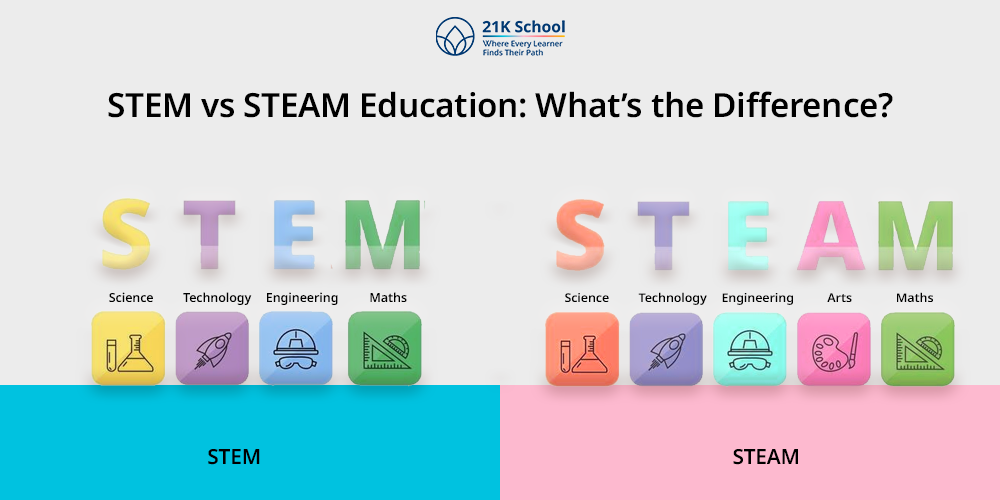
Think of a class where students are learning only science, technology, engineering & mathematics (STEM), but also they must be sharing their thoughts through music and arts.
Both STEM & STEAM play a vital role in the modern education system. Professionals, teachers & society everyone is demanding an exclusively creative individual who is capable of solving critical problems, feel free to communicate & interact with their peers & adapt to that particular learning or work environment.
So, when technology advanced, job opportunities also became wider with time. There is always a scope for the students to improve their skills & make themselves ready for the future by sharpening their logical reasoning & creative thinking skills .
Contents
5 Key Differences Between STEM & STEAM
So here comes a clear tabular representation of how STEM is different from STEAM in different aspects:
| Sl. No. | ASPECTS | STEM | STEAM |
| Focus | Stem prioritises technical thinking & logical reasoning, with science, technology, engineering & maths. | Steam prioritises an equilibrium of technical skills & creative ideas by including arts or music in order to enhance the learning. | |
| Career Scope | It is making the career of students ready for science, technology, engineering & maths-related fields only. | It is preparing students for the future with wide options in creative fields like designing, architecture, & a lot more. | |
| Learning Style | It mainly focuses on a structural learning environment, which includes problem-solving & logic-based study. | It provides a dynamic learning environment which includes practical & project-based learning , & creative design-based study. | |
| Student Outcomes | This helps students to improve their problem-solving skills , critical thinking skills & technological ideas. | This helps students to think in a creative way & learn practical & experimental skills & communication skills . | |
| Teaching Styles | Here, teachers prefer to arrange assessments , homework , and lab experiments related to science, maths. | Here, interactive & creative learning methods are followed by the teachers & by including arts & designs for better clarity of thoughts. |
1. Focus:
STEM education mainly prioritises the technical & experimental skills in order to solve real-life scenarios.
STEAM prioritizes creativity of technical skills by adding the art of designing in order to think & work in an innovative & practical way.
2. Career Scopes:
STEM makes the students ready for careers in science, technology, engineering, & mathematics fields.
STEAM improves the career scopes for students by including arts, design, architecture & a lot more.
3. Learning Style:
STEM education follows a structured & logical way of learning where methodology & experiments are valued.
STEAM education develops a dynamic & unique learning experience for the students where creativity, imagination are valued.
4. Students Outcomes:
STEM education improves logical reasoning skills & problem-solving skills .
STEAM education helps students to think creatively & improve their critical thinking ability & solve problems.
5. Teaching Style:
STEM usually depends on experimental-based projects for hands-on learning experience.
STEAM includes arts & design in order to make the learning more interactive & imaginative.
What is STEM Education?
STEM refers to Science, Technology, Engineering & Mathematics. It is a learning method that helps students build a deep foundation in scientific knowledge & technical skills.
Core Objectives:
- Helps students to build a strong base of knowledge for a career in order to get a good job in either computing, engineering, or biotechnology, etc.
- It helps students to learn how to perform experiments, test hypotheses, or apply technological solutions.
- Encourages students to think analytically & work on logical reasoning.
Skills Developed:
- Problem Solving – You need to identify the issue & work accordingly, step by step.
- Analytical Thinking – You can split the tough problems into simpler parts.
- Technical Ideas – Gaining a deep understanding of the basic concepts of scientific methods, engineering, maths & technical applications.
Benefits of STEM Education
1. Prepares Students for Science & Tech Careers
STEM education is just helping the students to improve their skills that are required for high-demanding jobs in the field of IT, engineering, biotechnology, etc.
2. Strengthens Logical Reasoning and Analytical Thinking
STEM education mainly focuses on structured learning; here, students start grasping the technique by thinking through a step-by-step process & taking bold decisions accordingly.
3. Global Demand
The demand for STEM-related jobs is continuously increasing every single time across the globe. This helps students to be smarter & confident enough to face any situation bravely.
What is STEAM Education?
STEAM is similar to STEM, but includes the arts & design. The main aim of implementing arts & design in this education is just to receive creative, innovative & thoughts ideas from students.
Core Objectives:
Why is the integration of arts important?
- It allows students to think in a creative way, instead of using any technical or scientific results.
- It includes fun, improves motivation & creativity, which is making learning more accessible & user-friendly while adapting to that particular environment.
Skills Developed:
- Creativity & Innovation: Thinking beyond the technical ideas, in place of the original ones.
- Communication: By explaining various ideas, verbally & through artistic expressions.
- Design Thinking: This helps students plan the idea as visual knowledge.
Benefits of STEAM Education
1. Encourages Innovation and Imagination
STEAM education allows students to think creatively about the various possible ways, experiment with those ideas, instead of solving a pre-defined problem.
2. Builds Confidence in Creative Problem-Solving
It helps students to build their confidence while solving problems on their own using creative techniques and by their own choices.
3. Helps in Both Technical and Non-Technical Fields
Students who want to learn with STEAM can choose their career not only in technological & scientific fields but also in arts, designing, media, as well as in traditional STEM-related fields with a creative edge.
Conclusion
Both STEM vs STEAM education have their different strengths.
STEM focuses on building a strong foundation on technical, scientific, & analytical skills , whereas STEAM adds arts & design to give students a wider chance to think in a more unique & creative way.
So, it is not about choosing one particular education system. Technically, if you see, the best education comes by mixing up these two types of education systems.
This combination of education makes students prepare for a world which values creativity, adaptability & both technical & scientific methods.
Therefore, by combining both, the teachers or mentors can provide a great learning experience, where students will not only get the idea but also they must be getting a wider scope to learn new things in a creative & innovative way.

You may also want to read