


When we think of virtual reality (VR), the first thing that might come to mind is VR games that are loved by children.
But, how about we incorporate VR in education ? Would learning be fun too for learners?
Virtual reality is a component of the digital revolution that has totally shifted the view of attaining knowledge in educational settings.
With VR, students are able to relate with their core subjects more efficiently, thus fostering student-engagement and immersive learning .
Other benefits of VR in education are briefed in the following article for you to have a read.
Contents
- What is VR in Education?
- 12 Benefits of VR in education
- 1. Enhances Engagement and Interest
- 2. Improves Understanding (Through Experiential Learning)
- 3. Boosts Knowledge Retention
- 4. Supports Safe and Risk-Free Learning Environments
- 5. Offers Equal Learning Opportunities
- 6. Enhances Collaboration and Social Learning
- 7. Improves Skill Development for Future Careers
- 8. Helps Students with Special Needs
- 9. Encourages Creativity and Innovation
- 10. Makes Learning Fun and Motivating
- 11. Enhances Teacher Effectiveness
- 12. Promotes Accessibility in Education
- Conclusion
What is VR in Education?
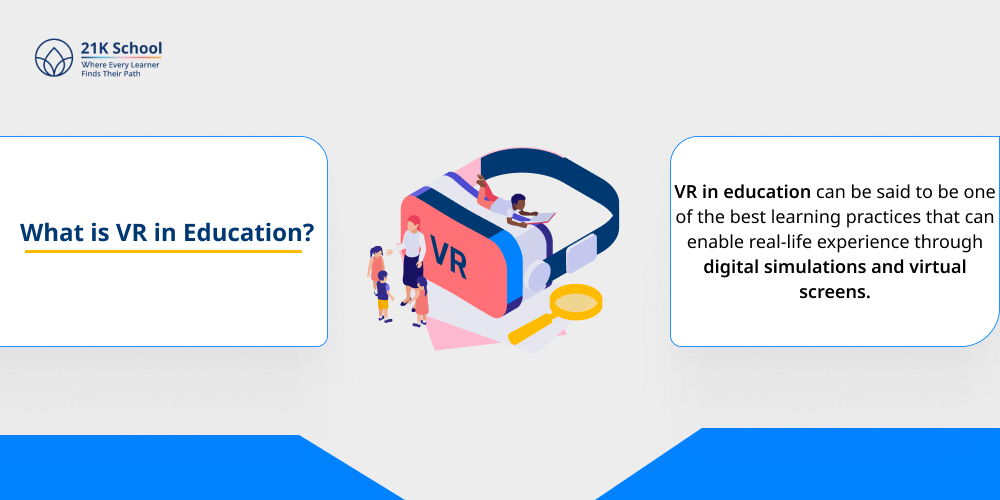
VR in education can be said to be one of the best learning practices that can enable real-life experience through digital simulations and virtual screens.
In K-12 classrooms, virtual reality softwares and hardwares are being utilized to provide vocational training to learners, thus leaving behind the old traditional schooling methods.
VR at schools can be applied in virtual field trips through historical recreations, studying languages, skills, special needs, career exploration, and even training teachers.
VR eases and makes the process of learning more interesting and memorable through direct experience and interactivity.
This enables students to grasp the complicated subjects in a much easier and personalized way.
12 Benefits of VR in education
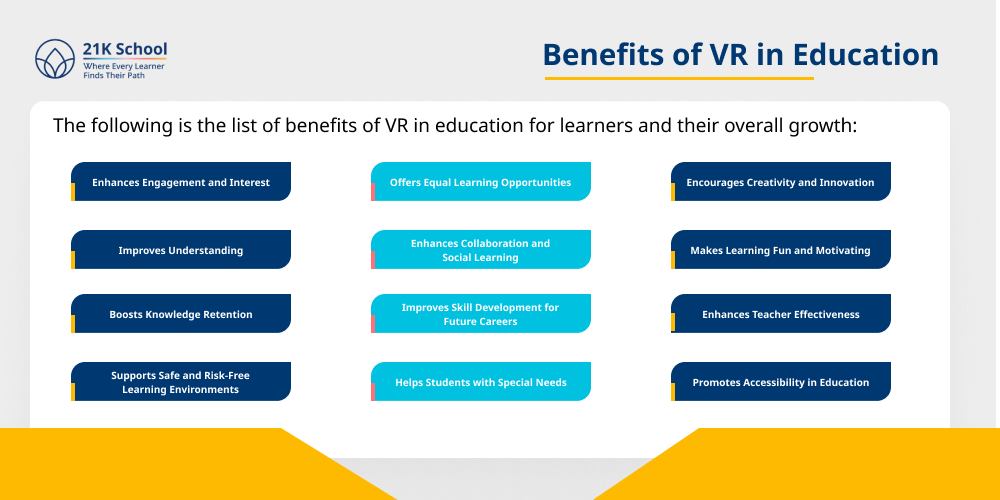
The following is the list of benefits of VR in education for learners and their overall growth:
1. Enhances Engagement and Interest
VR draws students’ attention effectively, unlike textbooks and lectures in traditional classrooms .
Learning becomes interactive, instead of passive, when students are taken to the dynamic, attractive, and interactive environments of stimulated learning.
The excitement obtained through this immersion also favours teachers when trying to engage the students throughout a lesson.
2. Improves Understanding (Through Experiential Learning)
One of the best educational techniques is learning through doing, which is also known as experiential learning .
The VR facilitates this by enabling students to navigate and interact with 3-dimensional worlds.
Scientific concepts like structure of the cells or chemical reactions are made easier to understand as learners can see them live through virtual equipment.
This real-world experience enhances their further comprehension and mitigates gaps between theory and practice.
3. Boosts Knowledge Retention
VR enhances memory as there is involvement of multiple senses.
The students view, listen to, understand, and engage with the content as opposed to just reading or listening. This makes learning a lot more memorable.
Immersive experiences tend to linger with the students even after the learning has been completed. And hence, better retention of lessons in the long run.
4. Supports Safe and Risk-Free Learning Environments
Science, engineering, medical studies, etc. are subjects that have risks, are costly to practice, and are hard to replicate in a classroom.
VR removes these barriers by providing controlled and safe environments where students can engage into practical execution.
Learners can be able to experiment virtually, recreate surgeries, operate machinery, or perform within a non-threatening emergency situation.
This risk-free learning establishes self-confidence .
5. Offers Equal Learning Opportunities
There are schools that lack laboratories, field-trip money, modern equipment, or other accessibilities required for learners.
VR makes sure that every student, regardless of their background and geographical limitations, has access to good learning opportunities.
A student in a distant part of the world can virtually visit the same museum, national park, or historical site as a student in a well-renowned school.
This aids in eliminating the inequality in education and making the learning processes more inclusive. However, the point here is the easy availability of the VR devices that may otherwise create a digital divide due to high initial costs for a segment of learners.
6. Enhances Collaboration and Social Learning
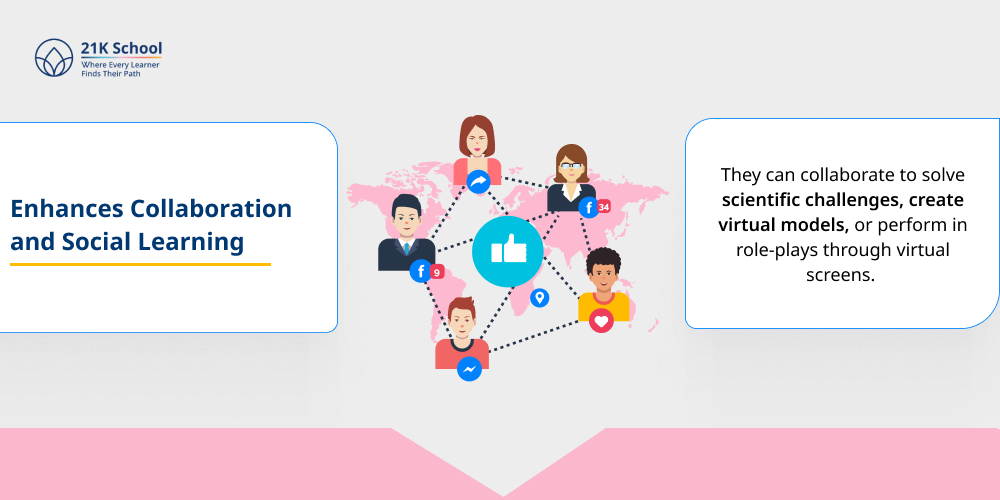
Even though VR can be an individual experience, a number of VR platforms do allow interactions in groups.
Students are able to access common virtual platforms where students interact and cooperate in tasks.
They can collaborate to solve scientific challenges, create virtual models, or perform in role-plays through virtual screens.
This cooperative aspect will assist in enhancing group-work, peer learning , and communication skills .
7. Improves Skill Development for Future Careers
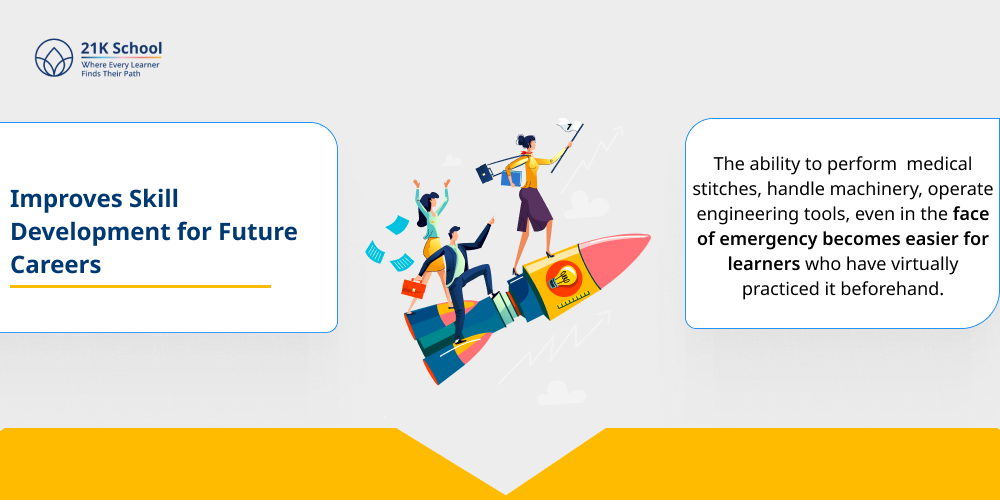
VR is employed in the industrial-training that are carried out today, including safety, aviation, healthcare, and engineering sectors.
Educators should start using VR in school to expose students to real-life skills at an early age.
The ability to perform medical stitches, handle machinery, operate engineering tools, even in the face of emergency becomes easier for learners who have virtually practiced it beforehand.
VR is useful in imparting both technical skills and soft skills , including decision-making , leadership, communication, and problem-solving techniques .
This exposure at an early age is a good base for acquiring future jobs in the 21st century .
8. Helps Students with Special Needs
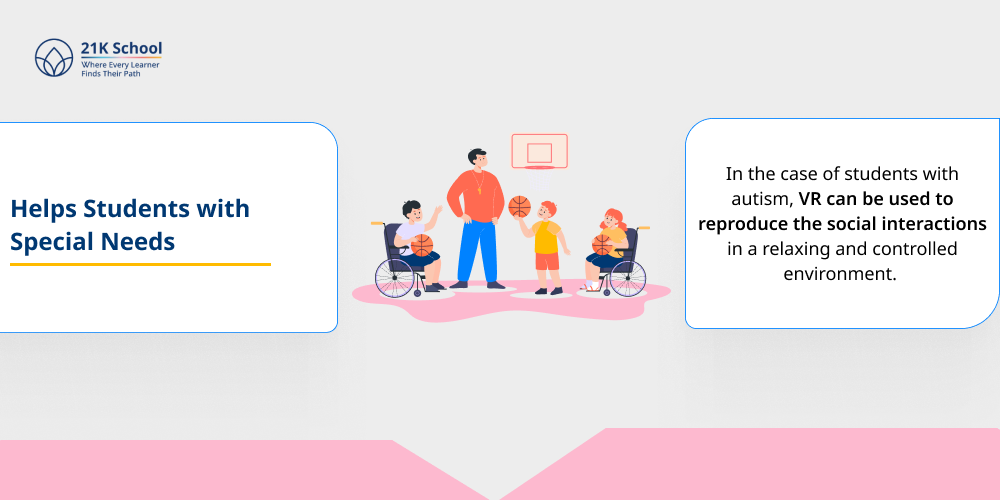
VR may also be tailored to the individual demands of students with special needs in learning .
In the case of students with autism, VR can be used to reproduce the social interactions in a relaxing and controlled environment.
Lessons which minimize extraneous distractions can be helpful to students with ADHD.
Individuals who have mobility restrictions are able to have access to places that they can not necessarily visit.
VR enables the lesson to be modified to suit each student with regard to the pace, lessons’ complexity, and their sensing-intensity.
9. Encourages Creativity and Innovation
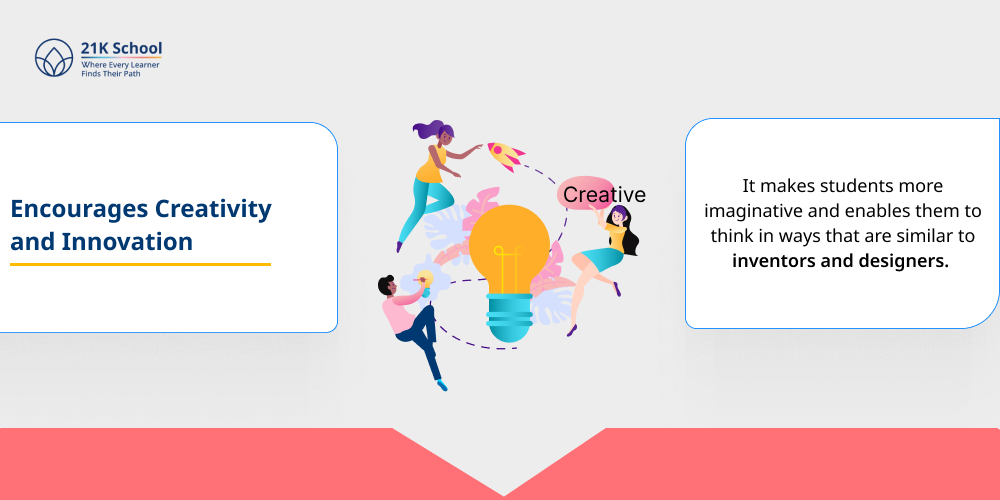
VR provides students the liberty of becoming creators rather than being consumers.
It makes students more imaginative and enables them to think in ways that are similar to inventors and designers.
They can create 3D worlds, virtual buildings, artistic settings, or have a programmed interactive simulation.
Such creative expression fosters innovation and it comes in handy during STEAM disciplines.
10. Makes Learning Fun and Motivating
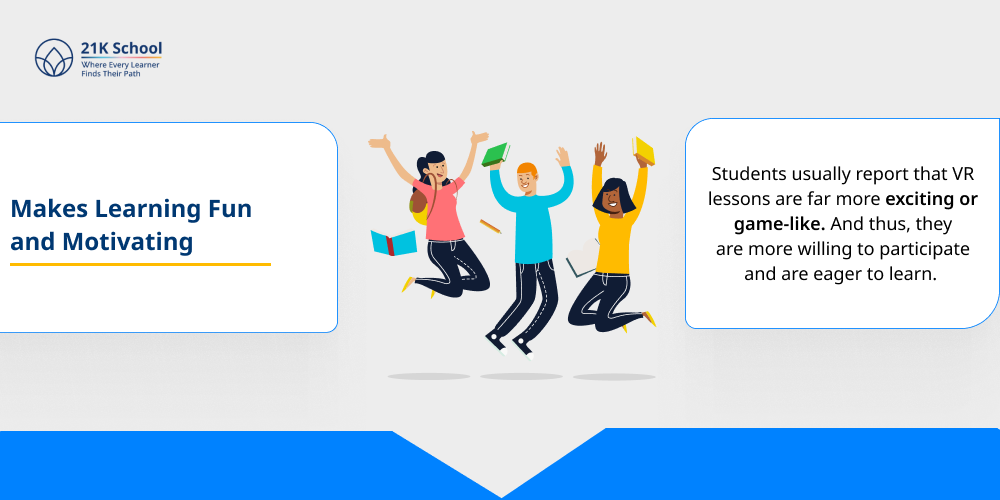
VR can make the process of learning similar to an adventurous journey.
Students usually report that VR lessons are far more exciting or game-like. And thus, they are more willing to participate and are eager to learn.
The attitude to school also improves when the students are emotionally involved in their educational goals.
Topics that otherwise might be challenging or dull in a conventional classroom can be entertaining without requiring much effort.
11. Enhances Teacher Effectiveness
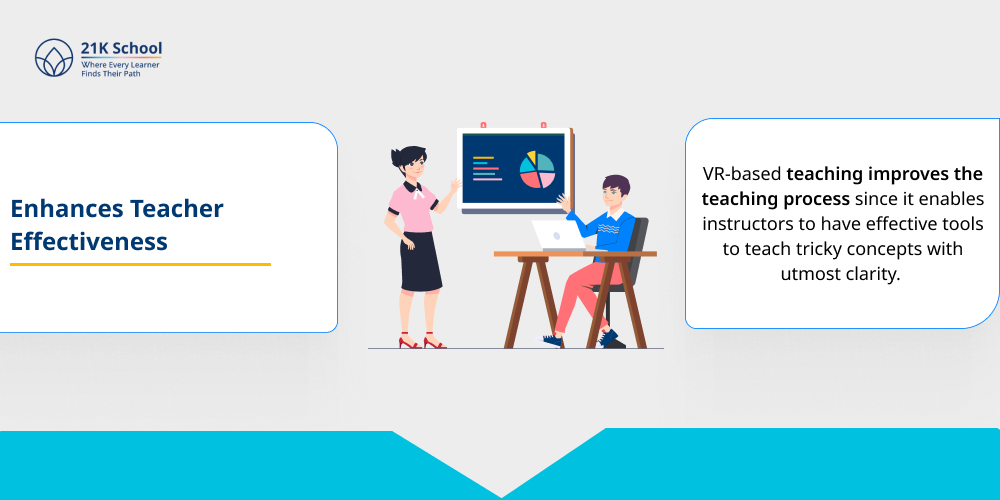
VR-based teaching improves the teaching process since it enables instructors to have effective tools to teach tricky concepts with utmost clarity.
The educators are able to provide real-life examples, lead students through virtual scenarios, track their progress in simulations, and customise lessons to varying learning styles .
This enhances the effectiveness in instruction that allows teachers to establish more dynamic and more personalized learning environments.
12. Promotes Accessibility in Education
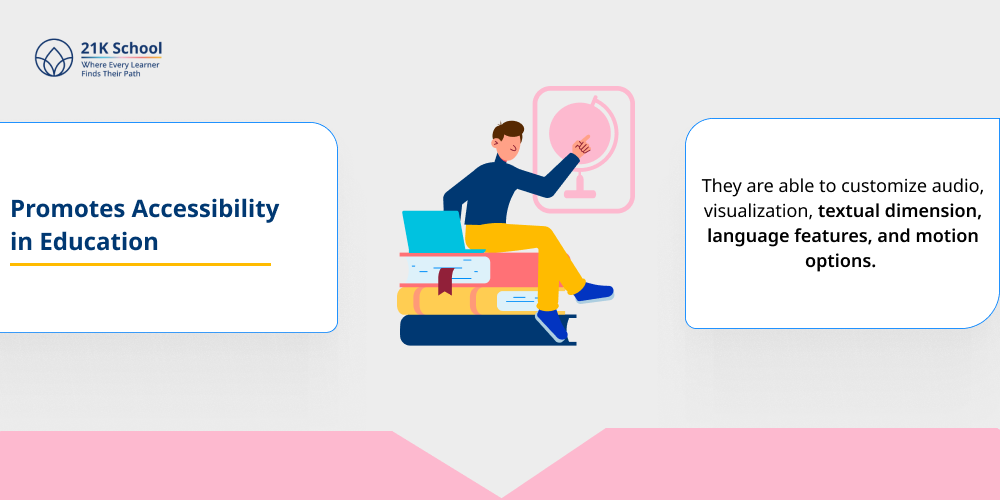
VR assists students to access their learning environment according to their needs, thus fostering inclusive education .
They are able to customize audio, visualization, textual dimension, language features, and motion options.
Learners with poor eyesight can magnify objects and learners that are unable to travel can learn about other locations in the world virtually. However, it is crucial here to acknowledge the cost/infrastructure barriers associated with VR in ensuring accessibility to all learners.
Conclusion
VR in education is working consistently towards a more inclusive and whole-level development of young learners.
Among all the benefits of VR in education, relevant stimulations and development of real-life skills required for future employment are the most relevant ones.
VR technology is still developing, and it will significantly contribute to the future of learning.
The potential is almost unlimited, and the possibilities of VR are yet to be explored in classrooms worldwide.

You may also want to read
CBSE Passing Marks Out of 100: Theory, Practicals & Grading
- Last updated on: 10 Mar, 2026
- 7 min read