

There are many learners who want to give competitive exams like NEET after passing class 12 and knowing how to prepare for the NEET exam is the first step.
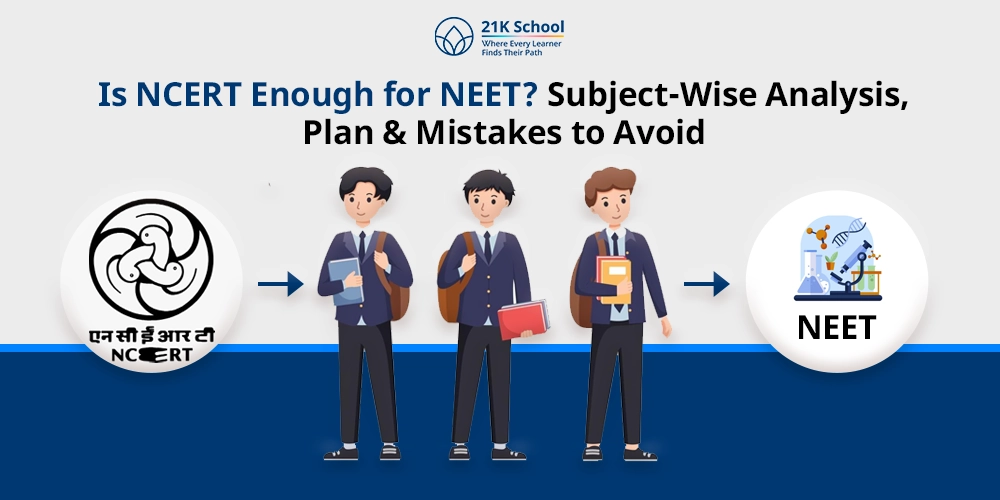
Many people including teachers suggest that studying NCERT can score good marks for the class 12 learners. But, is NCERT enough for NEET?
We will find the answer in this article, much like the way we explored whether NCERT is enough for JEE Mains . Get ready to get a blueprint to prepare for NEET using NCERT books and other resources.
Contents
What is the NEET Exam Pattern?
The initial step to good preparation is the knowledge of the exam pattern. This NEET exam pattern comprises three subjects including biology, chemistry, and physics.
The exam has 200 multiple choice questions out of which the candidate is required to take 180 questions.
Every right response is worth 4 marks making a total of 720 marks, while every wrong response results in deduction of 1 mark. The major part of the NEET paper is biology, which consists of 360 marks.
This means you should choose every answer with accuracy. Basic preparation from class 11 and 12 NCERT textbooks might help in foundational understanding, but NEET demands more.
It is here that most students will learn that reading National Council of Educational Research and Training may not suffice for their NEET preparation.
Why NCERT is Crucial for NEET
NCERT sets a basic standard for NEET level explanations. It is crucial because of the following:
1. Adherence with the Syllabus
NCERT is directly aligned with NEET syllabus and this benefits learners who are preparing for it.
The first thing told to these students is to read NCERT books thoroughly as many questions directly come from them.
NCERT is a compact book that covers almost all topics that are crucial for scoring well in NEET, especially in Biology.
2. Conceptual Clarity
The NCERT books are designed on the basis of establishing good basics.
Language is not complex and the introduction of concepts follows logical order. Thus, the complex concepts can be understood easily by the students.
The easy to understand language of NCERT books ensure that learners have a good conceptual clarity that they can utilize later to solve tough problems.
3. Direct Questions from NCERT
Many learners say that NEET often asks direct questions from NCERT books and their lines.
This is why educators often ask children to revise and practice from NCERT regularly.
4. Reliable and Error-Free Content
It is a standardised and very reliable reference book, unlike many others. Experts check it, so there are less chances of any errors.
This makes it a reliable source for both the students and the exam-paper setters.
Is NCERT Enough for NEET? Subject-wise Analysis
Though, NCERT is such a good book, let’s find if it is enough for NEET for each subject that is included in exams:
1. Biology: NCERT is Almost Sufficient
The most scoring part in NEET is biology, and in this case NCERT dominates. Most of the questions are asked directly from NCERT texts.
There is no point in reading without practicing, so make sure to practice as many MCQs as possible from sample papers or previous year question papers.
Each line, diagram, table, and summary box are important to remember if you want to score well in Biology NEET.
2. Chemistry: NCERT + Practice Required
With chemistry, it is a bit mixed. Reading NCERT can help learners to score better in inorganic chemistry and organic chemistry.
But, physical chemistry might require more practice from reference books. These reference books provide added concepts and examples that aid in clarification of complex problems.
3. Physics: NCERT Alone is Not Enough
Physics is one of the subjects that NEET aspirants face difficulty in.
While NCERT books provide basic concepts and examples, learners need more application-based questions to practice.
NEET aspirants should rely more on reference books to crack NEET and score well in physics as NCERT will not be enough.
4 Drawbacks of Relying Solely on NCERT
If you plan to rely solely on NCERT books for NEET preparation, it might have the following limitations:
1. Lack of Advanced Practice Questions
NCERT lacks sufficient MCQs or advanced-level questions.
NEET is among the toughest competitive exams, so you need to learn to give answers with accuracy.
Time management is another trait that you need to have while appearing in NEET exams.
2. Limited Depth in Physics
The concepts of physics taught in NCERT are usually too simple to match the level of NEET. The lack of further resources can make the students unable to deal with complex problems.
3. Insufficient Problem-Solving Exposure
NCERT provides good theory-based learning, but NEET demands practical problem-solving .
You might have noticed that questions asked in NEET physics and chemistry are based on application and to solve those questions learners should have such exposure. NCERT lacks such questions.
4. Competitive Edge Missing
NEET has a high cut-off rate and to get into good medical colleges, you need to have some competitive edge in terms of your preparation. NCERT offers basic concepts.
Relying entirely on NCERT can lead to average results in NEET exams.
How to Use NCERT Effectively for NEET
If you are really serious, you can utilize NCERT effectively for NEET concepts by doing the following:
1. Read Line by Line
NEET papers have direct questions from NCERT lines in textbooks.
You should read each line carefully multiple times and byheart them before final NEET exams.
2. Highlight Key Points
Make sure to underline key points, definitions, images, lines, and chemical reactions on the first read of NCERT books.
It serves as one of the best revision tips for your NEET preparation.
3. Practice Diagrams
In Biology, diagrams are really necessary as visual learning makes them easier to remember, because questions are asked indirectly from them in NEET. Practicing labels and familiarising yourself with them can help you score better.
4. Revise Multiple Times
The secret of learning lies in revisions. You should revise at least 4-5 times before actually appearing for the exam.
5. Solve Previous Year Questions
Solving PYQs can help you understand how concepts are framed into questions and what areas are frequently tested.
6. Make Short Notes
Write brief notes referring to formulas, reactions, diagrams, and some key facts so that you can revise them in due time before exams.
4 Common Mistakes Students Make
While preparing for NEET exams, many learners commit some mistakes that are worth mentioning:
1. Over-reliance on Coaching Material
Most students are lost in the heaps of coaching notes and neglect NCERT which may cause a learning gap in the basics.
2. Ignoring NCERT
Some students even underestimate NCERT. This can be bad for learners who want good marks in biology in NEET.
3. Lack of Revision
Without frequent revision, even well-understood subjects can be forgotten during the exam time.
So, it is crucial that learners focus on effective revision techniques and by heart all the common concepts before exams.
4. Neglecting Practice
Preparation does not only consist of reading. It should also include practice exercises and long sessions of revisions.
You might fail to perform your best in the actual exam without knowing how to answer questions and a good amount of practice from reference books.
NCERT + What Else? The Ideal NEET Study Plan
An ideal study plan for NEET can be the one that involves basics from NCERT and practicing sample questions from reference books.
In the case of Physics and physical chemistry, having reference books that have a variety of problems can be beneficial.
Some examples could be H. C. Verma for physics and O. P. Tandon for chemistry.
If you want to stand out in the NEET competitive exams, you will have to practice an ample amount of questions.
Consistent revisions and a good study routine can help you score well and crack NEET.
Final Comments
NEET is one of the toughest exams in India and you might need more than just NCERT to prepare for that.
NCERT is great for preparation of biology questions, but to get high cut-off marks in physics and chemistry you will have to depend on a few classic reference books.
Your preparation would be fruitful if you learn to revise your concepts diligently.

You may also want to read