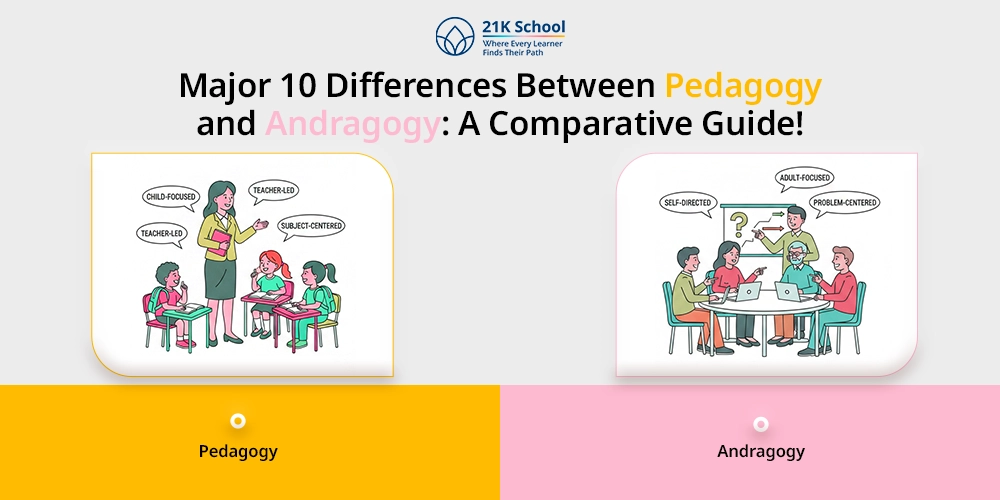
Major 10 Differences Between Pedagogy and Andragogy: A Comparative Guide!
 Written byAnkita SinghaContent Specialist
Last modified: 23 Jul 2026 5 min read
Education today offers various approaches to learn effectively. Did you know the child’s way of learning is quite different from an adult?
To understand the difference, one needs to get familiar with two distinct approaches: Pedagogy and Andragogy.
So, without any delay let’s go through a detailed guide on the key difference between pedagogy and andragogy in learning.
What is pedagogy?
The term "pedagogy" comes from the Greek word "paidagogos", meaning "to lead a child."
Pedagogy is a popular approach of teaching that includes both theory and practice. It is mainly concerned with the learning of children and adolescents.
Pedagogy defines a connection between the methods of learning and culture around the learners. Some common examples of pedagogy such as:
- Students follow the teacher's instructions to perform tasks like drawing a map.
- The homework is submitted and checked by the teacher.
What is andragogy?
Andragogy, also known as ‘Adult Learning Theory’ is popularized as a theory of teaching adults. It is a learner-centered approach in which adults bring prior knowledge, life experiences, responsibilities, and self-direction into the learning process.
Here, learning is often preferred as practical, problem-oriented, and immediately applicable to real-life situations.
Some common examples of andragogy such as:
- An assessment is completely through projects and practical tasks.
- Practicing a new skill through self-paced e-learning platforms .
10 key difference between pedagogy and andragogy
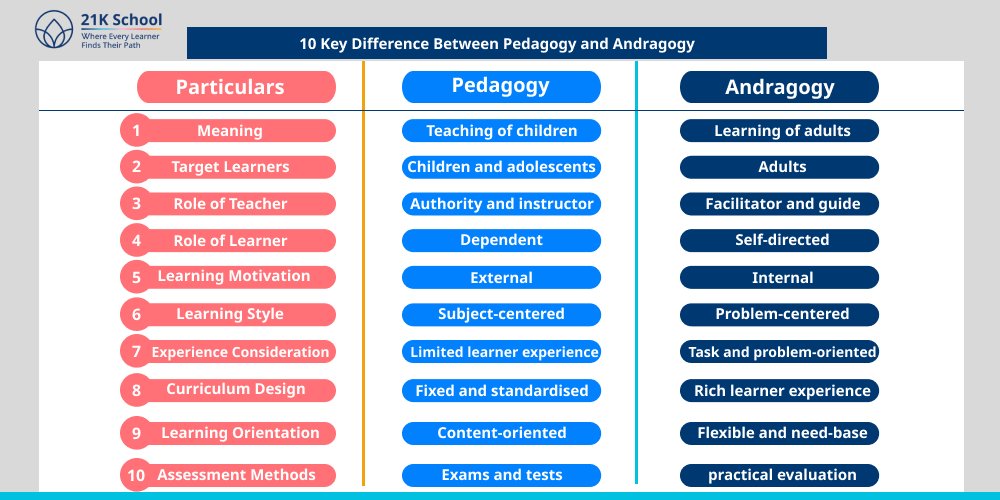
Pedagogy and andragogy are two different terms that can be understood in-depth through the below table.
| S No. | Particulars | Pedagogy | Andragogy |
|---|---|---|---|
| 1. | Meaning | Teaching of children | Learning of adults |
| 2. | Target Learners | Children and adolescents | Adults |
| 3. | Role of Teacher | Authority and instructor | Facilitator and guide |
| 4. | Role of Learner | Dependent | Self-directed |
| 5. | Learning Motivation | External | Internal |
| 6. | Learning Style | Subject-centered | Problem-centered |
| 7. | Experience Consideration | Limited learner experience | Rich learner experience |
| 8. | Curriculum Design | Fixed and standardised | Flexible and need-based |
| 9. | Learning Orientation | Content-oriented | Task and problem-oriented |
| 10. | Assessment Methods | Exams and tests | Self-assessment , practical evaluation |
1. Meaning
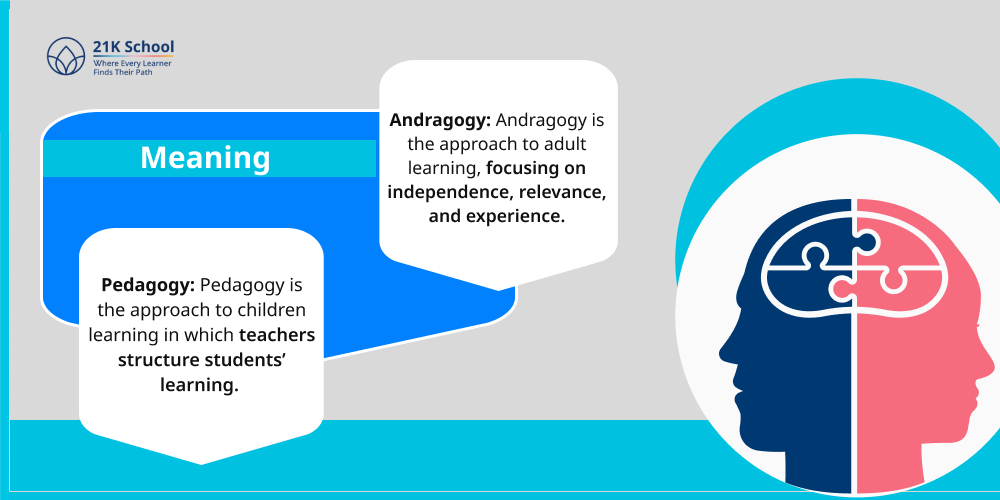
- Pedagogy: Pedagogy is the approach to children learning in which teachers structure students’ learning.
- Andragogy: Andragogy is the approach to adult learning, focusing on independence, relevance, and experience.
2. Target learners
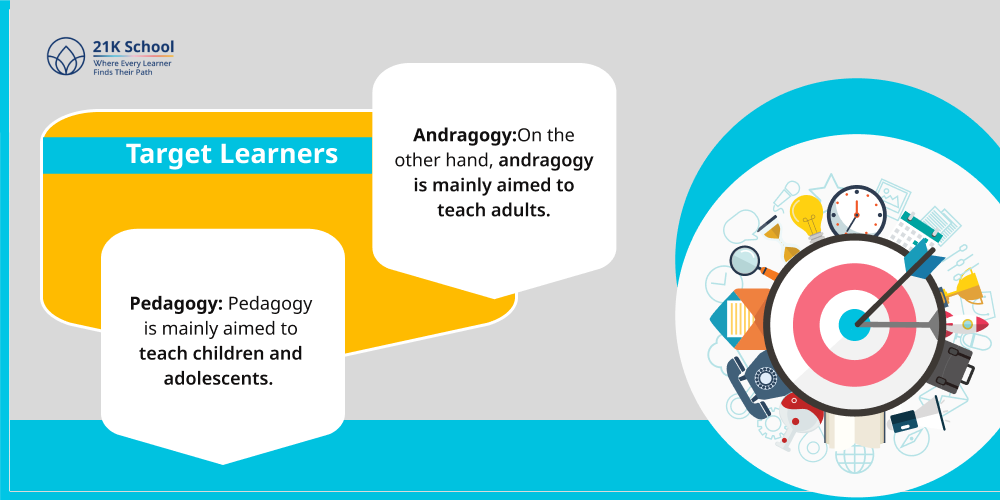
- Pedagogy: Pedagogy is mainly aimed to teach children and adolescents.
- Andragogy: On the other hand, andragogy is mainly aimed to teach adults.
3. Role of teacher
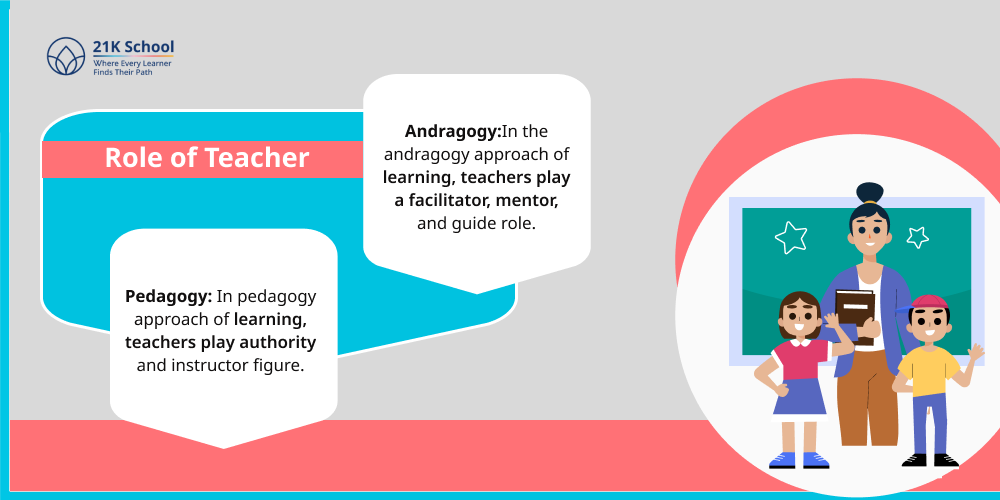
- Pedagogy: In pedagogy approach of learning, teachers play authority and instructor figure. They offer structured learning and monitor progress.
- Andragogy: In the andragogy approach of learning, teachers play a facilitator, mentor, and guide role. They showcase direction rather than control.
4. Role of learner
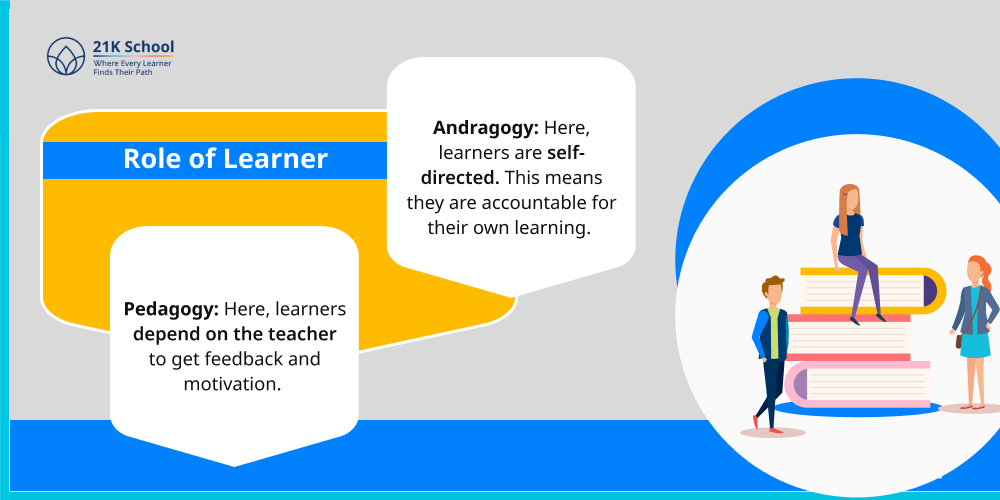
- Pedagogy: Here, learners depend on the teacher to get feedback and motivation.
- Andragogy: Here, learners are self-directed. This means they are accountable for their own learning.
5. Learning motivation
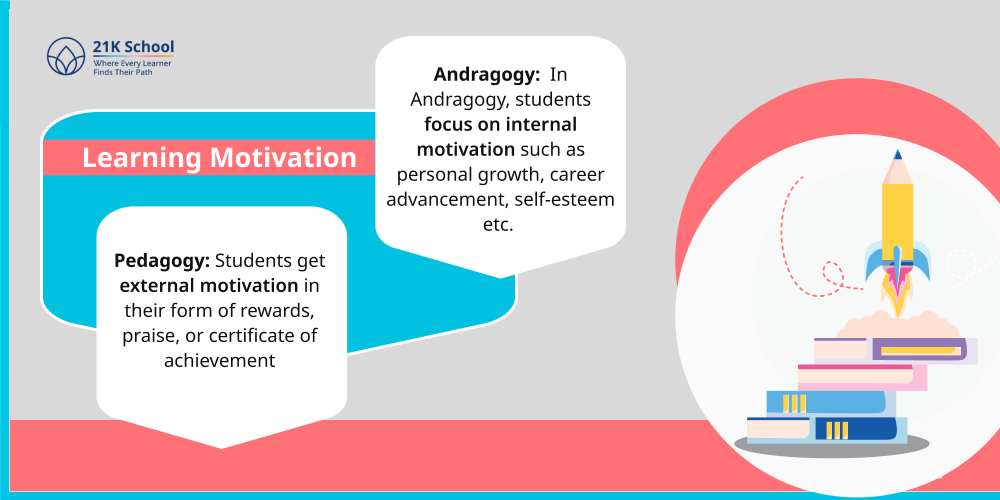
- Pedagogy: Students get external motivation in their form of rewards, praise, or certificate of achievement.
- Andragogy: In Andragogy, students focus on internal motivation such as personal growth, career advancement, self-esteem etc.
6. Learning style
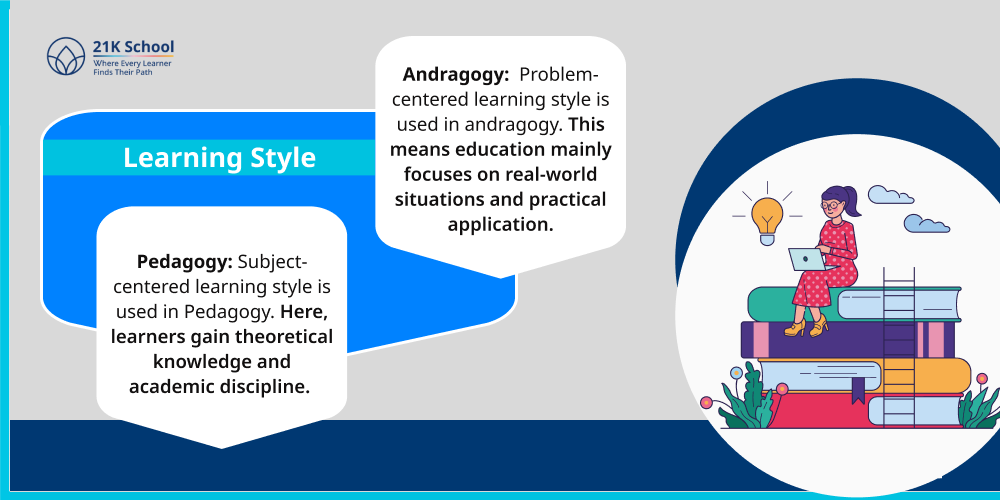
- Pedagogy: Subject-centered learning style is used in Pedagogy. Here, learners gain theoretical knowledge and academic discipline .
- Andragogy: Problem-centered learning style is used in andragogy. This means education mainly focuses on real-world situations and practical application.
7. Experience consideration
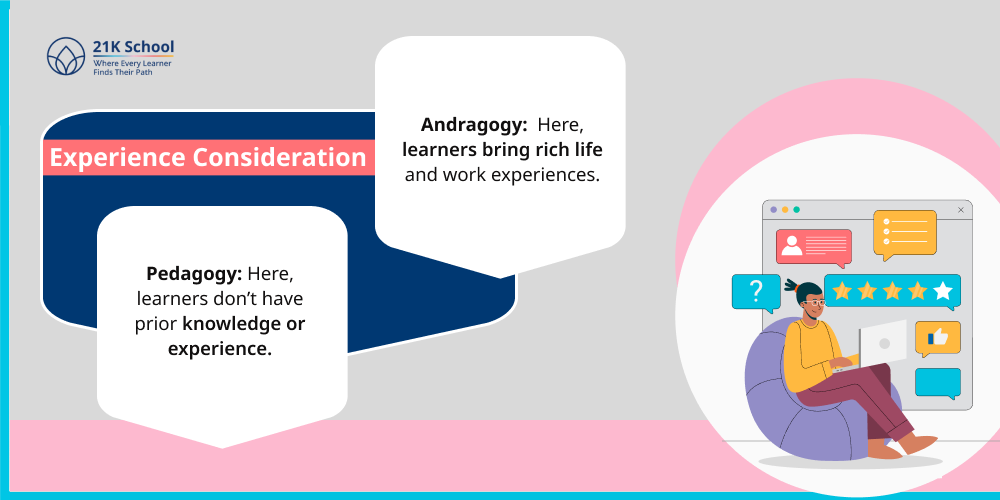
- Pedagogy: Here, learners don’t have prior knowledge or experience. They start with basic concepts.
- Andragogy: Here, learners bring rich life and work experiences. It becomes valuable for deep understanding.
8. Curriculum design
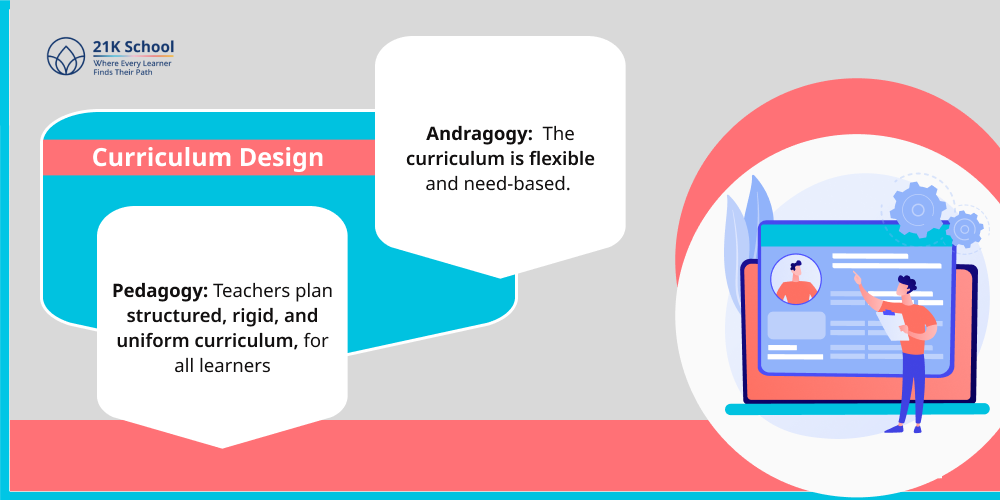
- Pedagogy: Teachers plan structured, rigid, and uniform curriculum for all learners
- Andragogy: The curriculum is flexible and need-based.
9. Learning orientation
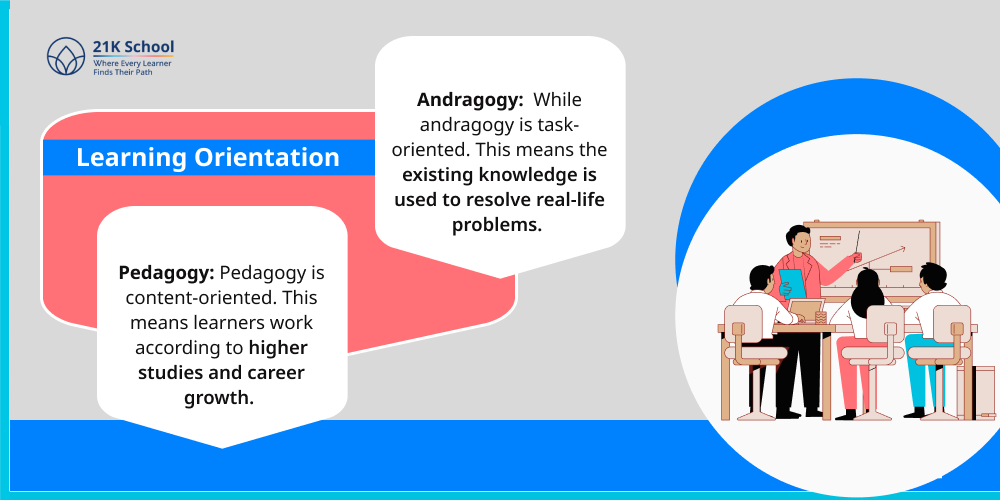
- Pedagogy: Pedagogy is content-oriented. This means learners work according to higher studies and career growth.
- Andragogy: While andragogy is task-oriented. This means the existing knowledge is used to resolve real-life problems.
10. Assessment methods
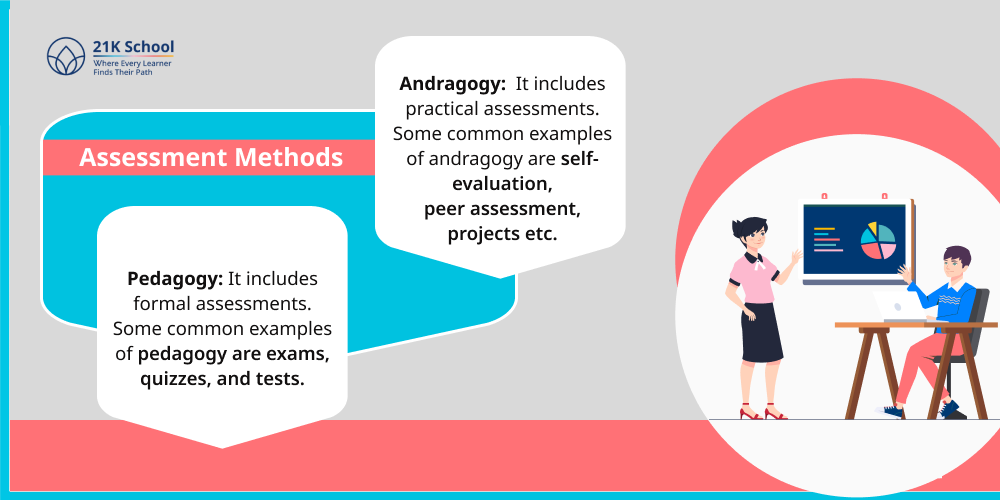
- Pedagogy: It includes formal assessments. Some common examples of pedagogy are exams, quizzes, and tests.
- Andragogy: It includes practical assessments. Some common examples of andragogy are self-evaluation, peer assessment , projects etc.
Conclusion
Pedagogy and andragogy are two different approaches to learning one should apply. It’s all about gaining knowledge in different ways.
Pedagogy and andragogy are effective for kids and adults. Pedagogy is best for kids who need structure, guidance, and foundational learning. On the other hand, andragogy fulfills the unique need of adults learning. By understanding the difference one can enhance learning of different age groups.
Frequently asked questions
8 questions
Who is the father of the method of pedagogy?
Johann Heinrich Pestalozzi is the father of the method of pedagogy.
Who is the father of andragogy?
Malcolm Knowles is the father of andragogy.
Is pedagogy only used for children?
No. pedagogy isn't only used for children. However, its principles are adapted for adults using andragogy.
What role does the teacher play in pedagogy?
In pedagogy, the teacher acts as an authority figure and instructor. They provide structured learning, direct students, monitor progress, and have primary control over the learning process.
Can pedagogy and andragogy be used together?
Yes. For more effective results both pedagogy and andragogy can be used together.
What are the 5 pedagogical approaches?
The 5 pedagogical approaches are: constructivist collaborative inquiry-based integrative reflective
What are the 5 principles of andragogy?
The 5 key principles of andragogy includes: self-concept experience readiness to learn orientation to learning motivation to learn
What are the three P's of pedagogy?
The three P's of pedagogy are: personalization participation and productivity
About the author
Ankita Singha
Content Specialist
Ankita Singha is an Education Content Specialist at 21K School, India’s first accredited fully online K-12 School. She focuses on the in-depth research and creation of the well-drafted guides on early childhood education, school admission processes, and CBSE/ICSE curriculum guidance. With more than 2 years of experience at 21K School, a fully accredited institute- Cambridge International (IA702) and Pearson Edexcel (94883), Ankita works closely with the school’s curriculum heads and academic coordinators. Ankita’s every article reflects on the official board guidelines, practical realities, and current policies of online education in 78+ countries. Ankita’s content has helped thousands of parents in understanding the topics like RTE eligibility, NIOS pathways, and age-appropriate admission criteria.
Every 21K School guide is written by our education team and reviewed by a subject facilitator before publishing.
Exploring a CBSE-pathway online school?
Talk to an advisor about 2026–27 admissions — no obligation.
Talk to an advisorComments
No comments yet — be the first to share your thoughts or ask a question.