


Short stories are useful to motivate and encourage students. They teach positive thinking, perseverance, and creative thinking skills through interesting stories, characters that people can relate to, and lessons.
Some of the values that can be taught through motivational short stories include hard work, determination, and resilience, which will enable students to face challenges and overcome them, gain confidence, and build a growth mindset that will give them the ability to achieve success in life and their academic activities.
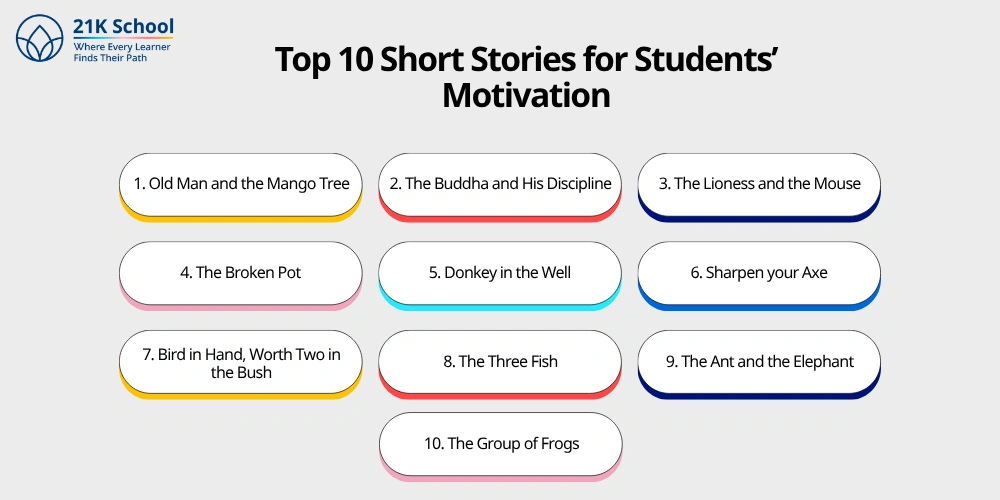
Top 10 Short Stories for Students’ Motivation
1. Old Man and the Mango Tree
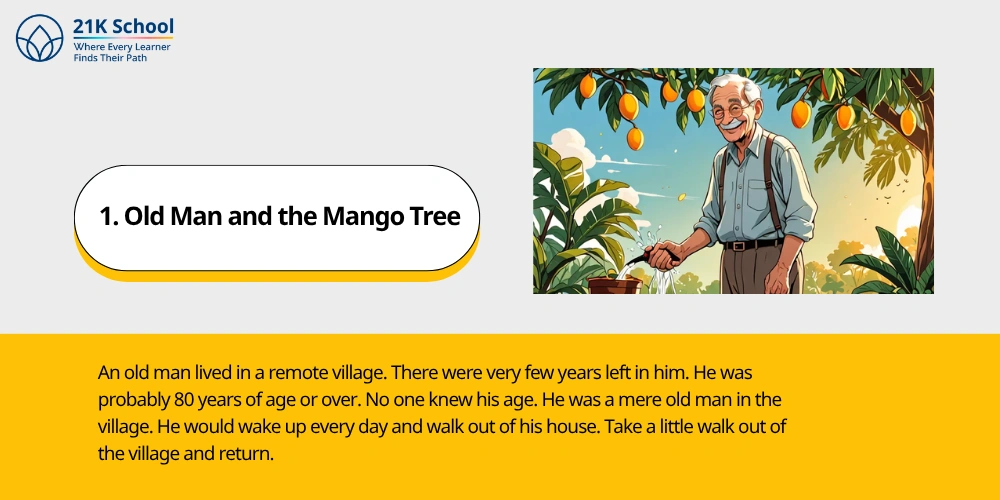
An old man lived in a remote village. There were very few years left in him. He was probably 80 years of age or over. No one knew his age. He was a mere old man in the village. He would wake up every day and walk out of his house. Take a little walk out of the village and return.
Binny and his family had just settled in the house adjacent to that of the old man. Binny was a good observer, and he saw that every day at the same time, the old man went out.
Binny was also a curious boy. He brought in a little bucket and poured into it the water in the local pond and watered the plant. Binny was amazed at this. Without thinking, he walked directly to the old man and told him, ‘Sir, you are so old, and you are watering a small tree; you will never be able to eat the fruit of this tree.’
The old man laughed and justified that he knew that he would never be able to reap the benefits of his labour, but he was watering the plant so that the generations to come could reap the benefits. I am also fond of the walk and the purpose it brings me.
Moral: Our results are sought, and most of our actions aim at getting results. It is a powerful tale to make us all remember that occasionally, doing something is the reward, and we need not always be results-oriented.
Also have a look: Success Stories for Students
2. The Buddha and His Discipline

Buddha was sitting under the tree meditating. When he was done meditating, he was feeling a little thirsty. One of his disciples happened to be around. He directed the disciple to bring him some water from the pond.
The disciple went with a small bowl towards the pond. As he approached the pond, some animals had crossed, and the water of the lake was muddy. The disciple came to Buddha and apologised to him. One more time, the Buddha requested him to go to the pond. The water was still somewhat muddy and not drinkable.
After a time, the Buddha said to the disciple, Wait a little, then I want you to fetch the water. This time it was clearer than ever. The disciple questioned the Buddha about what magic he had performed.
The Buddha replied,” Time. The animals contaminated the water when they crossed the water. But after allowing it some time, the mud settled, and again the water became clear. Our anger is just like the beasts that run in the water and cause it to become muddy. When we allow it time, the fury settles away, and we are like the clear water.
Moral: This is a lovely short story to show that we should not do anything when we are angry. We must have time, and then our minds become still as we have to be disciplined .
3. The Lioness and the Mouse
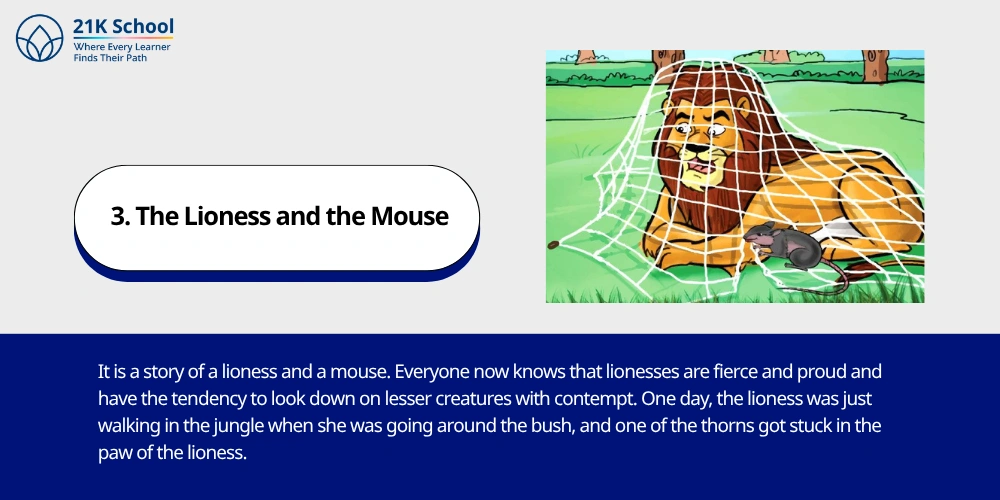
It is a story of a lioness and a mouse. Everyone now knows that lionesses are fierce and proud and have the tendency to look down on lesser creatures with contempt. One day, the lioness was just walking in the jungle when she was going around the bush, and one of the thorns got stuck in the paw of the lioness.
The lioness had the arrogant choice to refuse to seek help. She moved about the jungle with a bloody and grew weaker. She found a poor, lowly mouse one day. The lioness was in agony personified.
The mouse was quite frightened, but still dared to help. He tugged the thorn out of the paw of the lioness. At last, the lioness received relief from the pain and realised that she should have sought help a lot earlier.
Moral: The moral of the story is that pride may cause suffering, whereas humility and acceptance, however insignificant the source, may be relieving and can teach some worthwhile life lessons.
Storytelling for learning is important, but why?
4. The Broken Pot
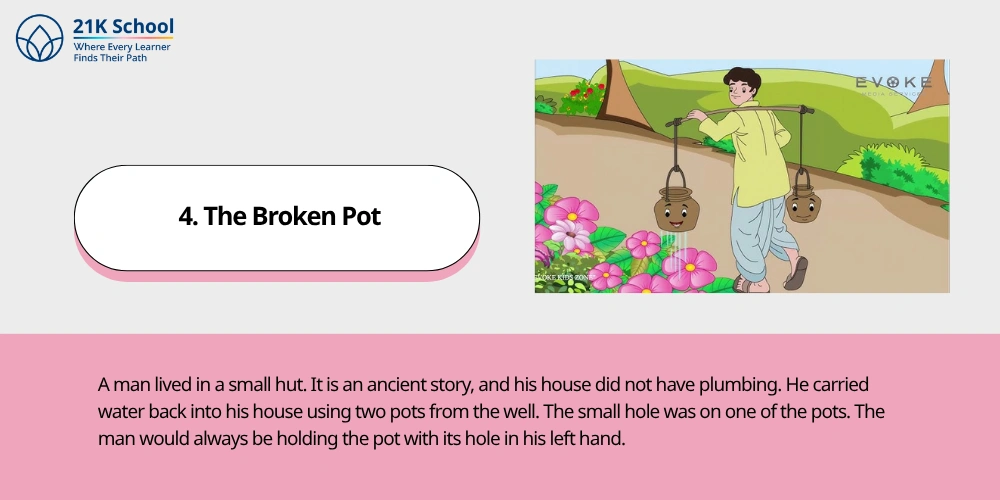
A man lived in a small hut. It is an ancient story, and his house did not have plumbing. He carried water back into his house using two pots from the well. The small hole was on one of the pots. The man would always be holding the pot with its hole in his left hand.
When the man got home, the pot on the right was always full, and the pot on his left was half full. This was noticed by one of the neighbour’s children, who questioned the man about the reason why he was using a broken pot. The man smiled and said,
This is because of two reasons. My left hand is a bit weak, and it is not possible to place the entire pot of water in my left hand. The other cause is that the route is watered when I take back the water. He indicated the way, and, indeed, on one side of the walk was green, and flowering plants, and on the other, a barren side.
Moral: This is one of the stories that teaches us that nothing goes to waste. We can consider that something is useless since it is bad, but it has a greater purpose in the universe.
5. Donkey in the Well
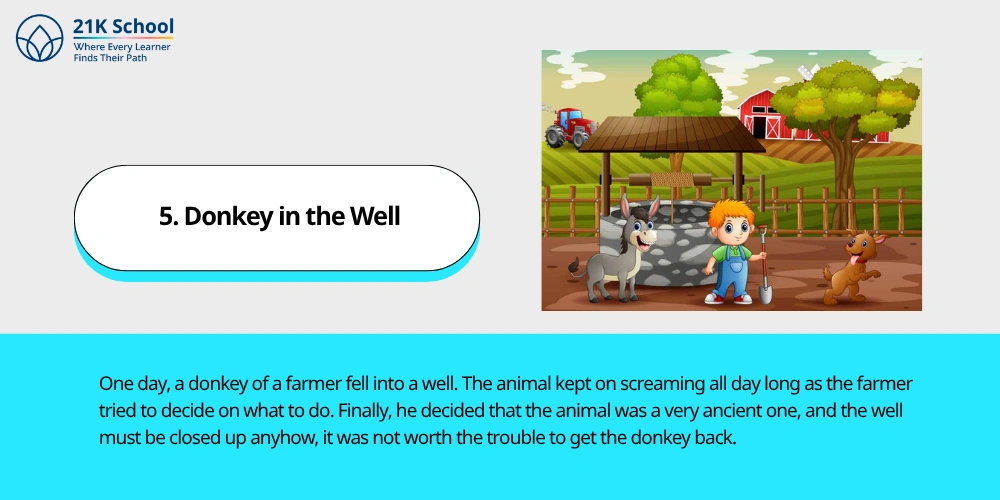
One day, a donkey of a farmer fell into a well. The animal kept on screaming all day long as the farmer tried to decide on what to do. Finally, he decided that the animal was a very ancient one, and the well must be closed up anyhow, it was not worth the trouble to get the donkey back.
He summoned his entire neighbourhood to come and assist him. Everyone of them took a shovel and started throwing dirt into the well. In the beginning, the donkey understood what was happening and screamed. Then he stunned the whole world into silence.
After a couple more loads of shovels, the farmer at last peered down the well. He was startled at what he saw. The donkey was doing something out of the ordinary with each shovelful of dirt upon his back. Shaking it off, he would take a step up.
The neighbours of the farmer still kept on pouring the dirt over the animal, but the animal would shake it off and make a step as it rose. Before long, all were astonished as the donkey came to the edge of the well and trotted away, rejoicing!
Moral: The moral of the story is that rather than letting the problems come down on oneself, turning them into an opportunity and being persistent and having a positive attitude, the worst of situations may turn out to be successful.
Fun Fact: Reading stories daily is a form of continuous learning .
6. Sharpen your Axe
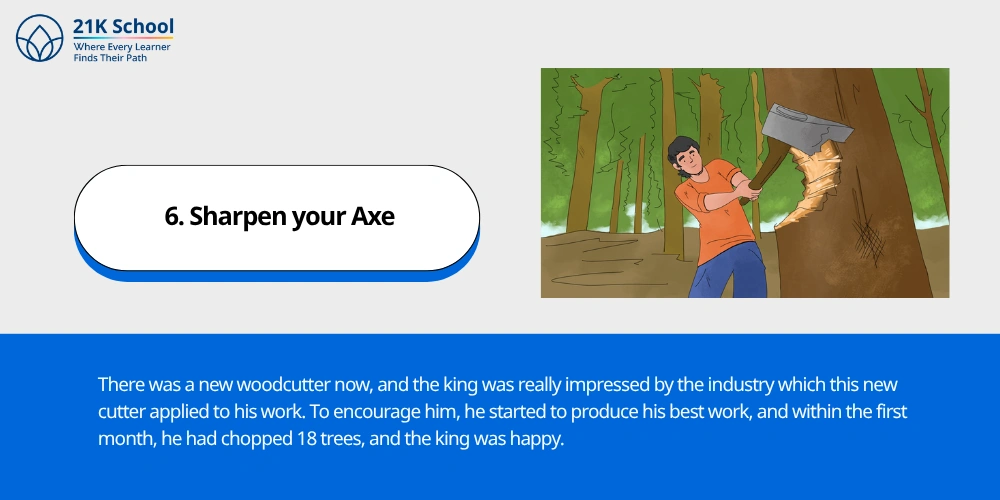
There was a new woodcutter now, and the king was really impressed by the industry which this new cutter applied to his work. To encourage him, he started to produce his best work, and within the first month, he had chopped 18 trees, and the king was happy.
The following month, he worked hard but was able to see only 15 trees. And in the third month, he again attempted to do his best, but was able to cut only 12 trees. In the third month, the king came and discussed with him his decline in productivity.
He gave the reason that he may have lost his strength or become too old to work. The king said to him, When was the last time you sharpened your axe? To the king’s surprise, he had never sharpened it in the last three months. This was just the reason why he could not cut more trees.
Moral: The moral of the story is that preparation and self-improvement are as important as hard work; sharpening the skills and tools on a regular basis results in higher efficiency, productivity, and long-term goals and success.
Also read: Importance of Resilience in Students
7. Bird in Hand, Worth Two in the Bush
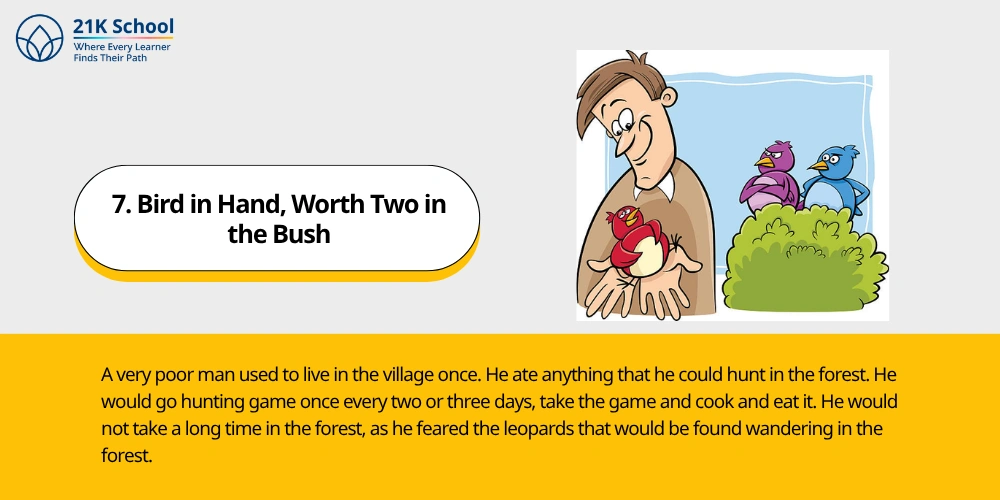
A very poor man used to live in the village once. He ate anything that he could hunt in the forest. He would go hunting game once every two or three days, take the game and cook and eat it. He would not take a long time in the forest, as he feared the leopards that would be found wandering in the forest.
One summer month, it was scorching, and the forest was withered, and there was no food. The poor man was pacing slowly through the forest. He encountered a bird that was sitting on a low branch. The fellow was quite light-footed, and the bird had no idea that he was coming.
He immediately took hold of the bird and grasped it. Even as he was on the point of leaving the woods, he watched a large deer lying close by the tree. He possessed a single arrow, and he could shoot at the deer.
He released the bird in his hand and picked the remaining arrow from the quiver, and shot at the deer. Fortunately for the deer, it caught sight of the man in time and fled, just as the arrow had left the quiver. The man was now left with no bird or with no deer.
Moral: The moral is a beautiful story to show that a bird in the hand is worth two in the bush – a life lesson as timeless as the moral values students must build.
Also read: How online schools help children with social anxiety
8. The Three Fish
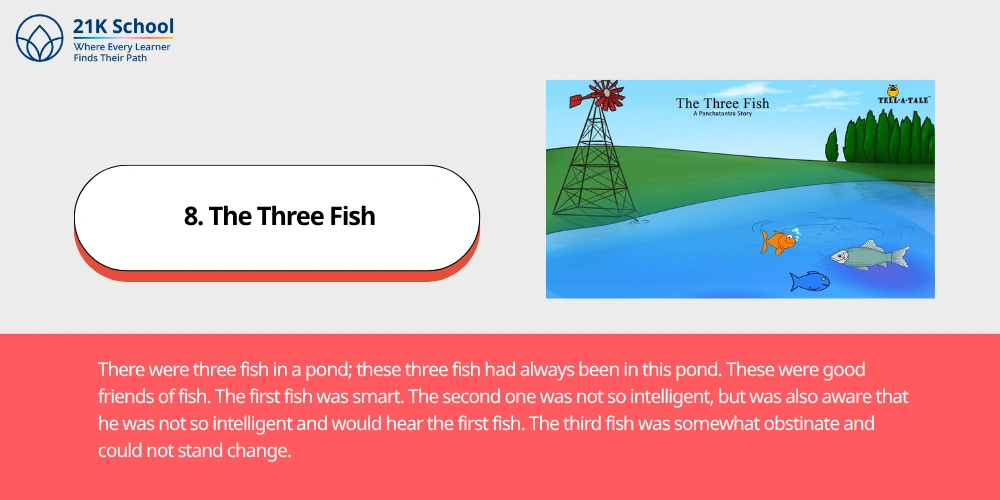
There were three fish in a pond; these three fish had always been in this pond. These were good friends of fish. The first fish was smart. The second one was not so intelligent, but was also aware that he was not so intelligent and would hear the first fish. The third fish was somewhat obstinate and could not stand change.
These three fish tend to go to a corner of the pond where they play every day. One day, the first fish saw a fisherman close to the side of the pond where they played. As he was a smart boy, he knew that he must not go to this side on this day. He made the same claim to his friends. The second fish, as he always did, concurred with the first fish.
The third fish was insistent, did not enjoy change and was determined to show that he was smarter than the first fish. He informed the other two that he was to go to the side of the pond we always go to. Despite the other two fish attempting to halt him, he nevertheless proceeded to go and was caught in the net.
Moral: The moral of the story is that being intelligent, adaptable, and having decision making skills is the key to survival and stubbornness and unwillingness to change may result in failure and loss.
Also read: the importance of punctuality in students .
9. The Ant and the Elephant

One day, an ant was addressing a pregnant elephant, and he said, How many days have you before the baby is born? The elephant responded that the gestation period of the elephant mama takes nearly two years before the birth of the baby.
Shocked was the ant, and said, “How can you be so patient?” The elephant mamma pondered for a considerable time and answered, ‘When I give birth after two years, my baby will shake the earth. My baby will become the most valuable thing — a reminder that true growth, like academic goals, takes time and intentional effort.
Moral: The moral of the story is that nothing becomes great immediately, and the path to any achievement process involves waiting, work and perseverance as opposed to rushing the product.
10. The Group of Frogs
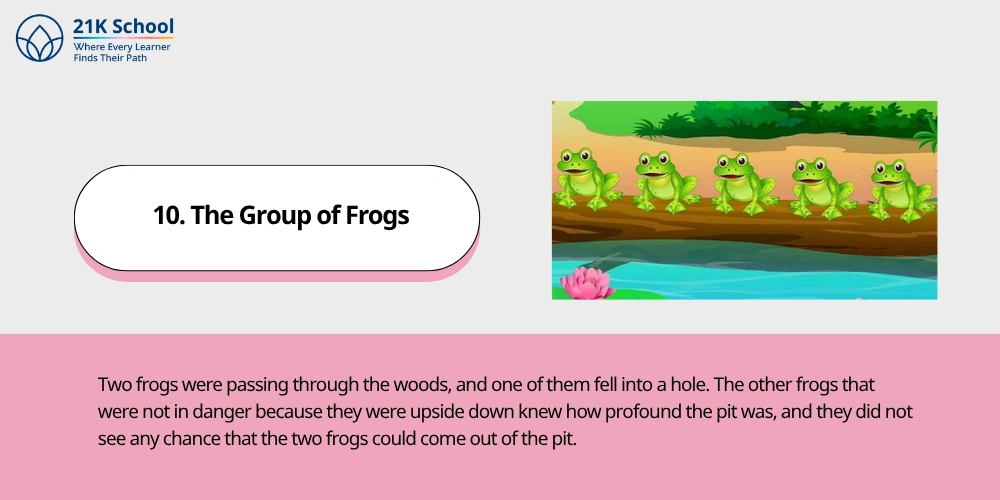
Two frogs were passing through the woods, and one of them fell into a hole. The other frogs that were not in danger because they were upside down knew how profound the pit was, and they did not see any chance that the two frogs could come out of the pit.
Both these frogs began to attempt to get out of the pit, and they tried several times to do so. The frogs on the safe side shouted that they should abandon the suffering of attempting, as they could not. One frog eventually heard the other frogs and, specifically, gave up trying and accepted his fate.
The other frog did not surrender, and by his perseverance, he eventually reached the top. They enquired about what the other frogs had said. Did he not hear us? He told him that he was deaf and urged him not to give up.
Moral: The lesson is that people should keep on trying and thinking positively to achieve success and should not listen to discouragement because failure is possible; a person has to believe in him/herself so as to overcome any obstacles.
Also read: How to overcome stage fear
Conclusion
The inspirational short stories also assist the learners to possess precious life lessons concerning not giving up, being patient, and being fearless.
The Old Man and the Mango Tree and Sharpen Your Axe are two such stories that talk of hard work and preparation, as compared to the Lioness and the Mouse and the Ant and the Elephant, which talk of kindness, resilience, and patience.
The stories will prompt the students to take the challenges in 21st centrury, to create a positive mindset and postive learning environemnt putting their faith in their ability.
It is through these stories that the students can grow as academicians, as a personality, and as a society, and build up the good habits as student that lead to success in the long run.

You may also want to read


Types of Studies: Everything You Need to Know with Examples

- Last updated on: 08 Apr, 2026
- 7 min read