

Education is a right of every child. Whether a student is a regular learner, slow learner, or children with special needs a proper education system is crucial.
Special children often feel separated and challenged to complete tasks with regular students. From syllabus to teaching methods special children need customisation.
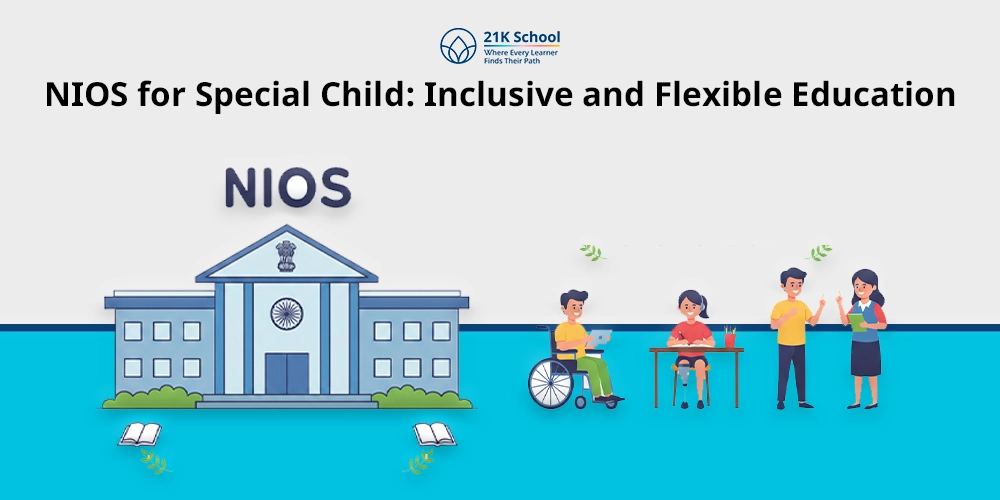
The National Institute of Open Schooling or NIOS is an ideal board for special children which help in implementation of inclusive education opportunities.
NIOS offers flexible learning opportunities to each student especially for special children who get various benefits to learn at their own pace and comfort.
Here, we will explore everything about NIOS for special children from important provisions, eligibility criteria to available courses for NIOS for special children.
Contents
What Is NIOS?
NIOS is an autonomous organisation, originally established under the Ministry of Human Resource Development (MHRD), now the Ministry of Education, Government of India. It offers open and distance learning from the secondary to the Senior Secondary level.
It accepts students who have various needs to follow a non-conventional way of learning as a result of health reasons, learning disabilities, distance from a formal school, or choice.
NIOS is a recognised board same as CBSE , ICSE and all State Boards . It is accepted in most of the universities, professional courses, and by government job exams.
NIOS for Special Child: Important Provisions
NIOS offers learning flexibility to each student especially for special children they provide customised facilities to ensure fair access to education.
1. Special Concessions in Examinations
NIOS provides various benefits to students with learning disabilities under special concessions during examinations.
It helps special needs students a fair participation. Some of the common concessions are:
- Extra time: An additional 20 minutes per hour is given to special children while writing the examination.
- Scribe or Reader facility: Scribe or reader facility is allowed to learners who are dealing with blind, visually impaired, or have cerebral palsy or other disability.
- Use of computer or typewriter: Due to difficulties in hand movement some disabled students get the opportunity to use a computer or typewriter.
- Exemption from handwriting or drawing-based questions: learners with particular disabilities get exemption from practical or written components.
- Separate examination rooms: For learners, a quiet space and flexible seating arrangement is given by schools for examinations.
2. Adapted Curriculum and Study Material
Every child and their learning style is different. To fulfill the needs of special needs students NIOS offers customised curriculum and study material.
It simplifies the daily tasks and lets special children learn their desired subjects. Some common facilities include:
- Braille books and audio formats.
- Video lessons with sign language interpretation for learners.
- Large-print books.
- Simplified language materials.
Self-instructional materials are also popular in NIOS which encourage students to learn in self-paced learning.
3. Use of Assistive Devices and Technology
Use of assistive devices and technology in education help students with disabilities.
Students can improve communication skills , and efficiency of learning daily.
Some common examples of technology in learning are screen readers and magnifiers, hearing aids and FM systems, speech-to-text and text-to-speech software, adaptive keyboards, switches, and communication boards.
4. Allowed Exemptions
The students with disabilities get the exemption of different subjects and skills based on specific guidelines. This exemption from certain subjects or skills is based on disability and hence crucial for students with special needs.
For example, visually impaired learners are exempted from drawing, geometry, or map-based activities, hearing-impaired learners are exempted from listening and speaking components in language subjects and children with intellectual disabilities get simplified subjects or alternative assessment options.
5. Home Examination Facility and Flexible Centers
Home examination facility and flexible centers is one of the ideal provisions for disabled students. Students who are take their exams from home get various advantages like:
- Home-based examination options.
- Centers with accessible infrastructure.
- Flexible scheduling.
Eligibility Criteria- NIOS for Special Child
A special child who meet all the basic eligibility criteria can take admission in National Institute of Open Schooling:
1. Medical/Disability Certificate
A medical certificate issued by a registered medical practitioner or government hospital is a must. NIOS checks the originality for confirmation.
2. Diagnostic Certificate
Some cases like intellectual or learning disabilities NIOS need a diagnostic certificate from a recognised psychologist or specialist.
It is mandatory which confirms that a child is dealing with learning challenges.
3. Standard Documents
Provide standard documents required while filling out the form. Some common documents are:
- Aadhaar card or other ID proof
- Recent passport-sized photographs
- Address proof
4. Age Proof
To become eligible for NIOS education special children should share age proof which is similar to regular students:
- For Secondary (Class 10): At least 14 years old.
- For Senior Secondary (Class 12): At least 15 years old.
How to Enroll – NIOS for Special Child
The detailed steps on how to enroll in NIOS for special children are:
Learners can begin by visiting the NIOS admission portal. Seek the “Admission” section and select the desired course.
2. Fill the Online Admission Form
Fill the online admission form. For disabilities, choose the type and percentage of disability. Add all the needful details such as:
- Name
- Date of birth
- Address
- Contact information, and
- Educational background
3. Attach Required Documents for Special Provisions.
Attach required documents for special provisions like:
- Disability or medical certificate
- Diagnostic report (if applicable)
- Identity and age proof documents
4. Submit an Application for Special Provisions
Students must reconfirm before submitting the application for special provisions. Remember to pay the registration fee before submission.
Available Courses for NIOS for Special Child
NIOS offers various courses for special children to provide opportunities for career growth.
1. Open Basic Education (OBE) for Elementary Levels
Open Basic Education is equal to elementary school class 1 to 8. It is an ideal way to start learning.
By this way, students with disabilities help in building Foundational Literacy and Numeracy skills.
Levels under OBE:
- OBE Level A (Class 3 equivalent)
- OBE Level B (Class 5 equivalent)
- OBE Level C (Class 8 equivalent)
2. Secondary and Senior Secondary Courses
Secondary course is equivalent to Class 10th and Senior Secondary course equal to Class 12th. Here students can select desired subjects.
NIOS offers various benefits to students with disabilities such as modified learning content, flexible subject choices, reduced academic load, assistive and technological support.
3. Vocational Courses
Vocational courses are educational approaches in which students learn practical skills for a specific job or career growth.
Vocational courses provided by NIOS includes:
- Computer applications
- Housekeeping and hospitality
- Handicrafts and tailoring
- Bakery and food processing
- Care and wellness
Conclusion
The National Institute of Open Schooling (NIOS) offers an amazing opportunity to all types of students from regular learners to students with disabilities.
It offers many benefits to special children from flexible curriculum, accessible learning resources, examination concessions to inclusive policies.
Through NIOS, students can learn without difficulties and grow at their own pace to achieve desired objectives.
To enroll, go through the step-by-step procedure mentioned above to provide empowerment, and lifelong learning opportunities.

You may also want to read
What is CBSE? Full Form, History, Structure & Key Benefits
- Last updated on: 30 Mar, 2026
- 14 min read