

Experiential learning is the learning that comes with experience and practice.
You can call it one of the best methods to foster real development in your kids or students because experiences stay with us more than passive facts ever could.
Keeping this in our minds, we will learn about some real benefits that experiential learning brings in our lives.
Contents
- What is Experiential Learning?
- 12 Importance of Experiential Learning
- 1. Bridges Gap Between Theory and Practice
- 2. Encourages Active Engagement
- 3. Improves Retention and Understanding
- 4. Develops Critical Thinking
- 5. Builds Problem-Solving Skills
- 6. Fosters Self-Reflection
- 7. Boosts Personal Growth
- 8. Encourages Collaboration and Communication
- 9. Builds Confidence and Autonomy
- 10. Adapts to Diverse Learning Styles
- 11. Prepares Students for Real-World Careers
- 12. Makes Learning Fun and Meaningful
- Concluding Thoughts
What is Experiential Learning?
To those who are unaware of the term “experiential learning”, it simply means learning with and through experiences.
Really, we because of having human minds and memory can be best taught with experience only.
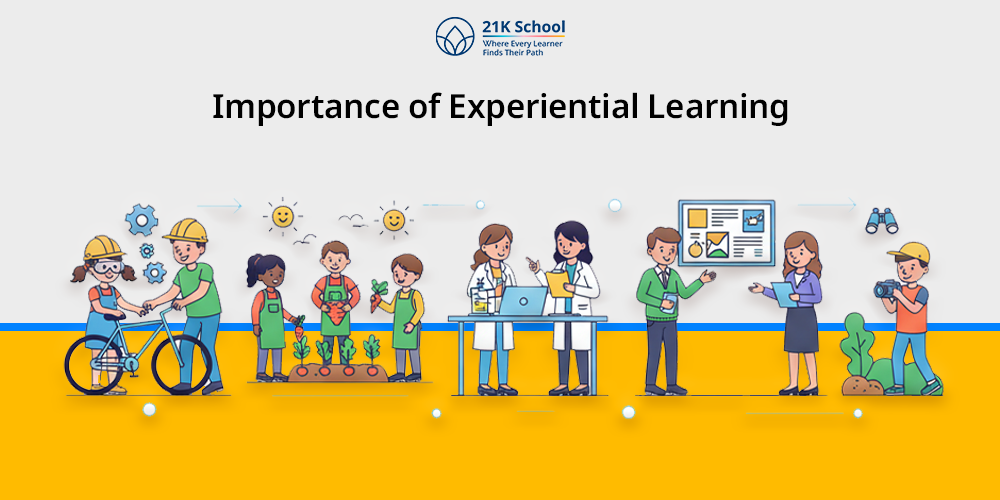
For learners, this might look like hands-on learning with practical submissions, science projects, or may be community visits.
To extend this, Kolb came up to announce that experiential learning can be processed in 4 stages including:
- concrete experience
- reflective observation
- abstract conceptualization
- active experimentation
Experiential learning leaves behind the part of rote learning from our education systems and encourages students to dive into deeper learning methods .
12 Importance of Experiential Learning
There are several importance of experiential learning including active engagement, retention, memory, and critical thinking .
1. Bridges Gap Between Theory and Practice
The main function of learning with experiences is to remove the gap between theoretical knowledge and practical knowledge .
So that students can apply what they read in their lectures and utilize it in reality-based situations.
This is the only method that actually works in favour of children in making them future-ready in terms of job or any other opportunity.
2. Encourages Active Engagement
Learners from different subject backgrounds actively learn to engage in learning.
Multiple field projects and workshops are real encouragement for their performance and attaining knowledge .
Without student engagement in activities and projects, experiential learning will remain unaccomplished in real sense, because the hands-on practice is still missing.
3. Improves Retention and Understanding
We are humans and what stays with us for the longest times can only be our experience.
Experiential learning understands this concept, thus improving our ability to retain and comprehend understanding.
It does by providing us with learning experiences having tactile sensations and real cognitive functioning of the brain.
4. Develops Critical Thinking
When subjected to perform in real field experiments, children in real life get to think and analyse what works best and why, while applying the theories taught in class.
This gives space to their critical thinking to grow and learn in actual sense.
Real situations require applying problem-solving techniques , analytical thinking, and decisions made on the basis of all.
5. Builds Problem-Solving Skills
Learners learn problem solving through experiential learning.
As it provides students with tasks and opportunities to solve their problems from their own understanding, it builds self-dependency in them.
Learning from experiences paves a better road for developing your confidence in yourself when faced with problems, leading to success.
6. Fosters Self-Reflection
The frequent exposure that you get from experiential learning activities accounts for your self-reflection.
These situations might show you your real strengths, flaws and how consistently you work to reach your best potential self.
Just the memorization techniques of learning were not enough to bring such a huge change in less time, what experiential learning does for quality education and personal development.
7. Boosts Personal Growth
Personal growth is only a by-product of continuous learning through experiences and skill development.
This is why experiential learning has made its roots in modern education systems.
The more practice you do, the more enhanced your skills might become.
It can be a great option for young learners who actually want to make a difference in this world and have started doing so firstly by themselves.
8. Encourages Collaboration and Communication
Real project-based learning also involves regular interactions and communication in practical sessions.
And when you are repeatedly pushed in such situations to speak and express, your communication skills improve without real conscious effort.
These 21st century skills learnt at these sessions or events positively affect your presentation skills in future and unlock many incredible opportunities.
9. Builds Confidence and Autonomy
When you know whatever you have learnt is from your experiences, you gradually shift from a surviving attitude to a thriving one.
You become that one confident person that you would admire.
The self-reliance and sense of autonomy become your best friends and allow you to handle your challenges by yourself in future.
10. Adapts to Diverse Learning Styles
Today inclusive education is in prevalence and educational programs are reforming to accommodate all types of learning styles and needs of children.
With hands-on learning practice, experiential learning subjects choose other teaching methods .
Thus, involving all senses of children and training through visual learning , audio playing, and tactile movements as well.
11. Prepares Students for Real-World Careers
Experiential learning has always emphasized education to prepare students for the future , getting real-world jobs in their most loved fields.
In present times, employers acknowledge you when you have real skills that are needed in society including your values, strengths and weaknesses.
All of these life skills come with practice and experience taught in experiential learning improving your networking,student discipline , and confidence.
12. Makes Learning Fun and Meaningful
Most of the students feel unaware and unbothered by what is taught during their theory-based classes.
They feel bored and eventually end up learning nothing apart from passing those subjects when assessments are done.
With experiential learning, you can get to learn and truly enjoy what you are learning because of the fun learning activities and active participation involved.
Concluding Thoughts
Experiential learning can play crucial roles in a learner’s life whether it is in general or career.
The more you practically utilize the experiential learning methods, the more success it would bring in for you.So, let your child’s learning journey begin with a new approach of experiential learning.

You may also want to read