

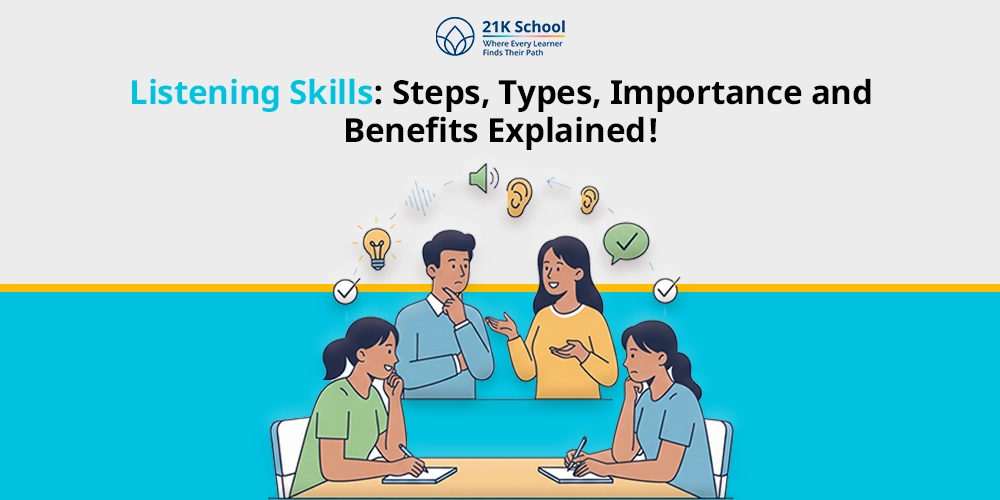
Would you consider yourself to be a good listener? How would you conclude about being one or not?
Listening is very different from hearing, and here we miss the actual meaning of listening skills.
When we listen, we actually pay attention to what is being said, try to comprehend it, make room for the things being said, have empathy while listening, and then respond.
Many of us even lose our relationships and other opportunities just because we don’t have good listening skills.
So to ease your daily communication, this article will take you into deeper insights of listening skills, covering its benefits, challenges, and strategies to improve.
Contents
- What are Listening Skills?
- Listening Skills in Communication
- Difference Between Hearing and Listening
- Step Involved in Listening
- Types of Listening Skills
- Importance of Listening Skills for Students
- Listening Skills Activities
- 4 Primary Benefits of Having Good Listening Skills
- Barriers of Listening Skills
- How to Improve Listening Skills for Students?
- How To Improve Listening Skills in Communication?
- Concluding It All
What are Listening Skills?

Listening skills can be defined as the skills providing the ability to receive, understand, interpret, evaluate, and respond accurately to the spoken messages.
Listening is an active process rather than a passive action that requires concentration and attention.
It entails the listener to listen to the speaker, interpret the meaning of the information, and respond in a manner that demonstrates understanding.
Listening cannot be achieved by merely hearing. It involves analyzing the tone, emotions, body language, and context of the message.
A good listener does not just listen to what is being said, they also listen to how it is being said.
You also need to have patience, be open, and be ready to listen to others opinions as part of the listening skills.
Educational and professional situations can improve listening skills by allowing people to acquire new information and cooperate with others.
In personal life, they are used in developing trust, empathy, and good relationships. Therefore, listening is a very important aspect of general communication.
Listening Skills in Communication

Listening is a crucial part of the communication process. Communication entails a sender, message, channel, and recipient.
Listening entails the process wherein the receiver interprets and comprehends what the other person is saying. Communication would be incomplete without effective listening.
Listening skills help one communicate better since it causes fewer misunderstandings.
Communication can be made more meaningful and productive when the listeners are attentive, ask meaningful questions and give real feedback.
Good listening also helps the speakers to speak in a better way and talk with confidence.
In group discussions at classroom and workplace, listening assists to make people comprehend different opinions and collaborate towards achieving the same objectives.
Listening in interpersonal communication enhances the emotional relationships and builds mutual respect.
Consequently, listening becomes not only an act that supports communication, but a core aspect of good communication.
Difference Between Hearing and Listening
Listening and hearing seem to be interchangeable yet the two are not identical.
Listening is a mental and an emotional process, while hearing is a physical one.
Hearing is the capacity of listening to sounds using the ears. This occurs naturally and you do not need to put effort to make it happen.
When the ears work well, an individual will be able to hear everything that surrounds them even without listening to it.
Listening is, however, an active and purposeful process. It entails listening to the sounds one hears, interpretation of the message, analysis of the message, and appropriate response.
The process of listening needs focus and active thinking.
A student could be in a classroom and hear the teacher talk. Still, it’s not necessary that he would be listening, in case his mind was distracted.
On the contrary, a listening student is able to grasp the lesson, remember vital facts, and use the knowledge in the future.
This difference between hearing and listening tells why it is necessary to develop listening skills .
Step Involved in Listening

The process of listening is organized into a number of steps that are related to each other.
Following this step-by-step overview is very critical in creating effective understanding and response.
1. Receiving

The initial step in the listening process is receiving.
It includes hearing what the speaker is saying and what are the words being used.
This step is based on the physical aspects of the listeners, like their clear speech, intensity, calm environment, and the hearing capacity of the listener.
Effective reception involves reduction of distractions and listening to the speaker.
2. Understanding

The process of interpretation of the meaning of the message is called understanding.
At this point, the listener processes the words, tone, and context of the speech to understand what the speaker wants to tell.
Vocabulary knowledge, background experience, and language proficiency are of importance in understanding.
If this step is not completed efficiently, there are high chances of misunderstandings in communication.
3. Evaluating

Evaluation is the stage during which the listener critically evaluates the message.
The listener determines the validity, context, and rationality of the information they are listening to.
This is particularly significant to the academic discussions, debate, official meetings, and decision-making.
Evaluation assists listeners to differentiate between facts and opinions to recognize if there are any biases or assumptions.
4. Remembering

Remembering is the process of encoding information that has been received and interpreted in memory.
This procedure enables the listeners to remember key information in the future.
Good methods of enhancing memory include taking notes, summarizing, or repeated rehearsals in the mind.
5. Responding

The last step in the listening process is responding.
It involves providing feedback to the speaker in a verbal or non-verbal form and this can be in the form of asking questions, nodding, or even giving opinions.
Good replies indicate that the listener has received the message and he is listening.
Types of Listening Skills

Listening can be of the following types:
1. Active Listening

Active listening refers to the act of giving full attention to the speaker as well as actively contributing to the communication process.
It involves maintaining eye contact, nodding, asking questions, and summarizing the message of the speaker.
Listening to the other person can build trust and guarantee good understanding.
2. Passive Listening

Passive listening refers to the message being passed through the ears of the listener without a genuine reply or reaction.
This kind of listening occurs while listening to music, radio, or speeches.
Though it takes less effort, it does not always lead to understanding.
3. Critical Listening

Critical listening means that a person critically interprets and analyses the message.
The listener involves critical thinking while analyzing the reliability and validity of the speech he has listened to.
Listening of this nature is significant in educational learning, arguments, and problem-solving .
4. Empathetic Listening

Empathetic listening is concerned with how the speaker feels and what he or she thinks.
The listener listens to the speaker and has no judgment or interruption. Instead, they try to be sympathetic, patient, and supportive.
Personal relationship, counseling, and conflict-resolution are the areas in which this form of listening is particularly critical.
5. Informational Listening

Acquiring knowledge or new information is accomplished through informational listening.
It is often applied during classroom, lecture, meeting, or training.
The aim of the listener is to receive the information presented and recollect it.
Importance of Listening Skills for Students

The listening skills especially benefit the students, because it determines the level of academic success, personal growth, and future career.
Let’s find all the importance of listening skills for students in the below mentioned points:
1. Importance in Education

In learning, listening is useful in enabling students to comprehend lessons, instructions, and be active in the classes.
Good listening enhances understanding, taking notes, and then overall grades.
Effective listeners have the capability of asking pertinent questions and also being able to engage in worthwhile discussions.
2. Importance in Professional Life

The ability to listen is also highly appreciated in the workplace.
They assist people in mastering work, cooperating with others as well as addressing the feedback.
Skilled and disciplined employees who are able to listen, communicate well, and adjust to instructions are common in the employment market.
3. Importance in Personal Relationships

Listening in personal relationships results in trust and understanding.
Respect and empathy are demonstrated by good listeners, and this builds emotional bonds.
Misunderstanding and peaceful resolving of conflicts is also achieved through effective listening.
4. Importance in Leadership

Effective leaders have a greater capacity to read the needs and issues of the team members through listening.
Listening will assist the leaders to make knowledgeable choices, inspire individuals, and establish a good working atmosphere.
Good listening is one of the major attributes of having effective leadership skills .
5. Importance in Conflict Resolution

Listening is very important in conflict management.
Listening to different sides will enable us to find common ground, which encompasses the underlying cause of the conflicts to find practical solutions.
Listening, which is empathetic and attentive, removes tension and encourages a cooperative spirit.
Listening Skills Activities

Through frequent practicing, one can develop good listening skills.
Examples of some of the useful activities used in learning listening skills include:
- Storytelling and retelling activities.
- Team discussions
- Roleplay exercises and simulations.
- Listening to audio recordings and responding to the questions.
- Taking notes on lectures of speech.
- Being able to take instructions of a game or for following a task.
- Feedback and reflection activities by a peer.
Such activities assist students in developing an ability in paying attention, understanding, remembering, and responding adequately.
4 Primary Benefits of Having Good Listening Skills

Effective listening has many advantages at academics, profession, and in personal life.
1. Better Knowledge Acquisition

The enhancement of knowledge is one of the greatest advantages.
Whenever people listen attentively, they can grasp information correctly which can minimize the chances of misunderstandings and mistakes.
This is particularly beneficial to students who want to have a great academic performance.
2. For Building Relationships

Listening is also important in the process of establishing relationships.
Trust and respect are accomplished when individuals feel heard and understood, instead of feeling ignored.
Patient and empathetic listeners are regarded as good listeners, as it reinforces personal and professional relationships.
3. Better Decision-making

The other significant advantage is enhanced decision-making and problem-solving.
The opportunity to hear various opinions enables people to study situations more thoroughly and make sound judgments.
In leadership, listening and respecting collaborative efforts are very important so that every voice feels heard.
4. Builds Confidence

Effective listening skills develop confidence and effectiveness in communication skills .
In situations where people get to know others well, they treat them accordingly and get to articulate their thoughts well.
Good listening skills, in general, make a person grow, have emotional intelligence , and succeed in many spheres of life.
Barriers of Listening Skills

While you are learning how to listen well, there can be many hurdles including the following:
1. Physical Barriers

Physical obstacles include the external elements like noise, bad acoustics, distracting settings, or poor audio systems.
Especially a loud classroom or a crowded area may be a reason for distraction to the listeners and disrupt the attention towards the speaker.
2. Psychological Barriers

The psychological barriers are caused by the mental or emotional condition of the listener.
A listener unable to always pay complete attention to the speaker due to stress, anxiety, anger, boredom, or personal reasons.
Some limiting prejudices and set views can also prevent open-minded listening.
3. Language Barriers

Language barriers take place when the listener and the speaker lack language proficiency or compatibility.
Vocabulary is challenging, particularly those with a solid accent or words that one is not familiar with.
This makes communication challenging, particularly to students who are learning a second language.
Before reading ahead, look at the benefits of learning a second language
4. Lack of Attention

One of the most widespread obstacles to listening is lack of attention.
Mobile phones, daydreaming, multitasking, or fatigue are some of the reasons that lead to lack of complete understanding and attention.
5. Poor Listening Habits

Unhealthy behaviours like interruptions, assumptions, selective listening, or paying attention to other unimportant things can undermine our effectiveness of listening.
These habits make listeners fail to understand the message given by the speaker.
How to Improve Listening Skills for Students?

You can follow the following blueprint to improve listening skills as students:
1. Maintain Attention

Students should pay their full attention to the speaker by ignoring distractions, maintaining eye contact, and being alert. Listening enhances knowledge and memory.
2. Avoid Interrupting

Interrupting the listening process in between might interrupt the communication process and cause misunderstanding.
Students must learn to let the speaker deliver their message before replying.
3. Ask Questions

By asking relevant questions you can clear any doubts, which will lead to active participation.
It enhances understanding and promotes meaningful communication as well.
4. Practice Empathy

Empathy helps students to sympathize with the speaker and act as being in their shoes.
By listening without judging, it can enable the students to possess a stronger relationship and enhance communication.
5. Improve Note-Taking Skills

Note-taking is a way of making students remember key points with short and systematic notes.
Taking notes is a good aid for remembering the parts of speech necessary for you. It is particularly beneficial in school.
6. Provide Feedback

The verbal or non-verbal feedback, including nodding or making the main points, demonstrates that a listener is attentive and comprehending what is being said.
7. Practice Regularly

Most skills, such as listening, are enhanced through practice.
Making conversations or listening to lectures ensure that the students develop their listening skills with time.
How To Improve Listening Skills in Communication?

To enhance listening skills in communication, people are supposed to have a habit of active listening.
This is about listening to everything a speaker has to say, keeping your mind off where your thoughts are, and attentively considering what the speaker has to say.
Open-mindedness and patience make the listeners hear a variety of views without being judgemental.
Effective communication also ensures that the listeners concentrate on the verbal and non-verbal communication like tone, facial expression, and body language.
It is important to ask clarifying questions and summarize what the speaker is saying so that one can be sure that his message is understood.
When these techniques are practiced regularly, it results in more valuable and effective communication.
Concluding It All
Listening skills are necessary in almost every realm of our lives, so it becomes a necessity to improve them as early as we can.
While communicating with someone, even if you want to be a great speaker, it is good to have strong listening skills.
This can give you confidence to present your point and make sound decisions.
For enhancing your listening skills, you first need to understand that hearing and listening are two different processes.
Then you can focus on active listening, ask questions, be non-judgemental, take notes, and give authentic feedback.
Listening skills could be beneficial if you are a student, teacher, or any other growing individual.

You may also want to read