

Education is evolving with time and implementation of an effective educational model according to need is essential for better results.
One of the recognised frameworks in India for education is the 10+2+3 system which helped formal education for decades guiding a standard pathway to improve learning.
Although NEP 2020 has introduced a new education policy for students’ smooth learning, the 10+2+3 system continues to remain relevant and influential.
Let’s take a closer look at the meaning of the 10+2+3 system, objectives, advantages, features, and a comparison with the new education model.
Contents
- What is the 10+2+3 System of Education?
- Why was the 10+2+3 System of Education Introduced?
- 10+2+3 Education Structure: 3 Step Breakdown
- Features of 10+2+3 System of Education
- 4 Objectives of the 10+2+3 System of Education
- 4 Advantages of the 10+2+3 Education System
- What is NEP and the 5+3+3+4 Education System?
- 10+2+3 System vs New Education Policy: 5 Key Differences
- Conclusion
What is the 10+2+3 System of Education?
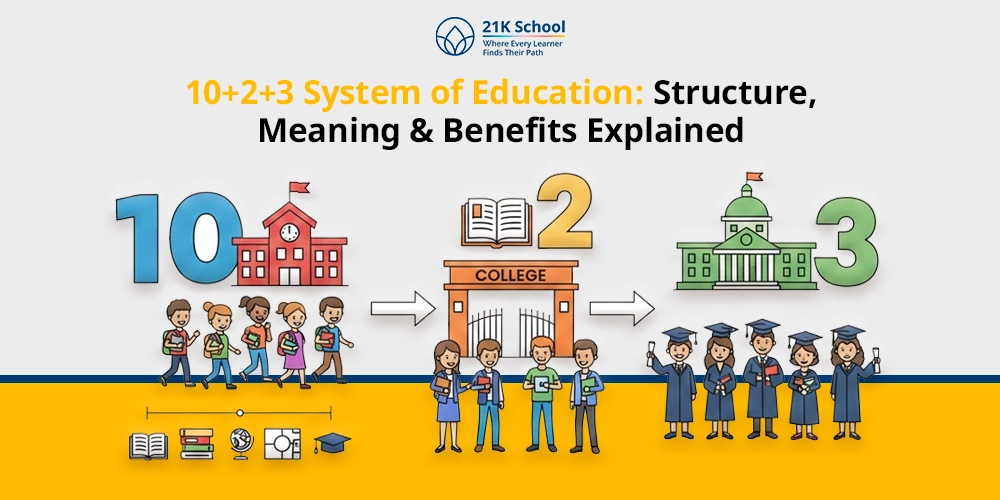
The 10+2+3 System of education is an effective educational system/framework which is divided into three crucial parts of formal education. It includes:
- 10 years of school education
- 2 years of higher secondary education
- 3 years of undergraduate education
These three steps showcase the sequence of education a child should complete to build foundational knowledge and skills .
10+2+3 System of Education Commission
The 10+2+3 system of education recommended by the Education Commission (1964 and 66). It is known as the Kothari Commission designed for structured schooling and higher education.
The introduction of the 10+2+3 structure brought more clarity, consistency and equality to the Indian education system.
Why was the 10+2+3 System of Education Introduced?
The main reason to introduce the 10+2+3 system of education is to fulfill students’ educational and social needs. Some key reasons for its introduction are:
1. Uniformity
Due to a lack of uniformity in different states and boards a 10+2+3 system of education was important to create consistency.
2. Balanced Curriculum
For effective learning especially in the foundational stage of the first 10 years students need a balanced curriculum .
Introduction of 10+2+3 system of education is effective to do so.
3. School Drop Out
One of the key reasons is students drop out due to poor academic planning from school.
To avoid this problem, the 10+2+3 system of education provides a structured framework.
4. Holistic Development
For students’ overall development a systematic and structured approach is essential.
The 10+2+3 system focuses on comprehensive subject knowledge and life skills such as critical thinking skills .
10+2+3 Education Structure: 3 Step Breakdown
To understand the stages of 10+2+3 system of education, check out the 3 step breakdown in detail:
Stage 1: 10 Years of School Education
The initial stage of 10+2+3 education structure includes 10 years of school education which basically divided into:
- Primary Education (Classes 1 to 5)
- Upper Primary/Middle School (Classes 6 to 8)
- Secondary Education (Classes 9 to 10)
This 10 year schooling from class 1 to 10 is a critical milestone to help students to enroll in higher secondary education.
Stage 2: 2 Years of Higher Secondary Education
After 10 years of foundational stage, students can pursue 2 years of senior/higher secondary education including Classes 11th and 12th.
These are two crucial years that help students to specialize based on their interests and career goals. Major streams offered:
- Science (Medical, Non-Medical)
- Commerce
- Arts/Humanities
- Vocational Streams
Completion of 2 years of higher secondary education guides students to take admission in college for future growth.
Stage 3: 3 Years of Undergraduate Education
In the last stage, students continue learning undergraduate education, offered by colleges and universities. For example, a 3 year bachelor degree in BBA, BSC, BCA etc.
The stage helps students to find a dream job which makes them independent in life.
Features of 10+2+3 System of Education
To understand the key features of the 10+2+3 system, go through below points:
1. Structured Stages
The 10+2+3 system is divided into three clearly defined academic stages effective for learning.
The stages include 10 years of schooling, 2 years of higher secondary, and a 3 year bachelor’s degree.
2. Skill Focus
The 10+2+3 system of education focuses on skill development with academic growth. It promotes critical thinking, problem-solving , communication, and life skills.
In this way, students work with their hobbies and interests.
3. Preparation for Higher Education
A structured approach like the 10+2+3 system helps students to prepare for higher education. The second stage 2 years of higher secondary education focus on competitive examinations.
4. Foundation for NEP 2020
The 10+2+3 system works as a foundation for the new NEP 2020 model which is more flexible for learning needs.
4 Objectives of the 10+2+3 System of Education
To create a structured learning pathway, explore the top four objectives of the 10+2+3 system of education:
1. Standardised Learning Structure
To provide a standardised learning structure 10+2+3 system is introduced in education. It gives equal opportunities to study.
2. Academic Progression
One of the main objectives of the 10+2+3 system is progress in academic journeys. Students get direction to start with the right pathway.
3. Preparation for Higher Education and Employment
The 10+2+3 system is not only ideal for foundation learning but also directs students to prepare for higher education and employment.
Balanced Intellectual and Skill Development
The model is ideal to gain theoretical knowledge and practical understanding to create a balanced intellectual and skill development.
4 Advantages of the 10+2+3 Education System
Through 10+2+3 system students have gained a lot of advantages such as:
1. Structured Academic Progression
The 10+2+3 system is a well-structured model designed to improve students’ academic results. In this way, students are able to track their milestones.
2. Early Career Orientation
With aligned education, students can easily understand their area of interest especially after the first stage of 10 years of school education.
3. Standardised Curriculum
A standardised curriculum helps students to maintain consistency across different regions.
4. Strong Foundation for Competitive Exams
For the preparation of competitive exams , 10+2+3 systems support a strong foundation to achieve desired career options.
What is NEP and the 5+3+3+4 Education System?
In 2020, a new educational policy was announced known as the National Education Policy or NEP 2020 which is India’s new education framework.
It aims to transform the entire education system from early childhood to higher education based on 21st-century needs of students.
A new education system introduced by New Education Policy 2020 in which the 5+3+3+4 model is used.
The 5+3+3+4 model categorised school education into foundational, preparatory, middle, and secondary stages. Stages divided into 4 parts:
- Foundational (5 years): Nursery to Class 2
- Preparatory (3 years): Classes 3 to 5
- Middle (3 years): Classes 6 to 8
- Secondary (4 years): Classes 9 to 12
To understand in detail, let’s go through a comparison table.
10+2+3 System vs New Education Policy: 5 Key Differences
Check out a quick table showcasing the difference between 10+2+3 system vs New Education Policy (NEP 2020):
| Number | Particulars | 10+2+3 System | New Education Policy (NEP 2020) |
| 1. | Education Structure | 10+2+3 system follow: 10 years of schooling 2 years of higher secondary 3 years of graduation | NEP 2020 is a new policy follows:5 years of nursery to class 23 years of classes 3 to 53 years of classes 6 to 84 years of classes 9 to 12 |
| 2. | Learning Approach | Content-heavy and exam-oriented | Competency-based, experiential, and skill-oriented learning |
| 3. | Curriculum Flexibility | Rigid stream separation | Multi-disciplinary approach |
| 4. | Assessment System | Summative examinations | Formative and holistic examinations |
| 5. | Skill and Vocational Education | Minimal exposure to vocational skills | Early introduction of vocational education, coding, and internships |
Conclusion
With time education has evolved and models, like the 10+2+3 system of education, work as a foundation to shape the academic journey of students.
The introduction of the 10+2+3 system of education and its replacement with NEP 2020 focuses on the progressive learning.
Understanding this system is essential as it continues to influence learning pathways today.

You may also want to read