


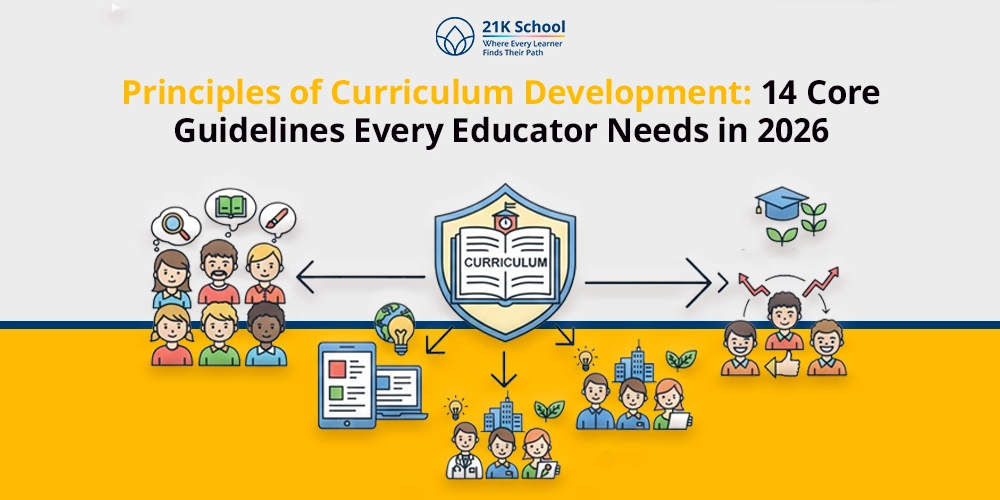
In the modern education system , curriculum plays a major role in students’ day-to-day learning and other activities.
That’s why understanding the principles, importance, and challenge help individuals to design and follow the curriculum effectively.
Curriculum development is a foundation of successful learning which offers students an effective, relevant, and meaningful learning environment.
Check out all the needful information related to the principles of curriculum development in education.
Contents
- What Is Curriculum Development?
- 14 Core Principles of Curriculum Development
- 1. Principle of Child Centeredness
- 2. Principle of Clear Educational Objectives
- 3. Principle of Community Centeredness
- 4. Principle of Activity-Based and Experiential Learning
- 5. Principle of Environment Centeredness
- 6. Principle of Flexibility
- 7. Principle of Variety
- 8. Principle of Integration
- 9. Principle of Utility
- 10. Principle of Interest
- 11. Principle of Harmony
- 12. Principle of Value Education and Ethics
- 13. Principle of Inclusivity and Equity
- 14. Principle of National and Global Alignment
- 5 Importance of Principles in Curriculum Development
- 5 Main Role of Teachers in Curriculum Development
- 5 Common Challenges in Curriculum Development
- Conclusion
What Is Curriculum Development?
Curriculum development is a systematic process of creating, revising, and improving educational programs according to learners’ needs, modern standards, and societal expectations.
It is an effective holistic development for learners focused on overall development rather than one area such as academic score.
Curriculum development includes a step-by-step process to meet students’ expectations to complete that lesson or course within that particular time period.
14 Core Principles of Curriculum Development
Understanding the core principles of curriculum development is ideal to meet students’ needs. Given below are 14 key principles of curriculum development:
1. Principle of Child Centeredness
The principle of child centered education in curriculum development embraces an approach where students learn according to their interest, abilities, and learning styles help them in active participation.
In this way, students both learn while enjoying at the same time to achieve desired objectives.
2. Principle of Clear Educational Objectives
The principle of clear learning objectives in curriculum development emphasizes the importance of setting well-defined goals that guide the teaching process toward consistent and focused results
This can be done by setting SMART goals (specific, measurable, achievable, relevant, and time-bound).
3. Principle of Community Centeredness
The principle of community centeredness focuses on students’ education which should be connected with social, cultural, economic, and environmental realities.
community-centered curriculum encourages group involvement where students engage in real-world problem solving by addressing genuine community issues.
4. Principle of Activity-Based and Experiential Learning
The principle of activity-based learning and experiential learning focuses on learning by doing rather than rote memorisation.
Here, students participate in meaningful tasks or educational activities that increase their curiosity and interest while learning.
5. Principle of Environment Centeredness
The principle of environment centeredness is important for both natural and learning environments in shaping education.
In this way, students understand the value of nature and look for solutions to environmental issues like forest safety, clean water mission.
6. Principle of Flexibility
The principle of flexibility in education helps to fulfill the needs of students by providing a diverse learning environment, changing societal demands, and emerging knowledge.
Students in flexible learning become more innovative, productive, and objective-orientated.
7. Principle of Variety
Including the principle of variety helps students to focus on diverse content, learning methods, educational activities, and assessments .
It balances the overall interest of students including academic, artistic, and vocational areas.
8. Principle of Integration
The principle of integration simply means connecting different subjects and learning experiences.
This ensures a coherent and impactful learning environment.
Some simple ways to do so are connecting theory with practical and school knowledge with real-world situations.
9. Principle of Utility
The principle of utility in curriculum development states that education should include useful, relevant, and applicable content useful for present and future growth.
Useful in the sense addressing real life requirements, development of life skills , and career growth.
10. Principle of Interest
The principle of interest means the curriculum should be created according to students’ interests, curiosity, and needs.
This motivates them to choose desired subjects and love to learn without pressure.
11. Principle of Harmony
The principle of harmony plays a vital role in personality development while learning.
Including harmony in curriculum development creates a balance between intellectual and emotional growth, individual and social needs, knowledge and values.
12. Principle of Value Education and Ethics
The principle of value education and ethics is integrated in the curriculum to develop students’ moral, ethical, and spiritual values.
The outcome of including value education and ethics is becoming responsible citizens and working towards social development.
13. Principle of Inclusivity and Equity
The principle of inclusivity and equity in curriculum development promotes Inclusive learning by making education more accessible, fair, and respectful of diversity for every student.
In this way, students can equally access diverse learning even with different cultural, linguistic, and barriers.
14. Principle of National and Global Alignment
The principle of national and global alignment plays a major role in curriculum development which opens new doors of learning.
One must align curriculum based on national and global perspectives. It helps students who want to pursue higher education abroad.
5 Importance of Principles in Curriculum Development
Check out the detailed benefits of curriculum development in education:
1. Supports Professional Development
Curriculum works as a blueprint for teachers, parents, and students.
In this way, one can choose effective teaching methods, resources, and assessment strategies to fulfill educational requirements.
2. Promote Equity and Inclusion
An effective curriculum promotes equity and inclusion.
This simply means everyone from diverse perspectives, cultures, and backgrounds collaborate together to learn and grow with time.
This creates a positive environment where students learn to respect and value each other.
3. Promote Holistic Development
Curriculum promotes holistic development which means it ensures overall growth including intellectual, emotional, social, physical, and moral growth.
4. Foster Critical Thinking and Creativity
A well-structured curriculum fosters critical thinking and creativity of students.
It guides students to bridge the gap between theoretical and practical experience which encourages them to apply knowledge in real-world scenarios.
5. Address Modern Needs
To understand modern needs in education, the latest curriculum helps students to meet the criteria.
Principles in curriculum ensures students to learn skills, values, and adaptability with time.
5 Main Role of Teachers in Curriculum Development
Teachers play significant roles in students’ lives. They become a mentor or educator to guide in every step of holistic growth.
Teachers help in many ways like classroom monitoring, preparing students for board exams , giving feedback etc. Curriculum development is also one of them.
Given below are mentioned some of the 5 key roles that teachers usually play in curriculum development:
1. Planning and Implementation
The initial role of teachers in curriculum development is planning and effective implementation.
This includes designing learning goals , content, and methods according to student needs and standards.
It is important for future growth and quality learning experiences that meet objectives.
2. Offering Practical Insights to Curriculum Development
Teachers help students to learn theory and practical together for deeper understanding and knowledge retention .
That’s why the curriculum must be planned and designed based on analysis. Teachers come up with a real-life classroom impression for curriculum development.
This helps to build a student-centric and meaningful curriculum.
3. Continuous Evaluation
Teachers should evaluate curriculum from time to time to check its suitability for classroom learning .
From understanding the ideal approach to including important topics, the curriculum should be organised and well-structured.
It helps to identify whether any change is required to enhance learning.
4. Innovating Teaching Strategies
After curriculum development, teachers plan for Innovative teaching strategies that enhance students learning and reduce stress like memorisation.
Some common examples include:
- Group learning
- Individual learning
- Inquiry-based learning
- Game-based learning
Teamwork , group discussions , interactive educational activities in the classroom etc are ideal.
5. Aligning with Educational Standards
It is the teacher’s responsibility to align curriculum with today’s educational standards. Look whether both state and national standards are met.
Focus on students needs and learning objectives through analysis and plan a strategy for proper balance in the academic and curriculum of the school.
5 Common Challenges in Curriculum Development
Curriculum development endures the structured process of learning. However, it also comes with challenges such as:
1. Rapid Technological Changes
One of the challenges faced by curriculum developers is rapid technological changes. It requires proper checking and customisation if needed.
Remember, an effective curriculum objective is to prepare to achieve future goals.
2. Diverse Learner Needs
Every student, their learning background, and needs are different from each other. This showcases that a curriculum must accommodate their differences accordingly.
So that each student can access it without any obstacle or pressure.
3. Resource Limitations
Some common resources like funding, technology, trained faculty, space, infrastructure etc play a major role in curriculum development.
Limitations of resources can impact negatively through which students are unable to fulfill their learning goals.
4. Curriculum Overload
One of the common challenges in curriculum development is overload. Students with excessive volume of content in education become confused and exhausted.
That’s why curriculum development should be analysed before implementing to avoid student stress , teacher burnout, and superficial learning.
5. Teacher Readiness
Teacher readiness is also a hindrance due to various reasons like insufficient training, lack of resources, outdated content, and difficulty adapting etc.
Conclusion
The curriculum is subject-centric, responsive to the learners. While developing the curriculum one must ensure that it is aligning the classroom learning and standards.
Understand the benefits, challenges, and role of teachers in curriculum development for effective development and implementation.
To make learning meaningful go through the principles of curriculum development in education.

You may also want to read
What is CBSE? Full Form, History, Structure & Key Benefits

- Last updated on: 06 Mar, 2026
- 14 min read