

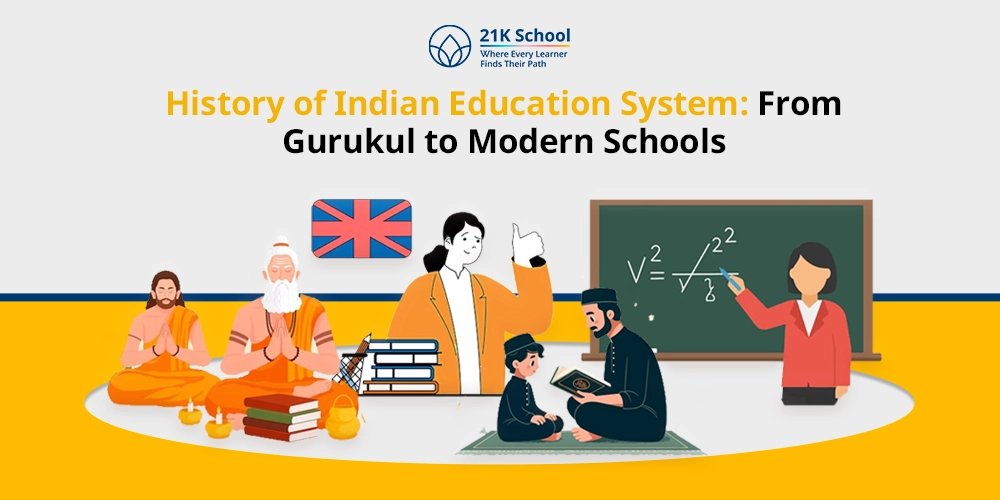
The Indian education system is one of the oldest and most popular education systems. Its roots are from the ancient Gurukul tradition to today’s modern education .
Have you ever explored the history of the Indian education system?
If not, this blog is for you. With time, education in India evolved to meet the needs of students. This continuous growth helps to make the environment flexible and diverse.
Understanding the history of the Indian education system helps in appreciating the past and customising future requirements. Let’s get deeper to understand in detail.
Table of Contents
What is the Indian Education System?
The Indian education system is the government-managed education system focused on theoretical knowledge sharing and practical experience.
The Indian education system provides a structured learning environment in which students can select from various subjects and courses.
With time, the Indian education system stepped towards vocational and skill-based learning . Now, modern education in India focuses on individual learning journeys, innovation, and on useful skills as opposed to memorising.
A Brief History of the Indian Education System
The education system in India is backed by a long and deeply rooted history which is fascinating to explore. To understand everything step-by-step here is a brief guide of the Indian education system.
1. Ancient Period (Vedic & Post-Vedic)
1.1 Objectives of Education
Starting with the ancient period of the Indian education system. During Vedic and post-Vedic period education aimed at self-realisation instead of material success.
The primary objectives of education are:
- Development of moral and ethical values
- Spiritual enlightenment and self-discipline
- Character building and social responsibility
- Preparation for the duties of life or Dharma
1.2 Gurukul System
In ancient times, the Gurukul system was one of the popular ways of education in which students, earlier called shishyas, lived with their teacher or guru in a residential setting for gaining knowledge .
The environment of students is natural surroundings like forests or ashrams to stay. Students learn different techniques from meditation to holy scriptures, medicine etc.
The Gurukul system is ideal for strengthening teachers-student relationship , living a disciplined life, and learning through real life challenges.
The six aims of education in the Gurukul system are:
- The acquisition of supreme knowledge
- Development of individual character
- Overall growth and development
- Social virtues
- Spiritual development
- Cultural education in students
1.3 Curriculum and Subjects
In this period, curriculum and subjects are based on the student’s role in society. For example:
- Vedas, Upanishads, Brahmanas, and Aranyakas
- Grammar, logic, philosophy, and ethics
- Mathematics, astronomy, and Ayurveda
- Warfare, politics, and administration
1.4 Methods of Teaching
In this period, the methods of teaching used are debate, discussion, memorisation, question-answer, practical application etc.
Here, writing plays a major role but mostly oral learning is preferred.
2. Medieval Period (Islamic Influence)
2.1 Education During the Islamic Period
While proceeding to the medieval period the introduction of Islamic educational traditions became high. In this time, education was provided through:
- Maktabs (primary education )
- Madrasas (higher education )
Here, various subjects such as Quranic studies, Islamic law, Arabic and Persian languages are taught to spread knowledge.
2.2 Contributions of Medieval Scholars
In the medieval period, the contributions in the Indian education system were in science, mathematics, literature, philosophy, and Indian texts translation into Persian and Arabic.
3. Colonial Period (British Era)
3.1 Pre-British Education in India
Before British rule, India had a wide network of:
- Pathshalas (village schools)
- Tols (centers for Sanskrit learning)
- Madrasas and Gurukuls
3.2 Introduction of Western Education
In the colonial period, the introduction of Western education by the British transferred the whole education system in India and brought formal education .
It is the start of building proper schools and colleges for learning. The British in this period promoted the English language and Western ideas among people in India.
The Charter Act of 1813 marked the formal beginning of state involvement in education.
3.3 Macaulay’s Minute (1835)
Lord Macaulay’s Minute is one of the popular names who shaped colonial education policy. Some key features of Western education are:
- English became the medium of instruction
- Education system designed based on Western science and literature
- Reduction of support for traditional education in India
4. Post-Independence Era (1947 onwards)
4.1 Constitutional Provisions for Education
The post-independence era is also a game changer in the Indian education system. The Indian Constitution highly focused on students’ education and development.
Some key policies and steps include:
- Education included in the Directive Principles of State Policy
- Equality and social justice in education
- Right to Education Act (Article 21A) specifies that students between 6 and 14 years old have a fundamental right of free and compulsory education.
4.2 Major Education Commissions
After independence, some major education commissions that changed the standard of education system in India are:
- University Education Commission (1948-49)
- Secondary Education Commission (1952-53)
- The first National Education Policy was based on the Kothari Commission (1964-66) recommendations and was introduced in 1968.
In this way, the government is working to bring equality, quality education , and integration.
4.3 Growth of Formal Education
The growth of formal education continues and the establishment of premier institutions such as the Indian Institutes of Technology and Indian Institutes of Management gradually leads to modernisation.
This helps in focusing on building an accessible and inclusive education system for student’s academic success .
Conclusion
With time, the Indian education system is getting better. Appreciating the past and working for the future is a key to success in students’ educational journeys.
Understanding the history of the Indian education system from holistic learning to modern approaches each phase contributes to the development of individuals and society.
It’s time to understand the depth of the past and work on future reforms to promote meaningful learning in the 21st century.

You may also want to read