


Collaboration in education has turned into one of the defining principles of the contemporary learning approach, which makes peer learning the central figure of this shift.
Opportunity to achieve high academic and personal success is present in the efficient leveraging of peers’ assets and perspectives.
Students also have a Collaborative Learning System for students at 21K School which is an online homeschooling curriculum in India, the US, and the UK.
In this blog, we will try to explain 7 types of enhancing the learning process using the concept of peer-to-peer education and how it benefits the learning process.
Table of Contents
- What Is Peer Learning?
- Benefits of Peer to Peer Education
- 1. Enhanced Understanding Through Peer Teaching
- 2. Development of Critical Thinking Skills
- 3. Improved Communication Skills
- 4. Increased Motivation and Engagement
- 5. Enhanced Social and Emotional Skills
- 6. Diverse Perspectives and Inclusive Learning
- 7. Preparation for Future Collaboration
- 8. Improved Knowledge Retention
- 9. Personalised Learning
- 10. Better Academic Performance
- 11. Boosts Confidence
- 12. Peer Assessment & Mentorship
- 13. Active Engagement
- 14. Encouraging Lifelong Learning Habits
- 15. Teaching Others Helps Students Learn
- 16. Embracing Diversity in Education
- 17. Helps in Teamwork
- 18. Enhanced Knowledge Sharing
- Promoting Peer-to-Peer Education at 21K School
- Conclusion
What Is Peer Learning?
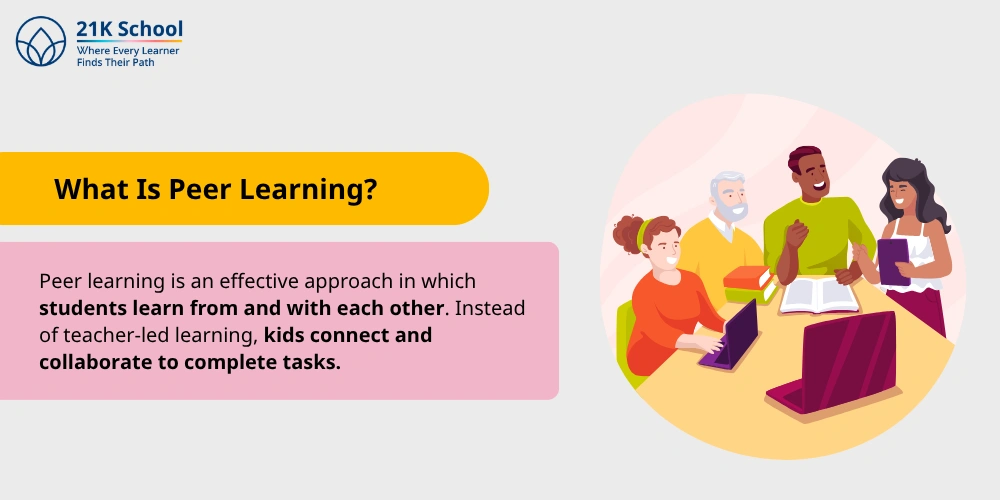
Peer learning is an effective approach in which students learn from and with each other. Instead of teacher-led learning, kids connect and collaborate to complete tasks.
From group projects to guiding each other in advanced maths peer learning offers open communication and motivation to achieve common learning goals.
Some common examples of peer learning include:
- Study groups
- Peer tutoring
- Collaborative projects
- Discussion circles
- Peer assessment activities
Explore the importance of peer learning.
Benefits of Peer to Peer Education
1. Enhanced Understanding Through Peer Teaching
The Concept of Peer Teaching
Peer teaching is referred to as an educational approach in which learners are allowed to become teachers for the other for some time.
Peer teaching is a strategy whereby students in a given class teach other students often in groups or with partners.
This method enables students to convey how a concept or an idea can be understood within easy-to-follow language and style.
Benefits of Peer Teaching
- Reinforcement of Knowledge: Students retain information in their intellects when they pass on this information to other students in the class.
- Confidence Building: Teaching knowledge to other students makes them more confident in their understanding of the concepts as well as the ability to explain the concepts to other people.
- Active Engagement: Peer teaching helps in the active participation of the students and therefore increases the chances of the students to master the content taught.
2. Development of Critical Thinking Skills
Encouraging Analytical Thinking
Group work setting puts students under pressure and pushes the students to analyze issues from multiple angles. It fosters higher-order thinking abilities that are crucial in learning and one’s life.
Benefits of Critical Thinking Development
- Problem-Solving: Students understand that there are well-defined technical ways to look at problems and solve them.
- Decision Making: The 5C of online schooling comprises Critical thinking improves the decision-making processes hence benefiting students to make better decisions.
- Intellectual Growth: Healthy and balanced peer debates assist the students to develop in terms of character and facilitate the acquisition of more information about several aspects of their lives.
3. Improved Communication Skills
Facilitating Effective Communication
The process of communication is one of the essential elements in peer-to-peer education, as everyone is both, a transmitter and a receiver of knowledge.
The students need to express ideas, listen to other students’ ideas, and listen to the feedback on the presentation of the classmate.
Benefits of Enhanced Communication Skills
- Clarity of Expression: Such discussions also help the students in a standardized and proper, manner so that they develop their thoughts.
- Active Listening: Different lessons illustrate the necessity to pay attention and understand other people’s points of view and how to respond appropriately.
- Collaboration: Skilled-based programs like public speaking are important for the students in particular in communicating to other students within the various group formations.
4. Increased Motivation and Engagement
Fostering a Motivated Learning Environment
Working in groups calls for timely and better performance from group members since they encourage each other.
This in turn increases the level of commitment and cooperation among the people involved boosting general motivation.
Benefits of Enhanced Motivation
- Positive Peer Influence: The success of peers motivates the students to work to the best of their abilities.
- Interactive Learning: Team tasks are highly effective since they encourage learning and at the same time make students have fun.
- Supportive Environment: The idea of learning in groups elevates achievement since learners are encouraged to know that their other colleagues understand what experts in the various fields are practicing.
5. Enhanced Social and Emotional Skills
Building Interpersonal Relationships
Interpersonal and emotional skills must be acquired through the collaboration that takes place in an academic setting.
Division of workload with other learners enables learners to appreciate others; solve conflicts and work together.
Benefits of Social and Emotional Learning
- Empathy Development: Learner interactions with students of other groups are always positive as they help in the development of tolerance of the student’s counterpart.
- Teamwork: Partwork assists in delivering a message to the students that in a given perspective people are required to join hands in working towards completing set objectives.
- Emotional Intelligence: Handling group outcomes enhances the act of making the students emotionally intelligent hence improving their status to become better individuals in society.
6. Diverse Perspectives and Inclusive Learning
Embracing Diversity in Education
Peer-to-peer education employs people from different groups and hence the students in a particular class will find it easier to identify with.
Thus, the chances of sharing and shaping cultures improve hence the learning culture.
Benefits of Inclusive Learning
- Broader Understanding: Grouping students with different experiences exposes them and broadens their understanding concerning various issues in the world.
- Cultural Competence: The inclusive learning environment enables the students to embrace the diverse cultures in the society hence improving their cultural competence.
- Respect for Diversity: The process of learning through cooperation improves the comprehension and application of diversity and behaviors while dealing with individuals.
7. Preparation for Future Collaboration
Equipping Students for Future Success
In contemporary society working jointly with other people is one of the key imperatives.
Peer-to-peer education equips students with the collaborative skills necessary for success in higher education and the workplace.
Benefits of Future-Ready Skills
- Career Readiness: Teamwork is a highly sought-after commodity in the job market, therefore it makes the students more employable.
- Higher Education: Implementation of the teaching skill enhances the students’ Group project & research in higher learning institute
- Lifelong Learning: Working together brings the aspect of desired knowledge and development in one’s life, and thus benefits all the students. It promotes lifetime learning habit in students
8. Improved Knowledge Retention
Education often requires knowledge retention abilities in students to reduce exam stress. Peer learning offers the advantage of memory preservation.
Students often actively take part in discussion and group study which help in enhancing memory retention.
9. Personalised Learning
Each student is different in their learning styles. That’s why peer-to-peer learning offers the benefits of personalised learning.
In this way, students get the opportunity to learn at their own pace with a group.
Getting mental and educational support builds confidence and self-esteem for students to achieve better.
10. Better Academic Performance
Peer learning helps in collaborative education which is ideal to improve student’s academic performance.
By discussion, sharing thoughts, debating on particular topics to get proper outcomes, learners are able to retain content.
Peer learning activities are also ideal for group assessments, problem-solving and continuous learning.
11. Boosts Confidence
Students often hesitate or have low confidence to connect and collaborate with peers due to various reasons.
However, the benefits of peer-to-peer learning actively promote group study which later boosts confidence, empathy, and teamwork skills.
In this open learning behaviour, students become free to reach a global audience without hesitation.
12. Peer Assessment & Mentorship
Peer assessment & mentorship are the process of improving others’ work to make it more meaningful.
The process improves the quality of learning and guides students to understand the importance of mutual growth.
Through mentoring students also reduce the dependency on teachers and improve leadership skills.
13. Active Engagement
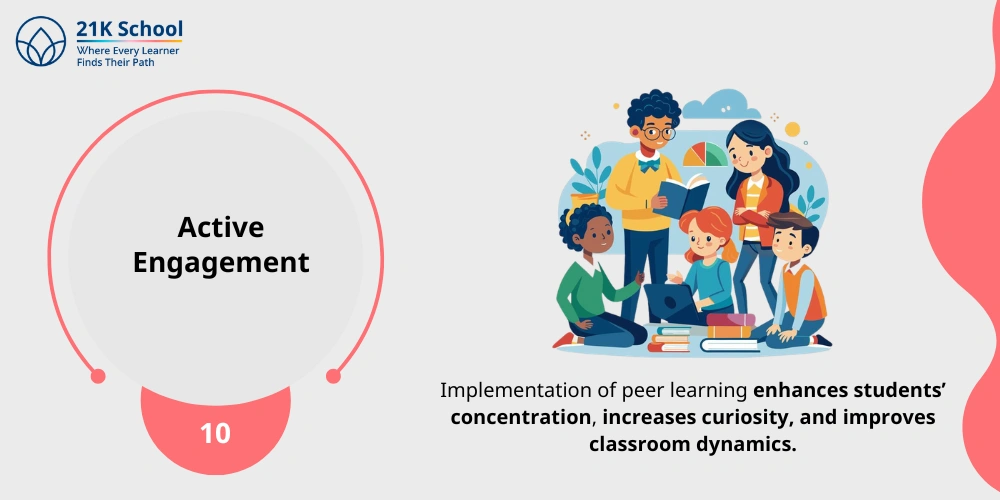
Teachers-led learning or constant listening reduce active participation. However, implementation of peer learning enhances students’ concentration, increases curiosity, and improves classroom dynamics.
Learners can improve active engagement by peer learning activities like gamification, peer teaching, role play, field trips, problem-based learning etc.
14. Encouraging Lifelong Learning Habits
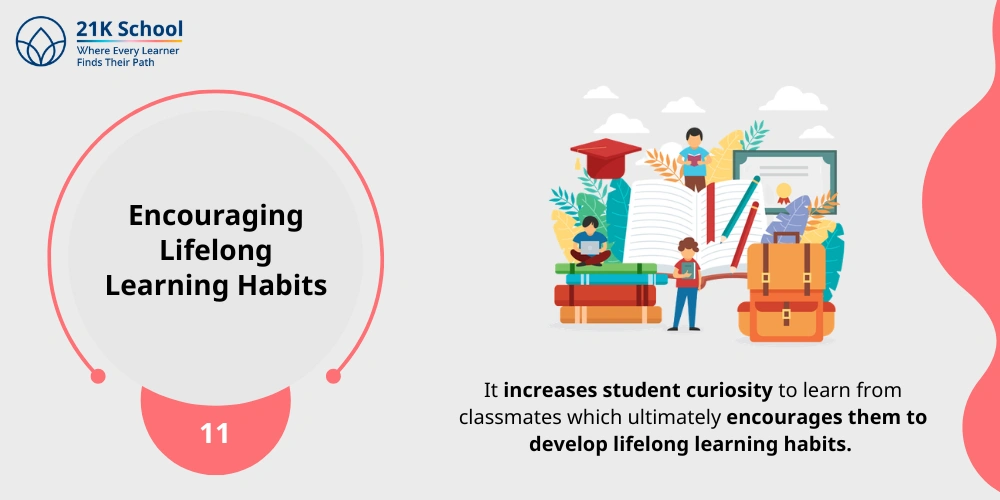
Peer learning is an independent educational approach that can be implemented in the classroom or in personal space.
It increases student curiosity to learn from classmates which ultimately encourages them to develop lifelong learning habits.
It is ideal because students love to interact and learn at the same time.
15. Teaching Others Helps Students Learn

It is often seen that individuals who share knowledge retain the maximum information. Explaining different concepts to peers ensures self understanding.
By this way students can also take a test by exploring how much they retain and areas of improvement. It is a win-win situation for students.
16. Embracing Diversity in Education
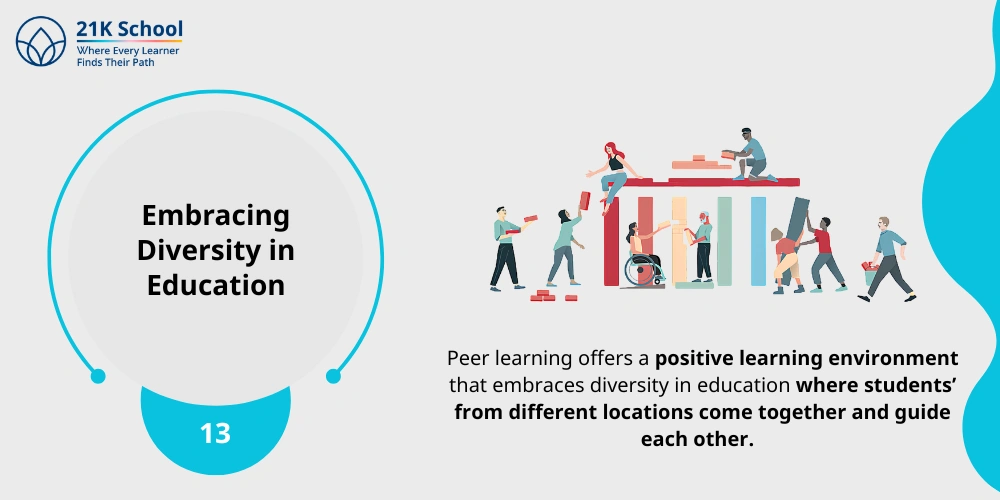
School and classroom are filled with learners from different backgrounds, cultures, country, and perspectives
Peer learning offers a positive learning environment that embraces diversity in education where students from different locations come together and guide each other.
It promotes cultural awareness, empathy, and acceptance of others’ thoughts etc.
17. Helps in Teamwork
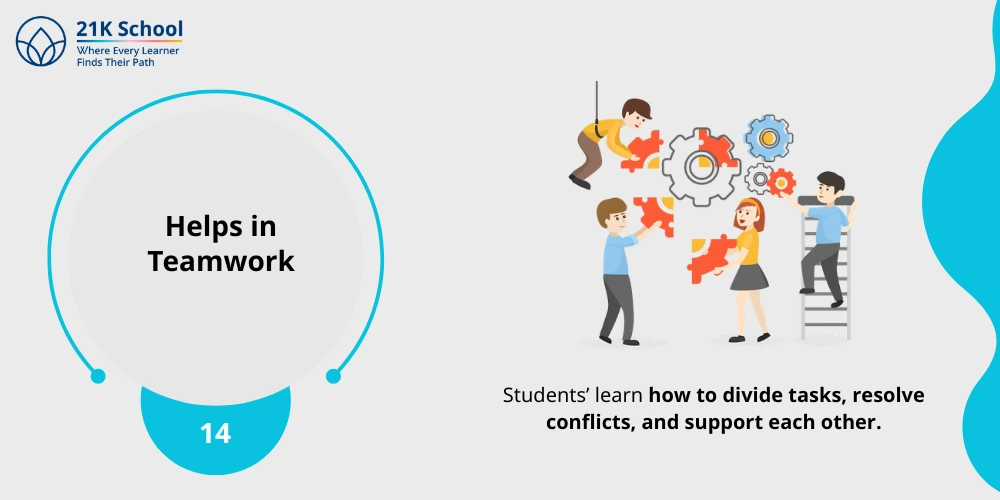
In the 21st century, skills such as teamwork and collaboration helps to fulfill future goals. Students learn how to divide tasks, resolve conflicts, and support each other.
Students through peer learning build social and emotional skills and look for creating solutions for upcoming challenges.
It not only helps students in the classroom but also works as a foundation for future needs in career and job.
18. Enhanced Knowledge Sharing
In traditional learning students limit their understanding by gaining knowledge provided by teachers.
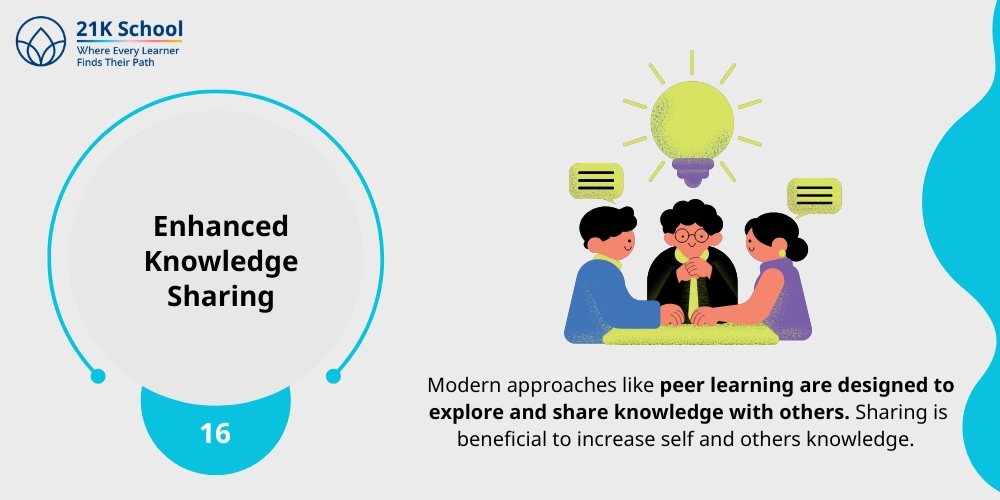
But, modern approaches like peer learning are designed to explore and share knowledge with others. Sharing is beneficial to increase self and others knowledge.
This makes students future-ready and to work with a big team at a job or business.
Promoting Peer-to-Peer Education at 21K School
At 21K School, we embrace the concept of peer education hence our students can benefit from this form of education.
Such online space helps to enhance the communication between students and allows them to exchange knowledge, discuss some topics or issues, and collaborate on projects.
It also serves the purpose of improving the student’s performance in class as well as predicting their achievements in the future.
Conclusion
Imparting education through fellow students is an effective measure that makes the process more effective and inspires cooperation, meaningful analysis of the issues, and proper communication.
At 21K School, we are committed to promoting collaborative learning to help our students thrive academically and personally.
This way students use peers to explain what is taught in the classroom hence they nurture qualities that make them fit in a successful future in the global world.

You may also want to read