

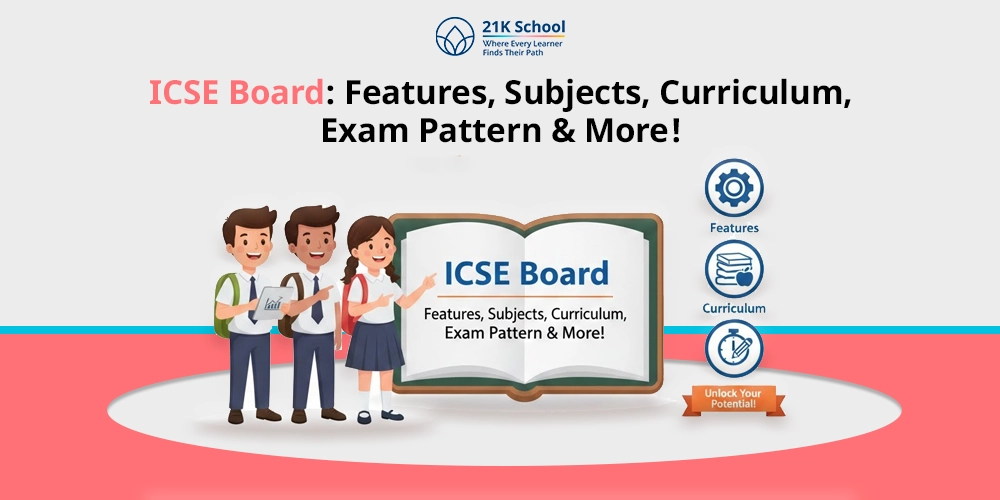
Selection of a right board is all about making the academic journey effective and successful. But the confusion starts when students are confused about which is best.
In the journey of finding the right board Indian Certificate of Secondary Education is one of the popular names parents and students must consider.
Here, we will go through a detailed analysis on the ICSE board, its benefits, and how it is different from other boards to ensure students choose the best as per their needs.
Contents
- What is the ICSE Board?
- History and Background of ICSE
- Key Features of ICSE Board
- ICSE Board Curriculum Structure
- ICSE Board Subjects
- ICSE Board Examination and Assessment
- ICSE Board Grading System
- 5 Benefits of the ICSE Board
- 5 Limitations of the ICSE Board
- Who Should Choose ICSE?
- ICSE Board: Why is ICSE the Right Choice for Students?
- ICSE Board vs Other Boards
- Conclusion
What is the ICSE Board?
The ICSE board is also known as Indian Certificate of Secondary Education . It is a private and non government board managed by the Council for the Indian School Certificate Examinations or CISCE.
ICSE board is popular for its structured curriculum created for students who need flexible learning in various streams such as language, humanities, science etc.
To know in-depth let’s get into the history and background of ICSE board.
History and Background of ICSE
Full Form of ICSE Board: Indian Certificate of Secondary Education
Established In: The ICSE examination itself was first introduced in 1970. Also, the CISCE (Council) was established in 1958.
Later Managed By: The Council for the Indian School Certificate Examinations (CISCE)
Some Important Dates:
- November 3, 1958: CISCE was established
- 1970: First ICSE (Class X) examination was conducted
- 1977: ISC (Class XII) examination was introduced
In summary, the CISCE evolved from the Cambridge examinations conducted in India, with the ICSE exam introduced in 1970 as India’s own examination system following recommendations of the Kothari Commission (1966) for the 10+2 pattern.
It mainly focused on holistic, concept-driven education through English, meeting national educational objectives.
Key Features of ICSE Board
Some of the key features of ICSE board are as follows:
1. Comprehensive and Detailed Curriculum
In ICSE board students get in-depth and detailed syllabus that focuses on concept clarity. In this way, students adapt analytical thinking instead of rote memorisation.
2. Strong Language Foundation
ICSE board is popular for its language proficiency which is not only beneficial in India but also for students who are looking forward to enrolling in foreign school or university.
3. Internal Assessment System
The internal assessment system is one of the ideal ways to reduce exam stress of students.
The weightage of internal assessment carries 20% overall which includes assignments, periodic tests, project work, and class participation.
4. Inclusive Education
The syllabus of ICSE board is created to support all students regardless of learning styles, abilities and disabilities.
This is important to provide equal access and opportunities for higher studies and career development.
ICSE Board Curriculum Structure
ICSE board curriculum structure is strong and based on the English language. It basically divides in:
1. Primary School
1.1 Core Areas
- English language mastery
- Mathematics basics
- Environmental Science (EVS)
- Second language
- Art and Craft, Music, Physical Education
1.2 Key Highlights of Curriculum
- reading, writing, and numeracy skills
- experiential and activity-based learning
- moral values and social awareness
2. Upper Primary / Middle School
2.1 Core Areas
- English (Literature + Language)
- Science: Physics, Chemistry, Biology
- Social Studies: History, Civics, Geography
- Mathematics
- Second Language
- Computer Applications
2.2 Key Highlights of Curriculum
- improve conceptual understanding
- critical thinking and problem-solving skills
- project work and practical learning
3. Secondary School
3.1 Core Areas
- English (compulsory)
- Mathematics
- Physics
- Chemistry
- Biology
- Second Language
- History and Civics
- Geography
- Optionals like Computer Applications, PE etc
3.2 Key Highlights of Curriculum
- in-depth theoretical knowledge
- internal assessment and practical work
- competitive exams and higher education
- map work, experiments, lab records etc
3.3 Key points of ICSE curriculum structure one must know:
- The curriculum focuses on English proficiency.
- Balanced approach where students can choose various subjects such as Science, Arts, Humanities, etc.
- Focused on practical learning and analytical thinking through theory.
- Flexibility to choose optional subjects.
ICSE Board Subjects
ICSE Board offers wide variety of Subjects for students diverse interests which includes both core subjects and elective subjects like:
1. Core Subjects
- English (Language & Literature)
- Mathematics
- Science (Physics, Chemistry, Biology)
- History & Civics
- Geography
- Second Language for example, Hindi, Sanskrit, French
2. Elective Subjects
- Environmental Science
- Art and Drama
- Computer Applications
- Fashion Designing
- Physical Education
- Classical Languages
- Economic Applications
ICSE Board Examination and Assessment
To understand ICSE board examination and assessment , go through below information:
1. External Examinations
The main written examination of ICSE includes 80% weight. It is conducted by the Council for the Indian School Certificate Examinations.
2. Internal Assessments
Internal assessments of ICSE include subjects that carry 20% of overall marks. This applies to Groups I and II only. Group III subjects have 50% internal assessment, not 20%.
It normally consists of:
- Projects/Assignments
- Practicals/Oral/Aural
- Periodic Tests/Class Participation
3. Practical Exam
Practical examination marks in subjects like Physics, Chemistry, Biology, Computer Applications are taken to observe students’ hands-on experience.
ICSE Board Grading System
The ICSE grading system uses a 9-point scale for external exams in which grade 1 is equal to highest and 9 is equal to fail. And for internal assessments letter grades letter format A-E is used.
1. External Examination Grades
- Uses a 9-point numerical scale (Grades 1-9)
- Grade 1: Highest (“Very Good”)
- Grades 2-7: Various passing levels
- Grades 8-9: Fail
- Based on absolute marks (percentage of total marks obtained)
- Top 5% get Grade 1, next 15% get Grade 2, etc.
2. Internal Assessment Grades
- A to E letter grades
- A: Highest
- E: Fail
5 Benefits of the ICSE Board
To know why one should chose ICSE board to complete schooling, go through the top benefits:
1. In-Depth Learning
Students who are looking forward to in-depth learning can opt for the ICSE board which helps them in building strong academic foundations.
It is highly recommended for higher education and research-based subjects.
2. Creativity and Innovation Opportunity
ICSE board promotes creativity and innovation opportunity by implement various techniques like:
- Project-based learning
- Creative writing and presentations
- Art, music, and environmental education
3. International Perspective
Students who are looking forward to pursuing their careers abroad should choose the ICSE board because it offers a curriculum that fulfils international education standards.
4. Exposure to a Range of Subjects
One of the benefits of choosing the ICSE board is getting exposure to a wide range of subjects from science to humanities and environmental science.
This helps students to continue their interests without distractions.
5. Practical Learning
ICSE board offers practical exposure to students by including projects, real-life situations, and lab work.
This helps to teach how to deal with real-world challenges.
5 Limitations of the ICSE Board
Even there are benefits of the ICSE board, some often deal with limitations like:
1. Less Flexibility
The board is less flexible due to fixed curriculum and syllabus which avoids innovation and customisation.
2. Fewer Schools
As compared to other boards the number of schools are fewer in ICSE boards which can negatively affect transfer.
However, different sources show varying numbers of ICSE schools. Generally it ranges between Over 2,700 to 3,100+.
Note: Go through the official CISCE School Locator to search for affiliated schools by country, state, and city.
3. Challenging Exams
ICSE exams are highly demanding due to its descriptive syllabus which can create pressure or stress in students.
4. Language Focused
The curriculum is strongly focused on language which can be challenging for some students.
5. Less Alignment with Competitive Exams
As compared to other boards like CBSE the ICSE board has less alignment with competitive exams .
Who Should Choose ICSE?
Enrollment in ICSE board is good option for students who:
- Enjoy reading, writing, and conceptual learning
- Wants to study in abroad
- Looking for creative and analytical learning
- Seeking holistic education
- Like to learn through practical approaches
ICSE Board: Why is ICSE the Right Choice for Students?
Parents and students often think why is ICSE the right choice, it is because:
1. Get Balanced Approach
Students who want a balanced approach can go with the ICSE board. It promotes a combination of academics, creativity, sports, and life skills.
2. Well-Structured Syllabus
ICSE board offers a well-structured syllabus which is created to provide smooth and distraction-free learning.
Students from primary, middle, to secondary school can enroll for preplanned structure.
3. Recognition and Acceptance
The certification from ICSE board is recognised and accepted in India and some global recognition.
4. Career Opportunities
ICSE opens new doors to diverse career paths through which students can gain required knowledge in the competitive world.
ICSE Board vs Other Boards
ICSE board and other boards have some differences. Let’s understand ICSE vs IGCSE vs CBSE vs IB with the help of a table:
| Particulars | ICSE | IGCSE | CBSE | IB |
| Recognition | India and some global recognition | Global | Primarily India | Global |
| Approach | Detailed and rigorous | Application-based | Conceptual and Competency-based approach | Inquiry-based |
| Flexibility | Balanced but less flexible | Wide subject choices | Limited electives | Highly flexible |
| Exam | Theory and some practical | Theory and practical | Theory-heavy | Research and projects |
| Grading System | Marks/Grades | A* – G | Marks/Grades | 1 – 7 scale |
Conclusion
Students in the 21st century have various options to choose from different boards. However, ICSE board is one of the popular names which offer unique benefits.
From proficiency in English language to planning higher studies abroad students can lift their career globally.
Hopefully, the information helps to understand the desired information related to the ICSE board. To know more stay tuned. Also, explore how to shift from CBSE to ICSE .

You may also want to read