

Education has its goals and objectives, which are commonly interpreted in two significant aspects which are individual and social.
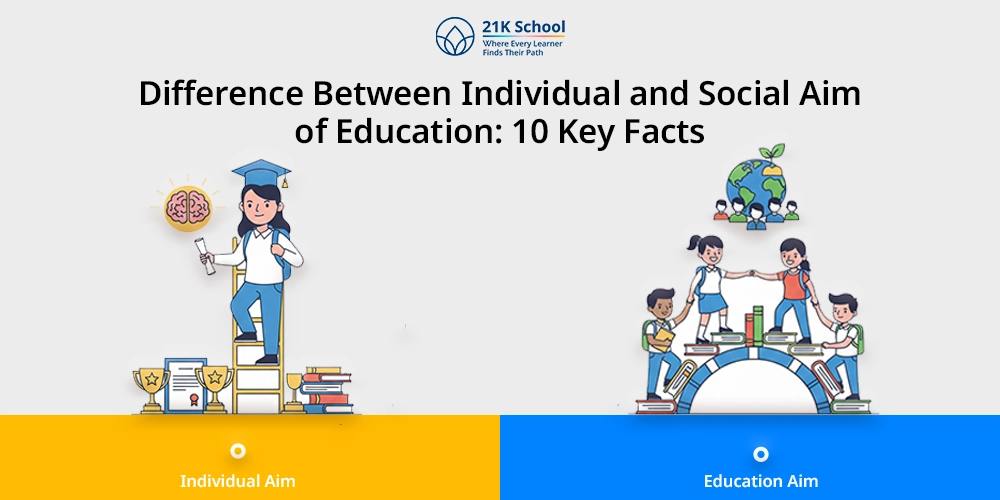
Whereas the individual goal accentuates the individual development, skills and self-development, the social goal stresses the development of a person to help society positively.
The distinction between the two objectives can help to clear up the real goal of education and the way it will transform learners into competent, responsible and all-round citizens.
Contents
What Are the Individual Aims of Education?
Individual aims of education are targeted at shaping the entire personality, skills, and potential of a particular learner. These goals assist human beings to develop mentally, emotionally, socially, and vocationally.
Education helps in personal growth, confidence, critical thinking and equips the learner with future careers.
1. Personal Development
Education builds the character, values, confidence and emotional well-being of an individual. It develops critical thinking, creativity and self-awareness, which prepares the learners to be responsible, all-rounded and independent persons.
2. Career Preparation
Education gives knowledge and skills that are necessary for future careers. It equips the learners to work, enhances competence, and helps learners to learn the strength in them, such that they are economically independent and grow in their professions.
3. Following Passion
In education, people get to explore and get to know what they are interested in. Through the different topics and activities, learners discover what they like, and this increases their level of motivation, fulfilment and personal satisfaction.
4. Self-Empowerment
Confidence, independence and choice making are caused by education. It improves the solving of problems and enables them to take charge of their lives, which results in their self-development and positive contribution to society.
What Are the Social Aims of Education?
Educational social goals are oriented to the aspect of making individuals worthy to be involved in societal contributions. This is because education fulfils these objectives as an accomplishment of personal growth in addition to the well-being of the community, cohesion, and development.
Social purposes can empower the learners to study the cultural values, be good citizens, build social peace, and boost economic and national growth.
1. Cultural Education
Education helps in preserving and transferring culture, tradition and heritage to the younger generation. It helps us to know and appreciate diversity, promote cultural understanding and accommodate the feeling of belonging to a community within society.
2. Social Cohesion
Education unites individuals as it enhances cooperation, tolerance and respect towards each other. It lessens societal polarities, promotes cohesion and assists people to realise their place in a diverse, multicultural society.
3. Economic Development
Education offers us well-trained, learned members of society who help in the expansion of the economy. Education enhances national development and minimises economic inequalities by enhancing productivity, innovation and employability.
4. Citizenship Education
Education makes one a responsible and active citizen. It instils rights, duties, morals, and civic values, and these strengthen the involvement in the democratic process as well as social responsibility and civic participation.
Key Difference Between Individual and Social Aim of Education
There are two significant goals of education: individual and social. The individual aim is concerned with personal growth of a learner, whereas the social aim is concerned with equipping people to make efforts to benefit society.
| Aspect | Individual Aim of Education | Social Aim of Education |
| Meaning | At the individual level, there is a focus on the individual level by concentrating on personal growth, self-improvement and care towards the discovery of individual abilities of the learner. | Social aim deals with the issue of shaping individuals to contribute to society and contribute to the social welfare, unity and growth. |
| Scope | Personal purpose deals with the personal capabilities, personal interests, talents and emotional and intellectual development. | Social purpose refers to cultural values, social roles, a collective effort, citizenship and group development. |
| Objective | The aim of the individuals is to help people become independent, self-confident, and receive personal satisfaction. | The social objective is to produce responsible citizens who, subsequently, can produce value to society. |
| Purpose | The individual ambition enhances the character and prospects of the learner. | Social goal ensures social order, cooperation and cultural continuity. |
| Motivation | The aim of the individual is founded on the personal interests, needs and objectives. | Social goal is dictated by needs, welfare and the needs of the society. |
| Examples | Personal objectives towards the child’s interest in art, the development of critical thinking or practising personal skills. | The social goal inculcates civic duties, social values, discipline, teamwork and respect for diversity. |
| Priority | Personal purpose lays more stress on personal growth and self-choice of the learner. | One of the social objectives is to satisfy society, community and the overall welfare. |
| Philosophy | Personal goals are premised on individualism, humanism and self-actualisation. | Social aims are set on the welfare of the community and citizenship that does not attach them to particular political ideologies. |
| Goal | Individuals aim at becoming independent, self-reliant and self-sufficed. | The social goal is to have socially responsible, cooperative and constructive citizens. |
| Outcome | Individual pursuit will lead to personal gratification, professional achievement and self-identification. | Social objectives lead to social steady and shared values, and national growth. |
1. Meaning
Individual Aim: The Individual aim is aimed at the full development of individual abilities, interests of a learner, intellect and personality. It is also sensitive to the personal growth and actualisation of self.
Social Aim: The social aim has been created to mould individuals to the societal requirements. It emphasises the social values, teamwork and cultural continuity and prepares the learners to be responsible in their communities.
2. Scope
Individual Aim: It is a developmental scope, which is emotional, intellectual, physical and creative, based on the potential of an individual learner. It promotes liberty and the right to self-expression and personal health.
Social Objective: The sphere is founded on social obligations, cultural education, moral principles, collaboration , and the process of lifting people up to become part of the society’s development and stability.
3. Objective
Individual Aim: It is directed at helping people to have personal fulfilment, self-confidence, and knowledge , the acquisition of skills that will help them live without requiring support, and deliver personal success.
Social Aim: It focuses on the production of responsible and disciplined citizens who are going to respect society, peace, and make a positive contribution towards the development of the country.
4. Purpose
Individual Aim: It is focused on enhancing the personality of a learner, encouraging him or her to the process of creativity, and letting them adhere to his or her own interests and life goals in a liberated way.
Social Aim: The reason is that they will be adamant to ensure that our societies are socially integrated; they will be tempted to have similar values and hold people accountable in their societies.
5. Motivation
Individual Aim: As a person is driven by personal growth, interests, enthusiasm, and the necessity to become better. It is covered with cheerfulness and self-education.
Social Aim: It is motivated by the societal pressures to shape individuals with the abilities to benefit society, democracy and the development of society.
6. Examples
Individual Aim: Developing students’ interests, creative capabilities, learning on their own, and self-identity development and advancement.
Social Purpose: To inform and train civic values, moral values, teamwork, cultural tradition and social discipline in order to have a balanced community life.
7. Priority
Individual Aim: Places at the apex of personal freedom, personal individuality, choice, and personal success. The first ones are the needs of the learner.
Social Aim: It assumes the priority of societal needs in which the people are supposed to conform to the social norms of the society, in order to make the society grow collectively, and also in order to maintain social peace.
8. Philosophy
Individual Aim: It is humanistic and individualistic, and it emphasises self-actualisation, personal rights, and the ability of specific potential to grow.
Social Aim: It is premised upon collectivism and socialism, the common good, cultural continuity, mutual responsibility and working with the common good.
9. Goal
Individual Aim: This is geared towards making self-reliant, independent and confident people to make decisions, problem-solving and lead fulfilling lives.
Social Aim: This is geared towards producing socially responsible, cooperating and disciplined citizens who contribute to the establishment of stability and advancement in society.
10. Outcome
Personal: The personal aim leads to individual success, creativity, and self-confidence and career success are founded on personal ambition.
Social Aim: Causes the social order, unity, preservation of the cultures and working as a team towards common goals.
Conclusion
The personal and social objectives of education are complementary to each other to produce well-rounded, able and responsible human beings.
Even though the individual aim is personal development, talents, interests and self-fulfilment, the social goal is present to ensure the learners grow to responsible citizens who positively influence society.
The two ends are mutually supportive- education is ideal when it assists in realising the individual potential and social tranquilly, and the communal growth.

You may also want to read