


Today, learning is often seen as a competition, where students race with each other to become the best among all.
Instead of being competitive, it matters a lot more to focus on what kids have actually learned.
Rather than focusing on ranking, comparisons or better scores students are evaluated through clear goals and meaningful feedback.
This is what exactly criterion-referenced testing means. An amazing approach that measures learning, not comparison. To know each point in detail let’s begin with its meaning, examples, and many more.
Contents
- What is the Criterion Referenced Test?
- Examples of Criterion-Referenced Tests
- 4 Key Characteristics of Criterion-Referenced Tests
- 5 Objectives of Criterion-Referenced Testing
- 5 Key Advantages of Criterion-Referenced Tests
- 4 Key Role of Technology in Criterion-Referenced Testing
- Criterion-Referenced Test vs Norm-Referenced Test
- 4 Limitations of Criterion-Referenced Tests
- Conclusion
What is the Criterion Referenced Test?
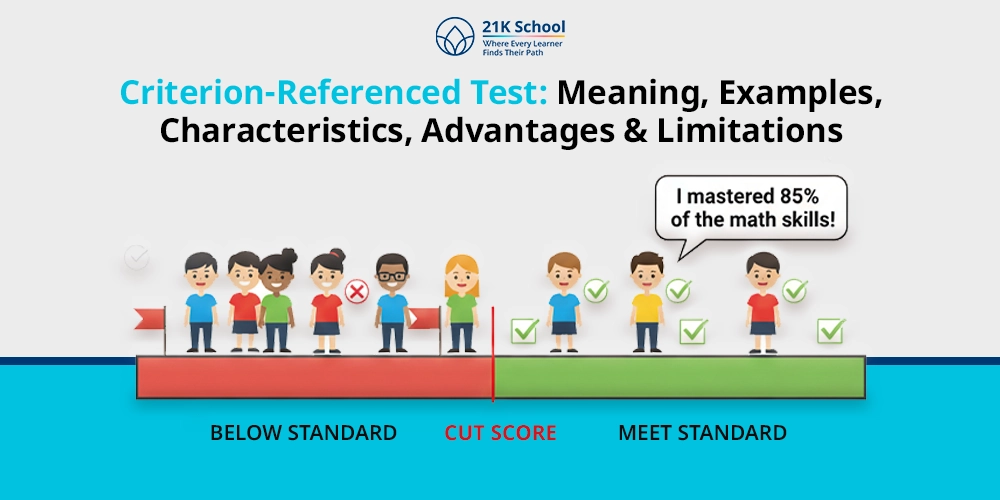
Criterion-referenced tests is an effective assessment that compares a student’s knowledge and skills against a predetermined standard, cut score, or other criterion.
Here, the performance of other learners does not impact a student’s score. In a simpler term, an individual is evaluated according to what they know and can do, instead of how well others perform.
The key idea in the criterion-referenced tests is focus on mastery of a particular skill or objective to showcase the goals are met or not.
Examples of Criterion-Referenced Tests
Criterion-referenced tests can be used in different places like classrooms and learning support systems. Simple examples include:
1. Unit/Chapter Tests
In a classroom setting, criterion-referenced tests help to evaluate whether students understand the concept for the long run.
A science chapter test on renewable energy measuring understanding of key concepts.
2. Quizzes
A quick assessment in the form of a quiz given by the teacher after completion of a chapter to check the progress and knowledge retention of students.
3. Reading Running Records
The teacher carefully listens to the student to check for accuracy, fluency, and comprehension.
4 Key Characteristics of Criterion-Referenced Tests
Criterion-referenced tests are a crucial part of education focus on understanding, mastery, and individual progress.
Here’s a breakdown of the key characteristics:
1. Focus on learning objectives
Criterion-referenced tests focus on learning objectives means the questions are accurately aligned with the outcome.
The assessment is purposeful, effective, and instruction-based.
2. Mastery-based assessment
The key characteristic of criterion-referenced tests is to understand whether a learner has mastered the content.
Mastering in a particular area helps students to become proficient. In this way teachers support students deep learning.
3. Performance measured against predefined criteria
Instead of competition or comparison students’ performance can be measured against predefined criteria.
In this way, a clearly stated benchmark for all students ensures fairness and consistency in evaluation.
4. Individual progress tracking
Criterion-referenced tests are a valuable way to track individual progress without comparing with others.
Here, teachers identify strengths, weaknesses, improvement areas to get a personalised learning approach.
5 Objectives of Criterion-Referenced Testing
Criterion-referenced tests are designed to understand and evaluate the students progress based on specific criteria.
For effective use of criterion-referenced testing, we need to understand the objectives in detail:
1. Measure mastery of specific skills
One of the key objectives is to understand whether a student mastered a particular skill or concept. This helps in designing the assessment by the teacher.
2. Identify learning gaps
By identifying the learning gaps, weaknesses, areas of improvement through criterion-referenced tests, teachers can provide a supportive and positive learning environment.
Through timely identification, one can work on solutions like revision, or remedial instruction.
3. Support individualized instruction
By evaluating the assessment teachers can design instruction for individual learning needs. For example, some students need extra support or unique strategies to learn faster and effectively.
4. Improve teaching strategies
One of the objectives of criterion-referenced tests is to improve teaching strategies if a student is not meeting certain criteria.
In this way, students pursue continuous learning and improvement through innovative techniques.
5. Ensure learning outcomes are met
In structured learning, educational goals are predefined. That’s why it’s important to align the outcome into curriculum goals.
Criterion-referenced tests ensure that curriculum goals and learning outcomes are successfully achieved for future growth.
5 Key Advantages of Criterion-Referenced Tests
Criterion-referenced tests are often used due to its advantages like focus on individual learning and clear learning expectations.
Here’s some detailed information one must read:
1. Focus on individual learning
One of the advantages of criterion-referenced tests is it focuses on individual learning instead of comparing with others.
Students understand their performance level against a set criteria and try to achieve better. In this way, students progress at their own speed.
2. Clear learning expectations
Through criterion-referenced tests students get clear objectives to achieve specific goals. This reduces the confusion and anxiety.
3. Supports inclusive education
Inclusive education means learning in a classroom that supports every learner and their learning styles abilities and disabilities.
Through criterion-referenced tests each student gets a customised approach to become better.
4. Encourages mastery learning
Criterion-referenced tests promote deep learning and encourage mastery in skills or objectives after completion of a particular concept.
This helps them to improve skills instead of scoring higher.
5. Useful for curriculum improvement
Assessments are an important part of learning and criterion-referenced tests play a major role by offering a clear target that aligns with students’ curriculum.
In this way, each student thinks about how to meet the curriculum objectives.
4 Key Role of Technology in Criterion-Referenced Testing
Technology plays an essential role in education by providing the right environment to teachers and students. In criterion-referenced test, technology supports by:
1. Online assessments
Teachers can use online assessments platforms to design criterion-referenced tests. It helps them to align objectives and predefined criteria.
It is beneficial for quick evaluation, remote access from anywhere, and less manual grading.
2. Adaptive learning tools
Adaptive learning tools help to adjust according to students’ responses. Remember, it’s important to match students’ level of learning to get appropriate feedback.
3. Learning Management Systems (LMS)
Learning Management Systems (LMS) is a popular name in technology used to organise, deliver, and evaluate criterion-referenced assessments.
Through LMS teachers can use features like objective-based grading and progress tracking dashboards.
4. Data-driven insights for teachers
Technology is often used for data collection, analysis, and finding out the right strategy to implement. In criterion-referenced tests, teachers get the facility to:
- Early identification of struggling learners
- Evidence-based instructional planning
- Continuous monitoring of learning outcomes.
Criterion-Referenced Test vs Norm-Referenced Test
The following are the key differences between criterion-referenced test vs norm-referenced test. Go through a quick table:
| S No. | Particulars | Criterion-Referenced Test | Norm-Referenced Test |
| 1. | Meaning | It is based on predefined learning standards or criteria | While it measure students performance in comparison to other students |
| 2. | Evaluation method | Evaluation methods used are mastery of specific skills, objectives, or learning outcomes | Evaluation methods used here are use rank, percentile, or grade distribution |
| 3. | Result interpretation | It indicates whether learning objectives are met, partially met, or not met | On the other hand, it indicates how well a student performed compared to other students |
| 4. | Student comparison vs standard comparison | Standard-based comparison | Student-based comparison |
| 5. | Classroom relevance | Highly relevant for daily classroom assessments, remedial teaching, and inclusive education | Commonly used for competitive exams, selection tests, and large-scale assessments |
4 Limitations of Criterion-Referenced Tests
Criterion-referenced tests is one of the effective way of measuring mastery of specific learning skills/objectives, but it also has some limitations like:
1. No ranking or comparison
Criterion-referenced tests are not designed to compare students’ progress. That’s why it is unable to provide rank results.
This is a challenge to understand who is better within a class or group.
2. Time-consuming to design
Criterion-referenced tests require careful planning and execution which is a time-consuming process to design.
Teachers need to follow the steps-by-step process to design and implement effectively.
3. Requires well-defined criteria
The accuracy of a criterion-referenced test is based on its established standards. A poor or inappropriate criterion can lead to wrong results.
4. May overlook broader abilities
CRTs are unable to capture students’ creativity, critical thinking, or problem-solving throughout the time.
Conclusion
Criterion-referenced tests are ideal to avoid competition and comparison. Instead one can promote comprehension.
To promote fairness, criterion-referenced tests can be used by teachers in regular classrooms, online settings, or any skill-based training programs.
In the 21st century, criterion-referenced tests are an impactful assessment
tool through which students can enhance their learning journey.

You may also want to read


Types of Studies: Everything You Need to Know with Examples

- Last updated on: 16 Mar, 2026
- 7 min read