

Parents and teachers are both foundational relationships that children experience in their early years of growth.
But how are parent-teacher relationships of so much significance? Actually, they both are crucial to form a healthy mind and environment for kids.
It is seen that when parents and educators also have harmony in their bonding, they understand the learners better and help in their academic success.
Here’s how to improve a childs academic performance .
This article would be focusing entirely on parent-teacher relationship, how to build it, what are the benefits of such relationships and challenges in practicing it.
Contents
- What is the Parent Teacher Relationship?
- How to Develop Parent Teacher Relationships?
- 9 Reasons Why are Parent Teacher Relationships Important?
- 1. Enhances Academic Performance
- 2. Supports Emotional and Social Development
- 3. Promotes Positive Classroom Behavior
- 4. Encourages Consistency in Learning
- 5. Better Understanding of the Child
- 6. Increased Trust and Cooperation
- 7. Early Identification of Problems
- 8. Emphasis on Shared Responsibility
- 9. Improved Attendance and Participation
- Parent Teacher Relationships in Early Childhood Education
- Benefits of Parent Teacher Relationships
- 5 Challenges in the Parent-Teacher Relationship
- 7 Strategies on How to Strengthen Parent Teacher Relationship
- Conclude It All
What is the Parent Teacher Relationship?
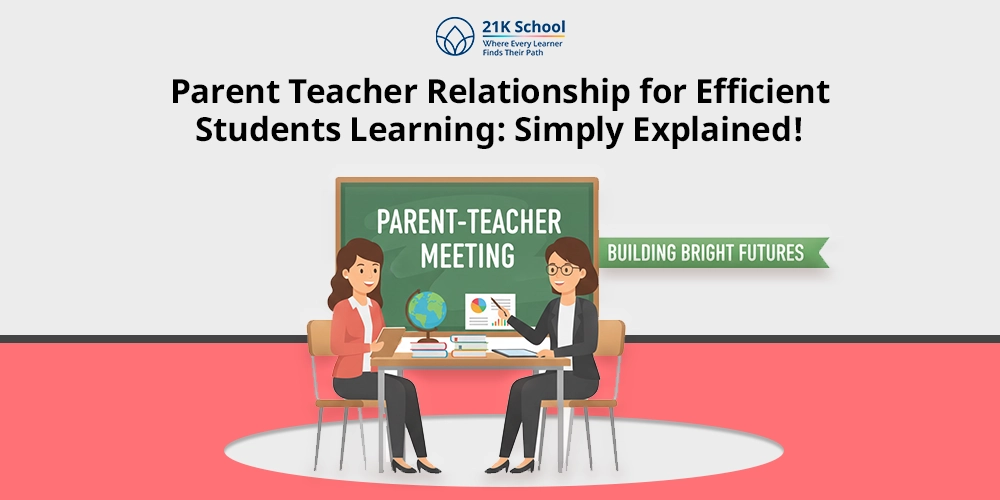
A parent-teacher relationship is a continuous communication and healthy collaboration between the parents and the educators.
It comes with the understanding of sharing emotional, social, and academic growth of a child.
In this scenario, parents and teachers share the strengths and weaknesses of the child.
They also discuss their achievements in school, and concerns to collaboratively come up with practical solutions.
Trust, understanding, and collaboration are the pillars of having a healthy parent-teacher relationship.
It entails collaborative effort from both the parties involved.
The teachers can send updates on school activities and parents communicate their insights into the behavior and needs of the child at home.
How to Develop Parent Teacher Relationships?
Forming an effective parent-teacher relationship can only begin with effective, and open communication.
The connection can start from the teacher’s side through their early introduction in the beginning of the school year.
They can then share their expectations from parents and offer a space of understanding and help.
The parents can improve the relationship by attending school meetings regularly and responding timely to the messages.
Empathy is an important aspect of relationship-building. Parents should realize that teachers monitor numerous students and might not necessarily give immediate response.
Teachers also should consider that parents have to be at work, at home, while also taking care of their children.
Time and point of view should be respected to ensure that there is harmony.
Constant interaction will help in growth too.
This can be done by attending parent-teacher meetings, volunteering in school activities, serving in school committees, or even by being updated on classroom activities.
Simple things like recognition of the work of a teacher or rewarding the improvement of a child are also important in creating the trust that will serve all through the academic year.
9 Reasons Why are Parent Teacher Relationships Important?
Parent-teacher relationships are vital for child’s personal as well as professional growth, as you will see in below mentioned points:
1. Enhances Academic Performance
Close parent teacher connections are directly related to the academic success of a child in future.
The child gets constant support when teachers impart learning techniques and parents extend the same support at home.
This harmony enhances the learning process, boosts subject-knowledge, and the desire to do better in school.
2. Supports Emotional and Social Development
Children develop better under the collaborative support from school and home.
Parents and teachers can recognize the weak emotional state of children by communicating on a regular basis and discuss the ways to address them.
This cooperation gives students a secure space in which they can feel accepted and appreciated.
3. Promotes Positive Classroom Behavior
It is also easy to cope with behavioral problems when parents and teachers collaborate.
Teachers can communicate the child’s attitude in the classroom to the parents, while the parents can offer background information on their behavior at home.
Parents and teachers need to be united.
Due to this children would be more likely to obey rules and act responsibly as they see that their parents and teachers are asking the same from them.
4. Encourages Consistency in Learning
When school and home are consistent in their guidance to the children, learning is enhanced.
A positive parent teacher relationship is such that both the parents and the teacher adopt similar styles in study-habits and discipline-management.
This consistency assists children to adapt more to expectations with less confusion.
5. Better Understanding of the Child
A combined effort to discuss and comprehend the challenges that students face in classrooms as well as homes can be beneficial.
In this way both teachers and parents can come up with individualized instructions that align with the learning styles of children, thus making children feel understood.
This knowledge can enable an educator and parents to better facilitate learning.
6. Increased Trust and Cooperation
Whenever there is honesty in communication from both sides, trust is built.
Parents are assured that their child is in good hands and the teachers feel open to speak to the parents.
This trust in each other forms a positive learning environment where issues can be openly discussed and solutions can be found without scolding.
7. Early Identification of Problems
When teachers and parents work in collaboration, kids’ initial problems range between emotional, physical, social, and mental ones.
Early diagnosis makes the children get early interventions like counseling or other assistance.
This can be a facilitating way to avoid minor issues developing into huge concerns later.
The teacher is not the only one in charge of education .
Parents taking active interest in the learning process of children makes them realize that their parents are also caring towards them and their academic achievements.
This effort in combination strengthens student-discipline and motivates the child to further work on their school-work.
9. Improved Attendance and Participation
When parents are involved, children will find it easier to attend school and also engage in activities.
An active participation of parents sends a good message that education is important.
This motivation increases the attendance-rate of students, and confidence in learning.
Parent Teacher Relationships in Early Childhood Education
Parent-teacher relationships are particularly important in early-childhood education .
This is because children at this stage rely largely on their caregivers and teachers to shape their growth.
Primary-class teachers can work in close interaction with families to be aware of students’ habits and behavioral requirements.
Close interactions enable teachers to offer a caring and non-threatening space that helps in socialization, self-expression, and emotional growth.
There is increased involvement of the parents in early-childhood through classroom visits to engage in bonding exercises and play-based activities.
Such participation reinforces a child’s security and also provides parents with an idea of how education is carried out in school.
The relationship formed in early life years tends to curate the manner in which the student relates to academics and the parental relations.
Benefits of Parent Teacher Relationships
The positive effects of a healthy parent-teacher relationship is much more than academic success.
When children observe the adults cooperating for their better upbringing, they become more confident.
Their attitude becomes positive towards school.
The parents also benefit as they get a clear picture of the academic status of the child and their school environment.
It is also beneficial to the teachers. The cooperation from parents simplifies classroom management, eliminates misunderstandings, and develops a collaborative learning environment.
Good relationships also promote schools to be more inclusive in their policies and enhance general community participation.
Such associations over extended periods result in a supportive system that improves the school culture and creates lifelong learning .
5 Challenges in the Parent-Teacher Relationship
In maintaining parent-teacher relationships, it takes a lot of consideration and cooperation. The challenges in such scenarios can be mentioned as the following:
1. Lack of Time
Time constraints arising due to busy schedules makes communication between both parents and teachers unfavourable.
Working parents or parents owning business might face difficulties in attending school meetings.
Due to this, teachers who deal with many classes and learners will often find it difficult to meet with such parents.
2. Differences in Expectations
There are cases when parents and teachers differ in their opinions on the academic discipline and behavioral expectations from children.
These contradictory expectations can cause misunderstandings unless they are dealt with through open communication.
3. Communication Barriers
Communication can be influenced negatively by the language barrier or reluctance to talk to school personnel.
These barriers might complicate the process of collaboration unless both parties take an initiative to find a solution.
4. Over-Involvement or Under-Involvement
Sometimes a few parents intrude excessively in the activities of schools and then there are those who are uninterested in everything.
The balance should be achieved so that the teachers can teach the child efficiently and parents can help the child without added pressure.
5. Negative Past Experiences
Parents or teachers whose previous experiences have been characterized by conflicts might be reluctant to communicate.
An earlier misconception or a bad experience may affect the subsequent communications unless it is addressed empathetically and patiently.
7 Strategies on How to Strengthen Parent Teacher Relationship
The following tips can be brought into practice to strengthen a parent teacher relationship:
1. Establish Clear and Regular Communication
Consistent communication via meetings, emails, diary entries, or messaging apps will help parents remain updated.
Anxiety caused by a lack of continuous communication will be eliminated and everybody will be in line with the progress of the child.
2. Adopt a Positive Tone
A positive tone helps in building respect and leads to co-operation between educators and parents.
When the time spent by parents and teachers is devoted to the solutions instead of criticism, the conversations become more productive.
3. Encourage Active Parental Involvement
Parents are able to engage and volunteer at schools contributing to a child’s learning activities.
This participation can assist children to realize that education is a priority in their family. Thus, pushing them to be more interested in school.
4. Respect Each Other’s Roles
Scholastic knowledge is provided by teachers whereas parents provide personal information concerning the child.
The recognition of these roles’ distribution and understanding would ensure that there is a balance and least conflict of ideas.
5. Use Technology for Better Collaboration
Communication is also easier and more rapid with the help of digital platforms, school apps, video calls, and messaging tools.
Technology also assists in reducing time and distance gaps among the working parents in particular.
6. Approach Problems as a Team
Collaborative problem-solving from parent-teachers bonding can create improved results for the child.
Instead of blaming one another, they can work in a team to find the best possible solution for the betterment of their learners.
7. Celebrate Student Success Together
Appreciation of any success, however small, of parents, teachers, or students, reinforces the relationship between them.
Celebrations help to build a good atmosphere and also emphasize the essence of encouragement.
Conclude It All
Parents and teachers are the foundation of knowledge acquisition and a successful future of students.
A parent-teacher relationship hugely contributes towards how a child looks at themselves growing up and finding their strengths.
A harmonious bonding can always be maintained between parents and educators when they both are willing to work upon it.
Even the language barriers or misunderstandings can be reduced.
All we need to do is be empathetic towards both parties and support each other while we communicate with the other party.

You may also want to read