

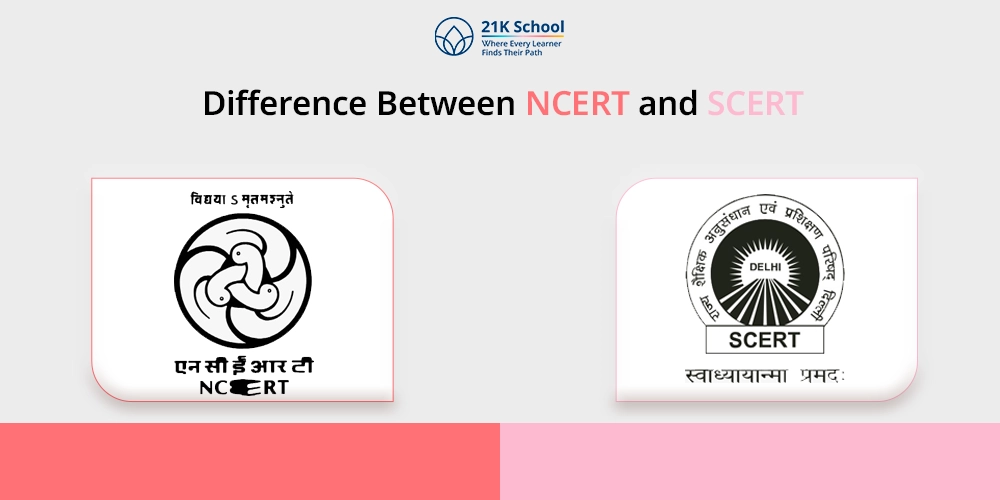
While learning, students, teachers, and parents come across various terms such as NCERT and SCERT. These are some popular organisations highly useful for students’ educational purposes.
Both NCERT and SCERT are useful in the development and promotion of education in India.
To understand both the terms and how they are different from each other we need to go through a journey that aims to explore the difference between NCERT and SCERT in detail.
Table of Contents
What Is NCERT?
The NCERT (National Council of Educational Research and Training) is an organisation in India established on September 1, 1961 by merging seven existing national government institutions.
The National Council of Educational Research and Training was formed by consolidating bodies like:
- The Central Institute of Education
- Central Bureau of Educational
- Vocational Guidance, etc.
It develops national curriculum frameworks, publishes textbooks for classes 1 to 12 to prepare students for real-world challenges.
What Is SCERT?
The SCERT stands for the State Council of Educational Research and Training, is a subordinate, state-level body in India.
It helps in improving the quality education in school and teacher training. The main aim of the SCERT is:
- Academic planning
- Curriculum development
- Publishes textbooks
- Conducts research
Difference Between NCERT and SCERT: 10 Key Points
NCERT and SCERT are two crucial educational organisations in India useful for students’ growth and development. Given below you can find out the table and elaboration of main difference:
| Number | Aspects | NCERT | SCERT |
| 1. | Full Form | NCERT stands for National Council of Educational Research and Training. | SCERT stands for State Council of Educational Research and Training. |
| 2. | Level | It is a national level organisation. | It is a state level organisation. |
| 3. | Established By | It was established by the Government of India in 1961. | It was established by State Governments. |
| 4. | Scope of Work | NCERT develops curriculum, textbooks, and policies for the nation. | While SCERT develops and implements curriculum at the state level. |
| 5. | Curriculum Focus | The curriculum of NCERT focuses on a standardized national curriculum framework (NCF). | On the other hand, the curriculum of SCERT is aligned with the state-specific curriculum aligned with local needs. |
| 6. | Textbooks | The NCERT organisation publishes NCERT textbooks used across India. | The NCERT organisation publishes SCERT textbooks for state board schools. |
| 7. | Boards Covered | NCERT textbook supports boards like CBSE and other national boards. | SCERT supports various State Education Boards in India. |
| 8. | Exam Orientation | It is helpful for national-level competitive exams. For example, UPSC, NEET, JEE | It is mainly focused on state board examinations. |
| 9. | Medium of Instruction | Medium of instruction include Hindi, English, and Urdu primarily. | Available in regional/state languages |
| 10. | Geographical Coverage | It covers the entire country. | It is limited to a specific state. |
1. Full Form
The full form of the NCERT is National Council of Educational Research and Training. While the SCERT is the State Council of Educational Research and Training.
2. Level
National Council of Educational Research and Training is a national level organisation. On the other hand, the State Council of Educational Research and Training is a state level organisation.
3. Established By
NCERT was established in 1961 by the Government of India but SCERTs are established by respective State Governments which come under their education departments.
4. Scope of Work
The scope of NCERT includes the development of national curriculum frameworks, publishing textbooks, conducting research, and training teachers in India.
The SCERT aims to implement state education policies, customising state-level curriculum for students growth, train teachers to fulfill educational needs, and conduct educational research in the state.
5. Curriculum Focus
The NCERT curriculum focuses on the standardized national curriculum framework (NCF), but the SCERT curriculum focuses on the State-specific curriculum aligned with local needs of students.
6. Textbooks
The NCERT books are preferred by various boards such as CBSE and many private schools. However, the SCERT books are used by state government schools to help students learn in regional languages.
7. Boards Covered
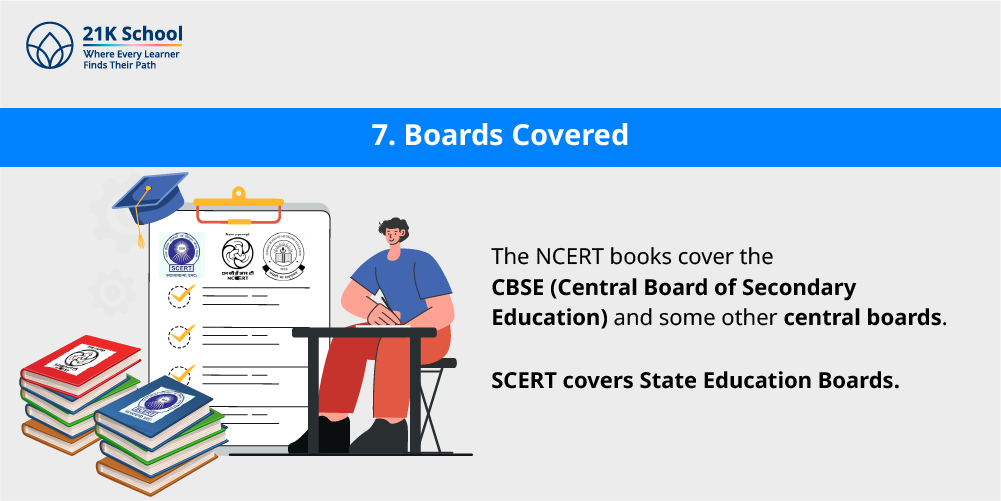
The NCERT books cover the CBSE (Central Board of Secondary Education) and some other central boards. However, the SCERT covers State Education Boards.
8. Exam Orientation
The NCERT books are highly effective for students who are preparing for national-level competitive exams like UPSC, SSC, NEET, JEE etc. While the SCERT books are ideal for state board examinations and state-level competitive exams.
9. Medium of Instruction
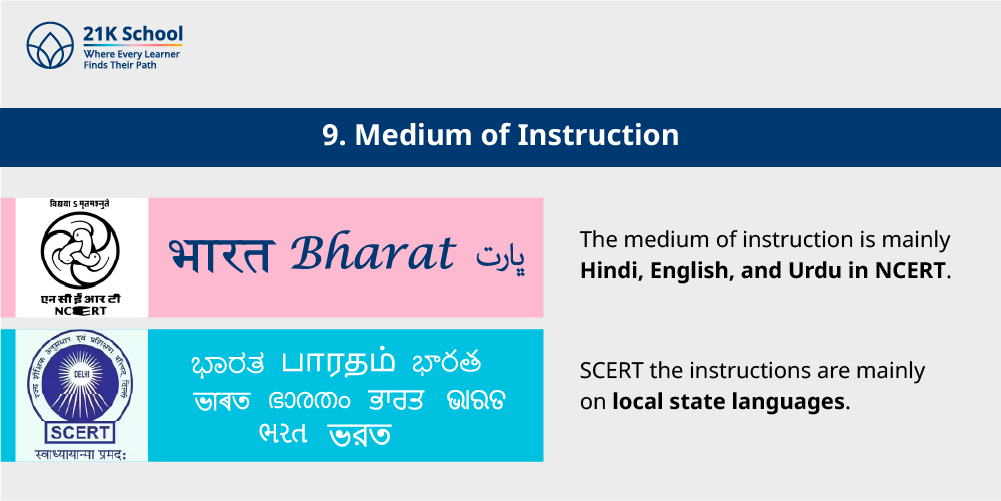
The medium of instruction is mainly Hindi, English, and Urdu in NCERT, while in SCERT the instructions are mainly on local state languages.
10. Geographical Coverage
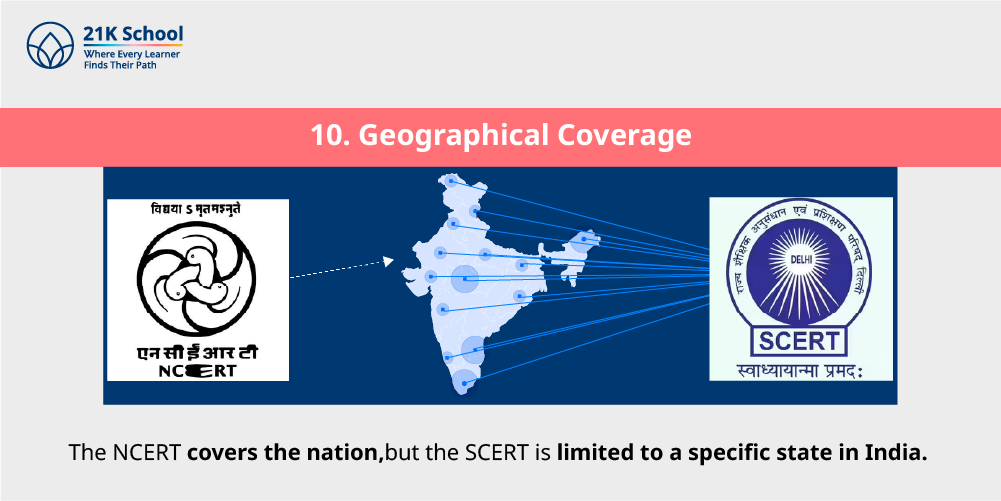
The NCERT covers the nation, but the SCERT is limited to a specific state in India.
Conclusion
To understand the difference between NCERT and SCERT, exploring the meaning and ten key points is essential for students’ educational growth.
The difference between showcase the need of NCERT and SCERT books to cater the diverse needs of students in India.
Hopefully, the information helped you to understand the difference to choose the best organisation to fulfill educational needs.

You may also want to read