

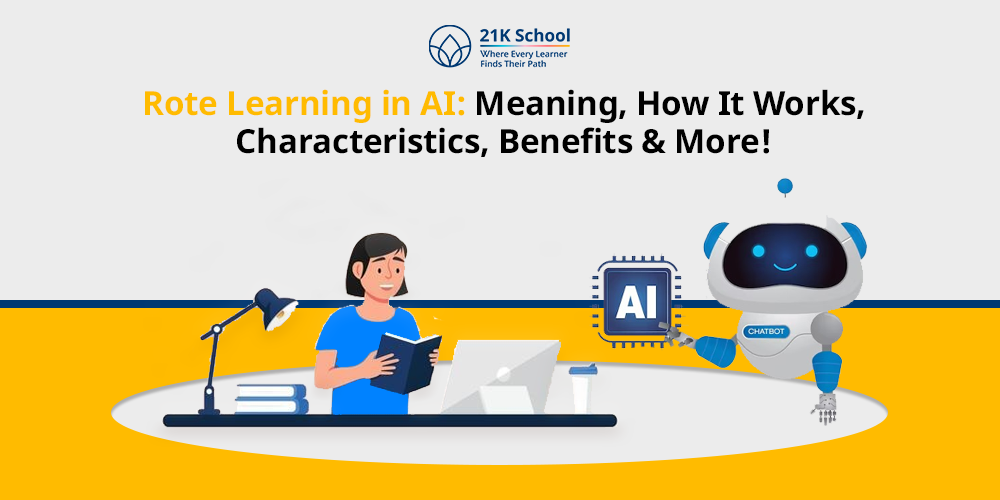
You might recall your memories of rote learning in the context of traditional education , where you memorize the topics and subjects from their syllabus .
So, what is rote learning in AI then? Rote learning in AI states that AI or machines memorize data without thinking or analysing.
In this article, we shall be discussing rote learning in AI in detail, while finding how this works, advantages and challenges in its use.
Table of Contents
- What is Rote Learning in AI?
- Rote learning in Artificial Intelligence: How it Works?
- Role of Rote Learning in AI
- How Rote Learning Emerges in Modern AI Systems
- Characteristics of Rote Learning in AI
- 3 Benefits of Rote Learning in AI
- Disadvantages of Rote Learning in AI
- How to Overcome Rote Learning Limitations in AI?
- Future of Rote Learning in AI
- Conclusion
What is Rote Learning in AI?
Rote learning in AI can be defined as the possibility of a model to learn training data without stressing on comprehending it or generalizing.
For example, when a student can end up memorizing multiplication tables without understanding mathematical principles.
Similarly, an AI system can take many pairs of inputs, and recreate them at a later point upon request.
This memorization-based learning occurs when the model approximates the data so well that it also ideally ignores real information.
It might result in outstanding performance on known cases, but negatively affects performance on unfamiliar or unseen cases.
Rote learning is the opposite of generalization.
It is the model capacity to use the learned concepts to new situations. The characteristic of true intelligence is the high level of generalization.
Rote learning is an obstacle on the path to this goal.
Rote learning in Artificial Intelligence: How it Works?
Again, AI systems train by optimizing internal parameters to reduce training set error.
A model that is large enough or a model that is of repetitive data might memorise the input instead of finding deeper patterns.
The mechanism of rote learning involves:
- Precise recall of patterns: Storage of definite patterns or instances.
- Overfitting: Occurrences when a model fits well on the training data.
- Storage of parameters: Parameter weights to encode particular data.
As an example, a language model can give a desired paragraph when it recognizes familiar content.
Vision models could learn hierarchical features through convolutional layers of images, rather than the general shape of specific images or semantic details.
This means that rote learning emerged unintentionally from the training dynamics, model size, and data format, with no planned objectives.
Role of Rote Learning in AI
Rote learning plays a vital role in the development of AI, even though it appears to be a drawback.
It acts as a baseline capacity that enables models to react rapidly, organize associations, and discard operations that necessitate accurate recollections.
In processes such as natural language processing, speech recognition, or medical diagnostics, rote learning can be used.
This would be to assist accuracy in predictive and convincing situations.
Rote learning helps:
- Institutionalize relationships
- Facilitate rapid pattern retrieval
- Offer predictable error responses in unpredictable areas
- Similar to upper-level reasoning using memorised knowledge
But as AI applications become uncertain and dynamic, rote learning is more of a problem.
How Rote Learning Emerges in Modern AI Systems
Rote learning emerges as the following in modern AI systems:
1. Large-Scale Pattern Matching
The recent AI models, especially the deep neural networks, are little more like context-matching engines.
They run on huge quantities of training information and acquire statistical relationships.
The model can just retrieve the memorized outputs when the correlations are close to the training examples.
Large language models, in particular, can suggest completely memorized phrases, code snippets, or documents in case these occur very often in the training data.
2. Overparameterization and Memorization Capacity
The current AI models include billions-or-trillions of parameters.
This huge storage provides amazing flexibility but also allows the models to store huge numbers of data.
Overparameterized models can fit random labels perfectly even though it was not intended to store random mappings since they already possess this property by design.
Huge capacity models are capable of encoding representations of images, long text sequences, rare patterns, and noise.
This memorization tends to be disguised as understanding.
3. Lack of True Semantic Understanding
In comparison with human learning, which involves a sense of context, and reasoning, AI systems can only be based on data-driven optimization.
Models can only separate meaningful patterns and semantically superficial correlations without semantic grounding.
This causes them to memorize information in a manner that is leaning towards memorization and not conceptual learning .
The model might seem to be smart enough, yet it might be simply repeating-or-remixing memorized bits.
Characteristics of Rote Learning in AI
The rote learning systems that are produced by AI systems may indicate:
- High training accuracy and poor test performance.
- Sensitive to small changes in input.
- Inability to understand underlying logic.
- Reproducing training examples.
- Excess dependence on superficial tendencies.
- Vulnerability to adversarial attacks.
- Reduced generalization capacity.
Such attributes are indicators of the fact that these models have learned to repeat patterns without any form of strong and general knowledge.
3 Benefits of Rote Learning in AI
While the content feels repetitive in rote learning in AI, there are some benefits that needs attention:
1. High Speed and Efficiency
Memorized knowledge can be instantly retrieved.
When it comes to tasks where there is a need to respond quickly, rote learning is more efficient.
For example with autocomplete code suggestions and ranking based on the search result rankings, it can quickly recall patterns that were previously observed.
2. Accuracy in Known Domains
With a predictable environment, exceptional accuracy is possible with rote learning.
It works best in cases where the field is stable and repeatable.
Such as medical diagnostic models, trained on well-curated datasets, may be equivalent or even outperform the competition at an expert level.
3. Foundation for Higher-Level Abilities
Memorization serves to have a ground for higher reasoning.
As human learners we first memorize multiplication tables, and later on skip to solving complex equations.
AI models also tend to build more generalization on what they memorize as the building blocks.
Disadvantages of Rote Learning in AI
Rote learning in AI has some serious drawbacks that can be discussed into the below mentioned points:
1. Poor Generalization
The greatest disadvantage of rote learning is that it does not accommodate new situations.
Memorizing models are unable to process new inputs or a shift in distribution, which is so-called data drift.
2. Vulnerability to Adversarial Examples
Rote learning AI models produce data based on certain patterns and not concepts.
Minor changes in input in most cases are not even noticeable by humans.
This can ruin these patterns leading the model to give wrong predictions.
3. Ethical and Privacy Risks
Imagine the model stores confidential information, copyrighted material, or private images that belong to a person or organization.
It might reproduce them unknowingly, posing a serious threat to their privacy.
This has been particularly apparent with large language models trained on large publicly-available datasets.
4. Illusion of Understanding
Memorizing may give the impression of being smart.
The model could work well in some familiar contexts but fail miserably in areas which it is not trained in.
Such mismatch of performance and comprehension may result in the false sense of trust in AI systems.
How to Overcome Rote Learning Limitations in AI?
To make best use of the AI systems, researchers need to incorporate some advanced learning methods .
Some of these techniques include:
- Regularization: Utilizing prevention techniques including weight decay, dropout or data corruption.
- Data diversification: It is imperative to make sure that training data has a broad distribution so as to promote generalized learning.
- Smaller or more efficient architectures: Overfitting can be reduced with limiting capacity. Therefore, supporting abstract pattern recognition..
- Curriculum learning: Showing data as generic to complex to encourage conceptual understanding.
- Contrastive learning: These teaching models teach the distinction of similar and different concepts.
- Meta-learning and few-shot learning: Helping models to learn.
- Symbolic integration of reasoning: Providing AI with structure to enhance abstraction.
These methods would get combined to bring AI systems to a more novel level, having least dependency on rote memory.
Future of Rote Learning in AI
AI is regularly evolving, and the future might bring the means of balance between memorization and generalization more effectively.
A number of the new trends promise:
1. Architectural Innovations
Models having sparse transformers, modular neural networks, and neurosymbolic hybrids are developed to promote abstraction, as opposed to pure memorization.
2. Regularization and Training Techniques
More advanced regularization schemes can be added to future systems which will dynamically change model capacity and impose generalizable representations.
3. Hybrid Symbolic-Neural Approaches
Integrating the use of symbolic reasoning (logic, rules, structures) and neural networks may assist the models to achieve more profound semantic interpretation and lessen the usage of memorized patterns.
4. Continual and Meta-Learning
Learning constantly enables AI to change with time without losing the previous knowledge .
Meta-learning allows models to learn based on a few examples, learning more as a human being.
5. Retrieval-Augmented Generation
The RAG systems are model generation systems coupled with external databases.
Models can access information on an on-demand basis without memorizing the facts internally and better factual accuracy.
Conclusion
Rote learning in AI is the function of systems of memorizing data from different sources and delivering it later based on these memories, rather than analysis.
Although it promotes speedy memorizing and precision, when in known settings it removes the flexibility, presents privacy threats, and creates an illusion of comprehension.
We can better adapt to rote learning in AI only when these AI systems have more human-like reasoning and understanding.
This can be done with the right training methods and exposure to human learning.

You may also want to read

CBSE Class 10 Subject List: Compulsory & Optional Subjects
- Last updated on: 22 Aug, 2026
- 12 min read