School Dropout Rates in India: A Complete Guide!
 Written byAnkita SinghaContent Specialist
Last modified: Jul 28, 2026 12 min read
Learning plays a key role in students’ lives. For social and economic development of students, schools offer a positive learning environment for years.
But, we often hear about school dropout scenarios especially at higher grades. Increasing school dropout rates in India is a concerning challenge everyone must talk about.
In this blog, we will look at what a school dropout means, presents the latest from reliable sources, major causes, and outlines government initiatives to prevent dropout rates.
What is school dropout?
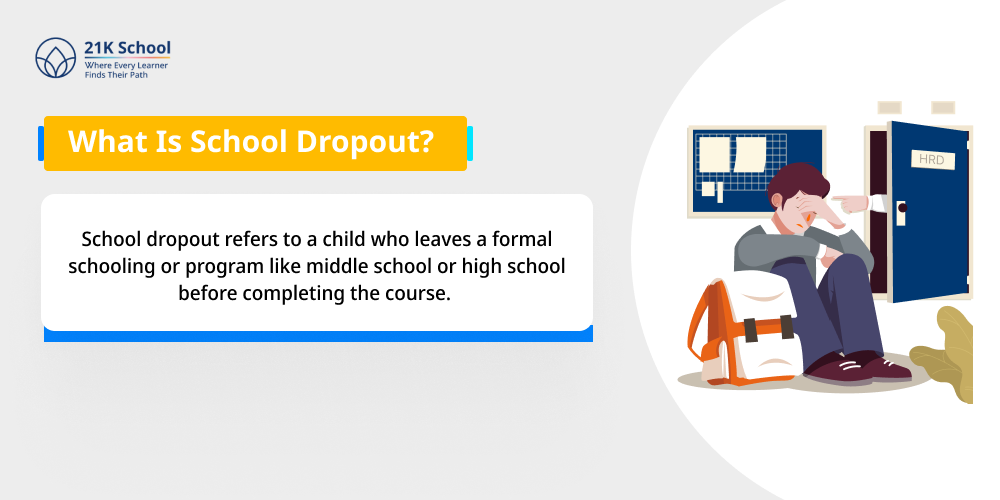
School dropout refers to a child who leaves a formal schooling or program like middle school or high school before completing the course.
In simple words, an individual started a course but dropped out after only a few months.
School dropout rates in India: Latest survey
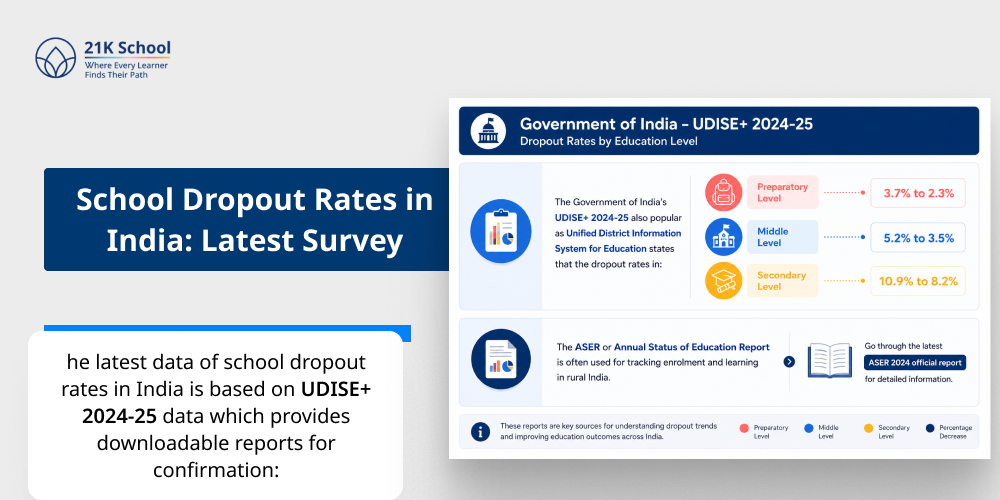
The latest data of school dropout rates in India is based on UDISE+ 2024-25 data which provides downloadable reports for confirmation:
- The Government of India's UDISE+ 2024-25 also popular as Unified District Information System for Education states that the dropout rates in: The preparatory level from 3.7% to 2.3% - The middle level is around 5.2% to 3.5%. - The secondary level from 10.9% to 8.2%.
- The ASER or Annual Status of Education Report is often used for tracking enrolment and learning in rural India. Go through the latest ASER 2024 official report for detailed information.
Major causes of school dropout in India
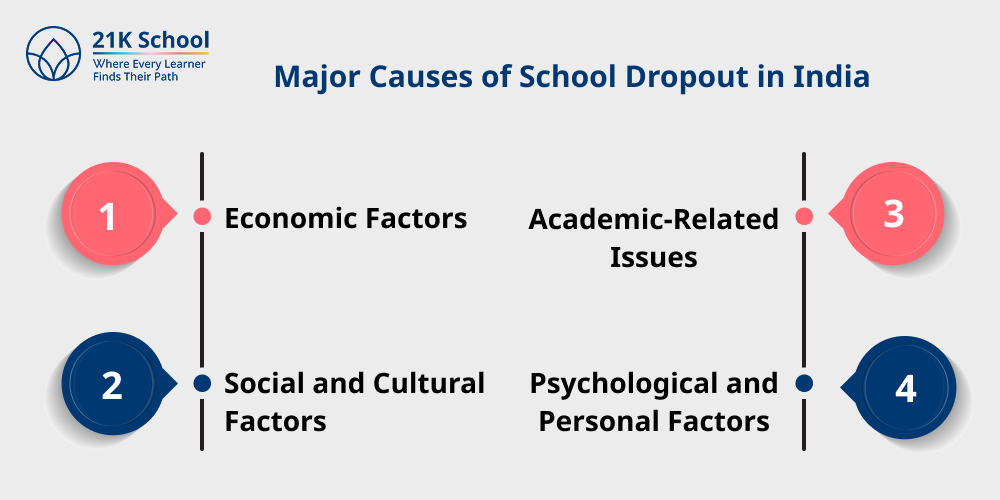
To understand the school dropout in India let’s go through some of the major causes:
1. Economic factors
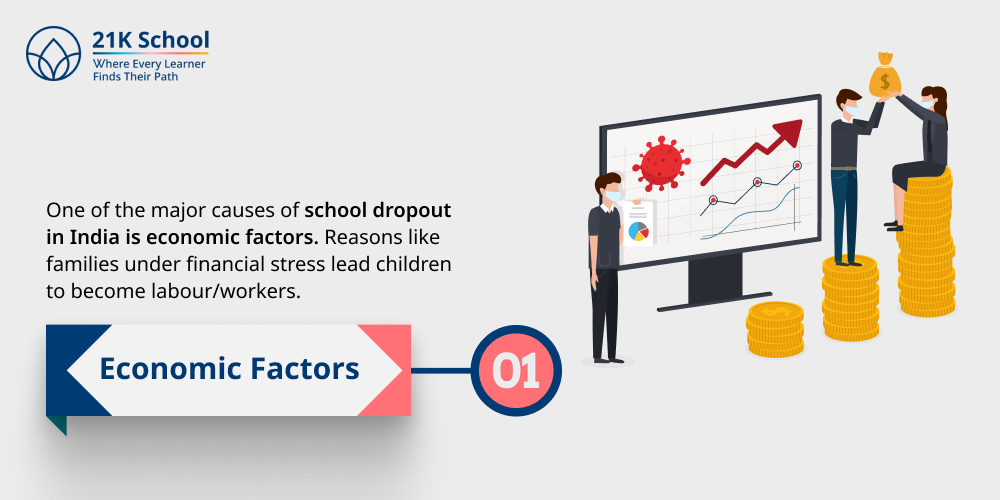
One of the major causes of school dropout in India is economic factors. Reasons like families under financial stress lead children to become labour/workers.
Economic factors for rural kids also include school distance and transport cost. This increases the dropout rate.
2. Social and cultural factors
Social and cultural factors also play an important reason for dropout in which gender norms and early marriage limit continuous learning .
It also happens due to discrimination based on caste and social exclusion.
3. Academic-related issues
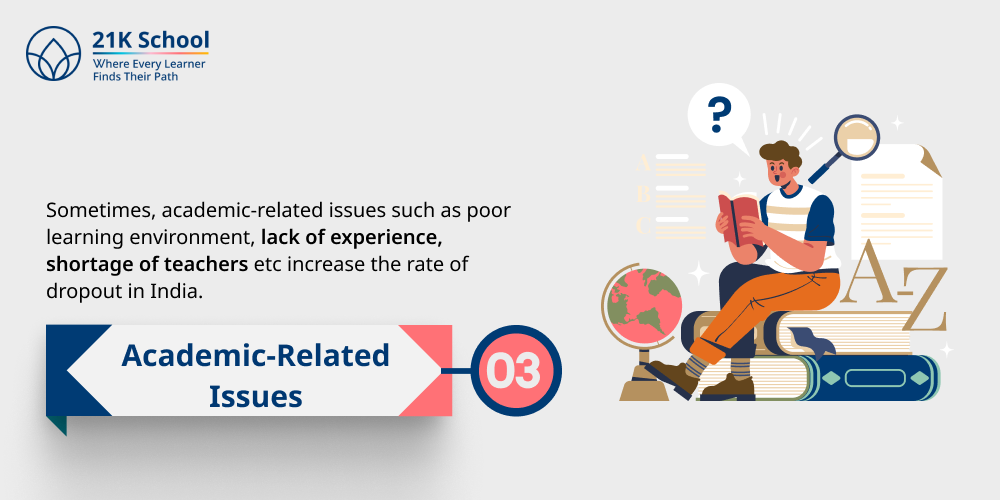
Sometimes, academic-related issues such as poor learning environment, lack of experience, shortage of teachers etc increase the rate of dropout in India.
4. Psychological and personal factors
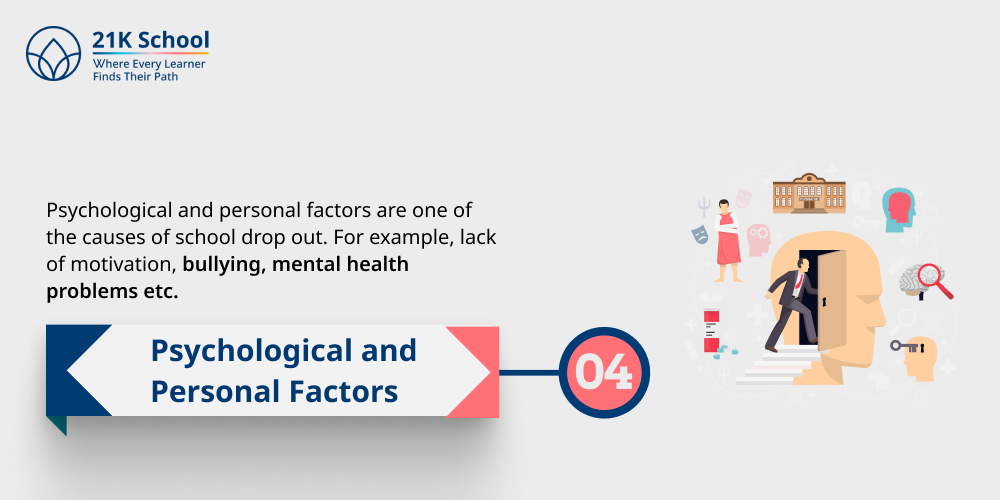
Psychological and personal factors are one of the causes of school drop out. For example, lack of motivation, bullying, mental health problems etc.
Government initiatives to reduce dropout rates
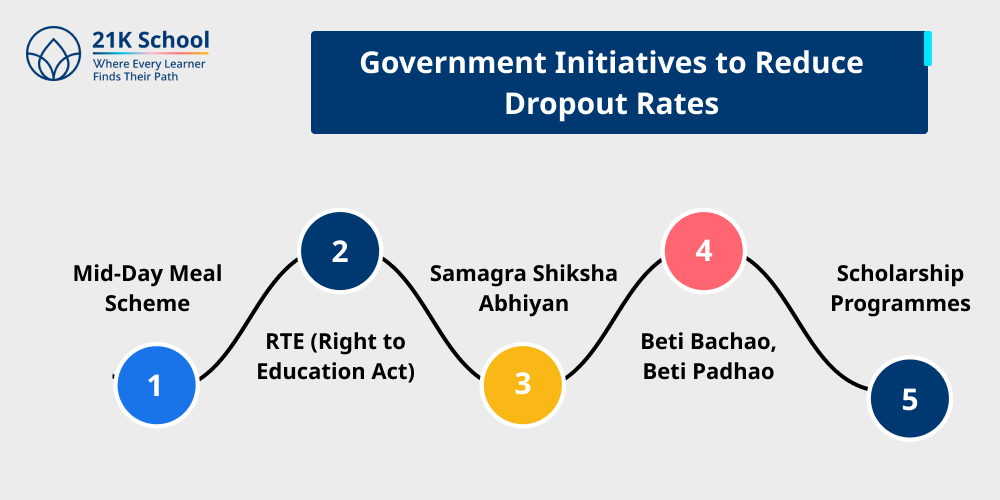
To reduce dropout rates in India, the government has sponsored programmes. Some common examples are;
1. Mid-Day Meal Scheme
Mid-day meal scheme also popular as PM POSHAN is an initiative in which schools provide cooked food to increase enrolment and attendance.
It is beneficial for parents who are unable to feed their children.
2. RTE (Right to education act)
RTE is designed by the government which aims to provide free and compulsory elementary education to children aged 6 to 14. Learn more about right to education act .
It is an effective way to motivate parents and students to improve drop rate in India.
3. Samagra Shiksha Abhiyan
In this initiative, students from elementary to senior secondary are motivated not to drop out from school.
The objective of this scheme is to:
- Improve the quality of education
- Promote equity and inclusion
- Enhance learning outcomes
4. Beti Bachao, Beti Padhao
It is a popular campaign by the government of India aimed for girls' education and survival.
The scheme is an effective approach to understand the importance of educating girls.
5. Scholarship programmes
There are many central and state-level scholarship programmes in different domains which help to reduce dropout rates.
Dropout rates by grade level
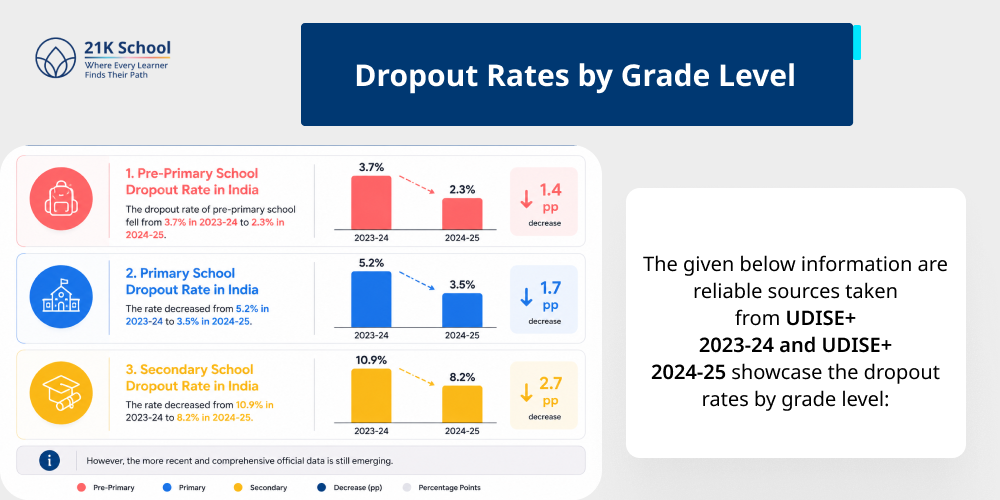
The given below information are reliable sources taken from UDISE+ 2023-24 and UDISE+ 2024-25 showcase the dropout rates by grade level:
1. Pre-primary school dropout rate in India
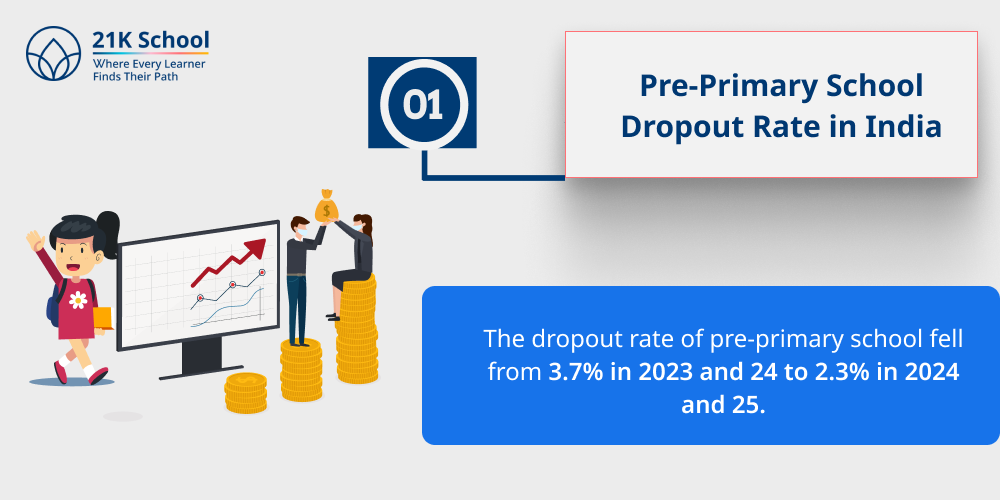
The dropout rate of pre-primary school fell from 3.7% in 2023 and 24 to 2.3% in 2024 and 25.
2. Primary school dropout rate in India
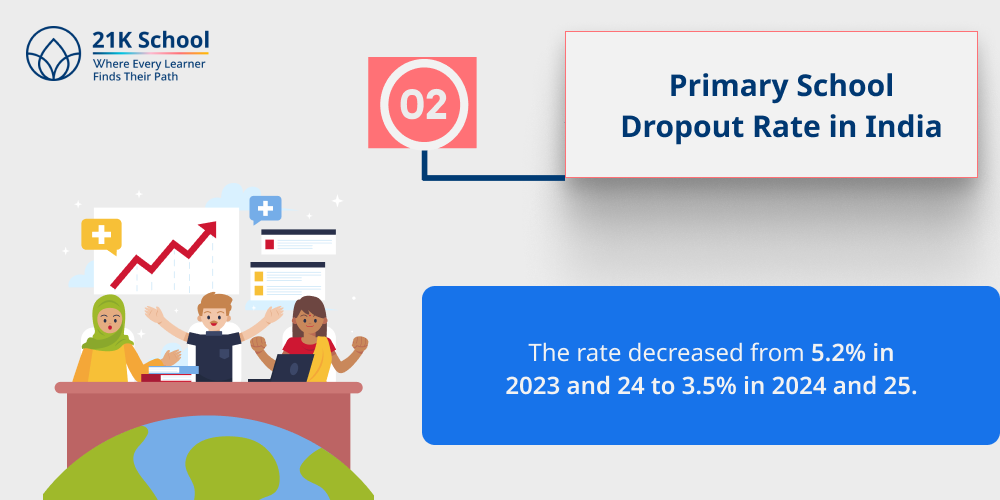
The rate decreased from 5.2% in 2023 and 24 to 3.5% in 2024 and 25.
3. Secondary school dropout rate in India
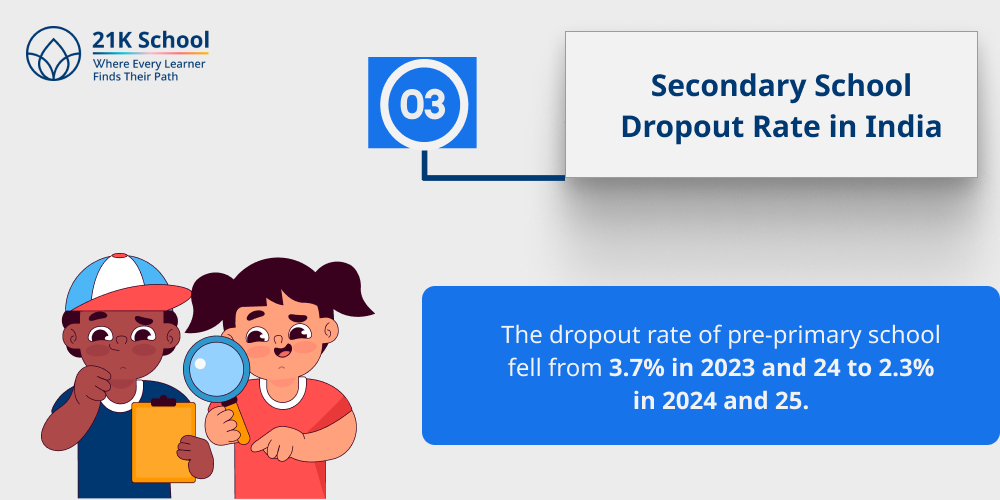
The rate decreased from 10.9% in 2023 and 24 to 8.2% in 2024 and 25.
However, the more recent and comprehensive official data is still emerging.
State-wise school dropout rate in India
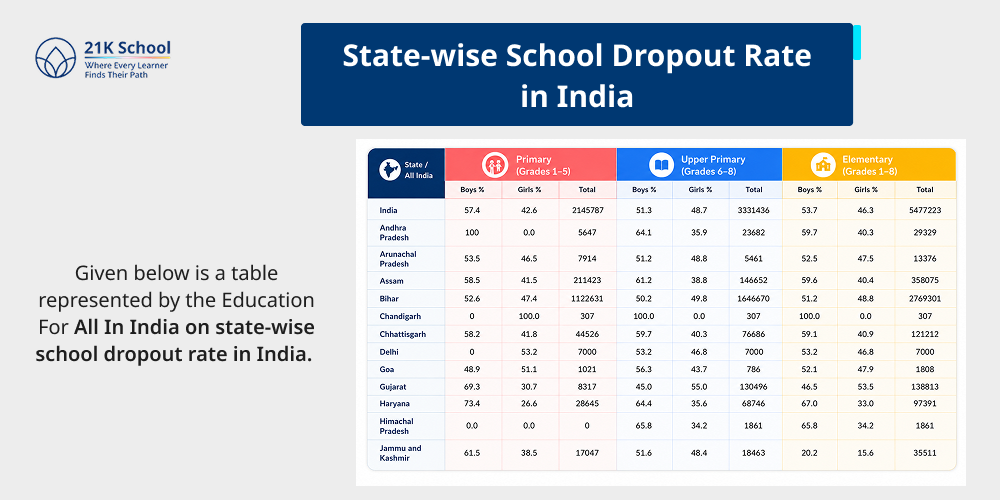
Given below is a table represented by the Education For All In India on state-wise school dropout rate in India.
| State / All India | Primary (Grades 1-5) | Upper Primary (Grades 6-8) | Elementary (Grades 1-8) | ||||||
| Boys % | Girls % | Total | Boys % | Girls % | Total | Boys % | Girls % | Total | |
| India | 57.4 | 42.6 | 2145787 | 51.3 | 48.7 | 3331436 | 53.7 | 46.3 | 5477223 |
| A & islands | 68.0 | 32.0 | 192 | 100 | 0.0 | 71 | 76.7 | 23.3 | 263 |
| Andhra Pradesh | 100 | 0.0 | 5647 | 64.1 | 35.9 | 23682 | 0.4 | 0.2 | 29329 |
| Arunachal Pradesh | 53.5 | 46.5 | 7914 | 51.2 | 48.8 | 5461 | 52.5 | 47.5 | 13376 |
| Assam | 58.5 | 41.5 | 211423 | 61.2 | 38.8 | 146652 | 59.6 | 40.4 | 358075 |
| Bihar | 52.6 | 47.4 | 1122631 | 50.2 | 49.8 | 1646670 | 51.2 | 48.8 | 2769301 |
| Chandigarh | 0 | 100.0 | 0.0 | 307 | 100.0 | 0.0 | 307 | ||
| Chhattisgarh | 58.2 | 41.8 | 44526 | 59.7 | 40.3 | 76686 | 59.1 | 40.9 | 121212 |
| D and N haveli & D and D | 57.1 | 42.9 | 1015 | 54.8 | 45.2 | 1131 | 1.0 | 0.8 | 2146 |
| Delhi | 0 | 53.2 | 46.8 | 7000 | 53.2 | 46.8 | 7000 | ||
| Goa | 48.9 | 51.1 | 1021 | 56.3 | 43.7 | 786 | 52.1 | 47.9 | 1808 |
| Gujarat | 69.3 | 30.7 | 8317 | 45.0 | 55.0 | 130496 | 46.5 | 53.5 | 138813 |
| Haryana | 73.4 | 26.6 | 28645 | 64.4 | 35.6 | 68746 | 67.0 | 33.0 | 97391 |
| Himachal Pradesh | 0.0 | 0.0 | 0 | 65.8 | 34.2 | 1861 | 65.8 | 34.2 | 1861 |
| Jammu and Kashmir | 61.5 | 38.5 | 17047 | 51.6 | 48.4 | 18463 | 20.2 | 15.6 | 35511 |
| Jharkhand | 66.4 | 33.6 | 29505 | 52.9 | 47.1 | 173608 | 54.9 | 45.1 | 203113 |
| Karnataka | 57.7 | 42.3 | 92924 | 56.5 | 43.5 | 85214 | 57.1 | 42.9 | 178138 |
| Kerala | 0.0 | 0.0 | 0.0 | 0.0 | 0.0 | 0.0 | 0.0 | 0.0 | 0.0 |
| State / All India | Primary (Grades 1-5) | Upper Primary (Grades 6-8) | Elementary (Grades 1-8) | ||||||
| Boys % | Girls % | Total | Boys % | Girls % | Total | Boys % | Girls % | Total | |
| Ladakh | 58.8 | 41.2 | 962 | 62.1 | 37.9 | 695 | 60.2 | 39.8 | 1657 |
| Lakshadweep | 70.2 | 29.8 | 118 | 100.0 | 0.0 | 92 | 83.2 | 16.8 | 210 |
| Madhya Pradesh | 65.2 | 34.8 | 65100 | 54.0 | 46.0 | 272164 | 56.1 | 43.9 | 337265 |
| Maharashtra | 0.0 | 0.0 | 0.0 | 0.0 | 0.0 | 33636 | 61.5 | 38.5 | 33636 |
| Manipur | 51.9 | 48.1 | 13081 | 57.1 | 42.9 | 4911 | 53.3 | 46.7 | 17991 |
| Meghalaya | 55.7 | 44.3 | 36969 | 52.3 | 47.7 | 28563 | 68.9 | 58.1 | 65532 |
| Mizoram | 54.3 | 45.7 | 4391 | 58.3 | 41.7 | 3856 | 56.1 | 43.9 | 8247 |
| Nagaland | 54.7 | 45.3 | 7363 | 55.0 | 45.0 | 5285 | 54.8 | 45.2 | 12648 |
| Odisha | 0.0 | 0.0 | 0.0 | 0.0 | 0.0 | 40911 | 113.4 | 82.4 | 40911 |
| Puducherry | 64.1 | 35.9 | 1068 | 57.1 | 42.9 | 803 | 61.1 | 38.9 | 1871 |
| Punjab | 100.0 | 0.0 | 1199 | 61.4 | 38.6 | 35115 | 62.7 | 37.3 | 36314 |
| Rajasthan | 56.4 | 43.6 | 610302 | 55.7 | 44.3 | 288938 | 56.2 | 53.8 | 899240 |
| Sikkim | 68.2 | 31.8 | 1103 | 60.6 | 39.4 | 1371 | 64.0 | 36.0 | 2474 |
| Tamil Nadu | 0.0 | 0.0 | 0.0 | 0.0 | 0.0 | 0.0 | 0.0 | 0.0 | 0.0 |
| Telangana | 0.0 | 0.0 | 0.0 | 0.0 | 0.0 | 917 | 37.1 | 0.0 | 917 |
| Tripura | 73.4 | 26.6 | 1682 | 55.6 | 44.4 | 7001 | 59.1 | 40.9 | 8683 |
| Uttar Pradesh | 52.6 | 47.4 | 343062 | 40.9 | 59.1 | 398563 | 46.3 | 53.7 | 741626 |
| Uttarakhand | 100.0 | 0.0 | 1577 | 60.5 | 39.5 | 12995 | 1.3 | 0.7 | 14573 |
| West Bengal | 0.0 | 0.0 | 0 | 0.0 | 0.0 | 0.0 | 0.0 | 0.0 | 0.0 |
Important note: The data in the table is calculated based on information provided in the UDISEPlus report in various years.
Dropout rate and out of school girls in India
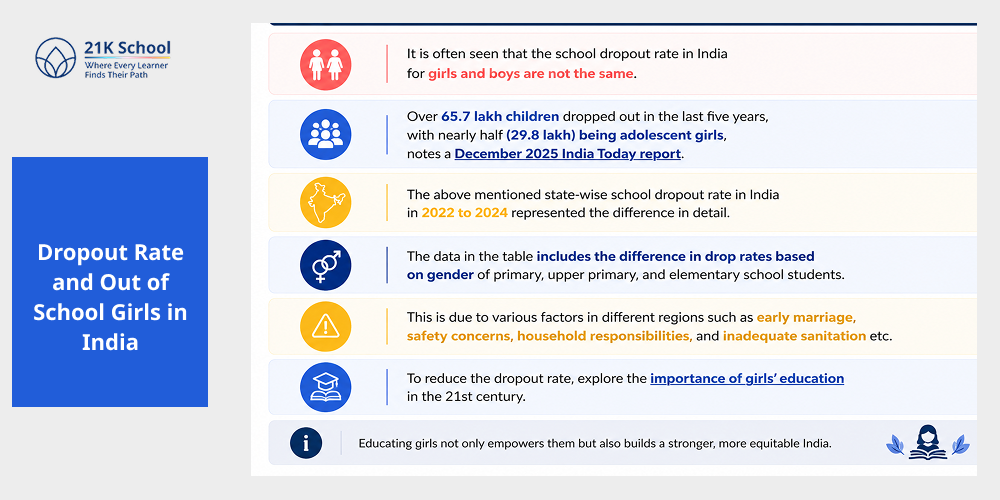
It is often seen that the school dropout rate in India for girls and boys are not the same.
Over 65.7 lakh children dropped out in the last five years, with nearly half (29.8 lakh) being adolescent girls, notes a December 2025 India Today report.
The above mentioned state-wise school dropout rate in India in 2022 to 2024 represented the difference in detail.
The data in the table includes the difference in drop rates based on gender of primary, upper primary, and elementary school students.
This is due to various factors in different regions such as early marriage, safety concerns, household responsibilities, and inadequate sanitation etc.
To reduce the dropout rate, explore the importance of girls education in the 21st century.
Conclusion
To empower knowledge and skills , education is essential for each individual. However, dropping out from school in India is not a good decision.
With time, the Indian education system is taking essential measures to reduce the dropping rate.
Some government schemes like RTE, mid-day meal scheme, and scholarship programmes are effective solutions. Other common ways to reduce drop out rates in India for both boys and girls are universal access to education, inclusive curriculum , flexible learning pathways and vocational education .
Frequently asked questions
9 questions
What are the reasons for the high dropout rate in schools in India?
There are many reasons for the high dropout rate in schools in India such as: Economic and financial reasons Social and cultural reasons Issues with the education system
Suggest some effective strategies to reduce dropout rates in India?
Some effective strategies to reduce dropout rates in India are: Community involvement Mentoring and guidance Promote equality Connect with parents outside of school Quality teacher training
How technology is helping reduce dropout rates?
Technology is helping reduce dropout rates of students by: Enabling personalised learning Improving student engagement Providing early intervention tools
How NEP 2020 Helps Prevent Dropouts?
NEP 2020 helps prevent dropouts by: Providing universal access and improved infrastructure Flexible learning pathways Relevance and engagement Monitoring and support
What is the impact of high school dropout rates?
The major impact of high school dropout rates are: Limited job opportunities Lower lifetime earnings Poorer health outcomes Higher rates of poverty
What are the problems that cause students to drop out of school?
Some of the major problems that cause students to drop out of school are: Financial hardship Poor academic performance and disengagement Lack of infrastructure Health problems Lack of parental support
How to reduce high school dropout rate?
Some ideal ways to reduce high school dropout rate are: Coaching and mentoring Professional development Cultivate relationships Enhancing educational quality Provide community resources
How to prevent school dropouts in India?
To prevent school dropouts in India, it's important to promote: Community and parental involvement Enhancing educational quality Enhancing infrastructure and facilities Addressing teacher shortage Financial support mechanisms
Are school dropout rates improving in rural India?
In rural India, school dropout rates are improving. According to a MoSPI report, the secondary-level dropout rate dropped to 8.2% in 2024 to 25 from 13.8% in 2022 to 23 (also published by Economic Times).
About the author
Ankita Singha
Content Specialist
Ankita Singha is an Education Content Specialist at 21K School, India’s first accredited fully online K-12 School. She focuses on the in-depth research and creation of the well-drafted guides on early childhood education, school admission processes, and CBSE/ICSE curriculum guidance. With more than 2 years of experience at 21K School, a fully accredited institute- Cambridge International (IA702) and Pearson Edexcel (94883), Ankita works closely with the school’s curriculum heads and academic coordinators. Ankita’s every article reflects on the official board guidelines, practical realities, and current policies of online education in 78+ countries. Ankita’s content has helped thousands of parents in understanding the topics like RTE eligibility, NIOS pathways, and age-appropriate admission criteria.
Every 21K School guide is written by our education team and reviewed by a subject facilitator before publishing.
Exploring a CBSE-pathway online school?
Talk to an advisor about 2026–27 admissions — no obligation.
Talk to an advisorComments
No comments yet — be the first to share your thoughts or ask a question.